
Back in the darkroom : a pilgrimage
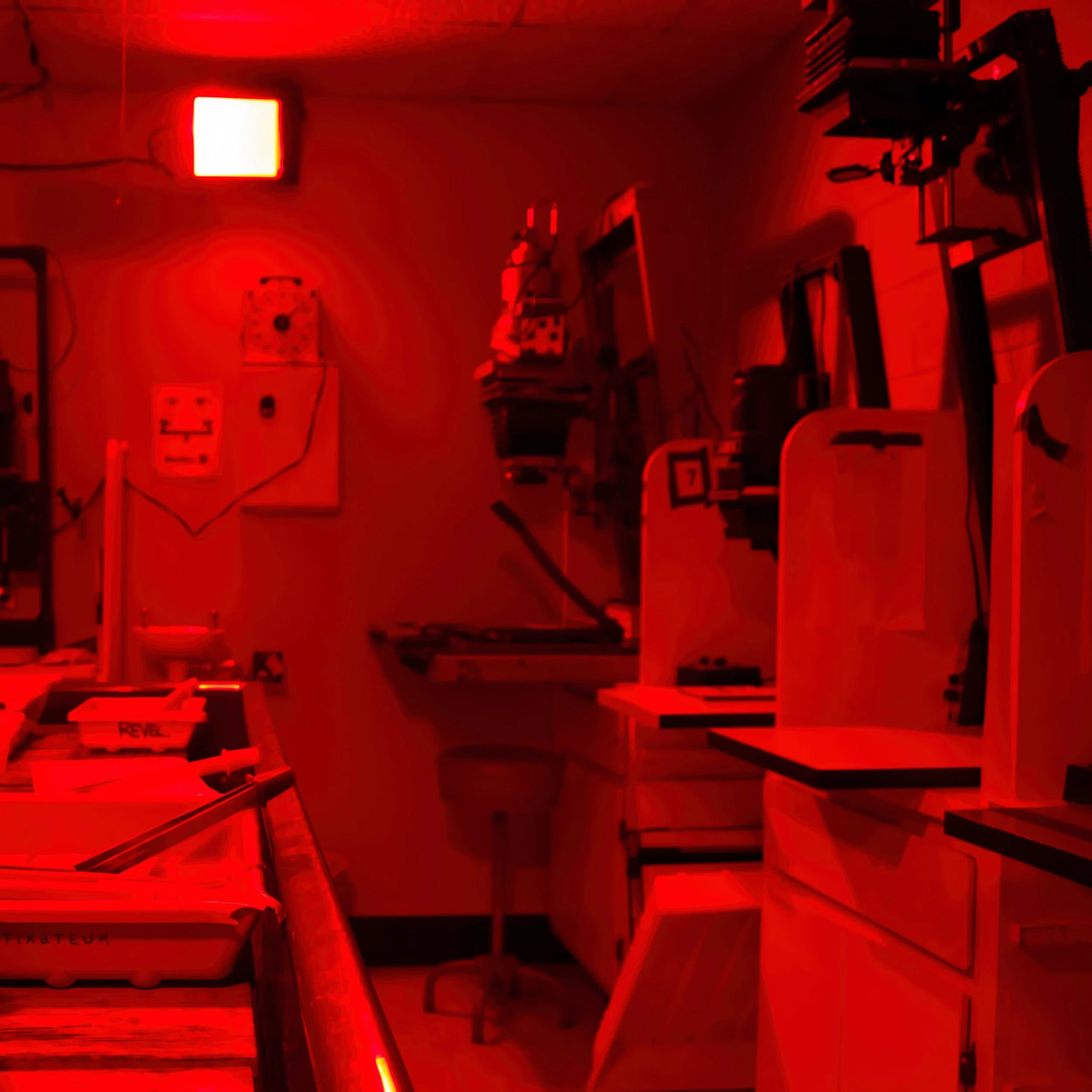
The darkroom at Club 3e Œil.
Forty years after the lab, I'm finding my way back
Some decisions aren't really made. They appear, you recognize them, and you say yes.
Club 3e Œil, in the Plateau-Mont-Royal neighbourhood of Montreal, occasionally offers a course on the fundamentals of film photography. Spots are limited and sessions don't run on a regular schedule. I saw the announcement. I said yes.
It wasn't planned and it certainly wasn't coordinated with the launch of lucelenta.art. The timing is a coincidence, a real one, and I have no interest in dressing it up as something more deliberate. The two things happened at the same time. That's all.
The camera for the pilgrimage
It arrived in a box shipped from Japan. Bought on eBay from a Japanese seller, a Canon P with its Canon 50mm f/1.4 lens in perfect visual and mechanical condition, as though time had decided to leave it alone.
This lens circulates in photography communities under the nickname "Japanese Summilux." The name is flattering, but it carries a small irony that few people notice: the Canon 50mm f/1.4 was introduced in 1957, two years before Leica presented the first Summilux in 1959. The original ended up being named after what came after it. I find that amusing.
What is less amusing is that I still don't know whether this camera takes good photographs. I've shot two rolls since I received it and neither has been developed yet. The first will be developed during my course at Club 3e Œil, which gives that first darkroom session a slightly suspended quality I hadn't anticipated.
There is also this: the Canon P is a rangefinder and 50mm is not my usual focal length. Focusing through rangefinder coupling rather than through-the-lens is a different way of seeing and of hesitating. I'm not certain I've fully mastered it. That feeling of uncertainty is, itself, part of the pilgrimage.
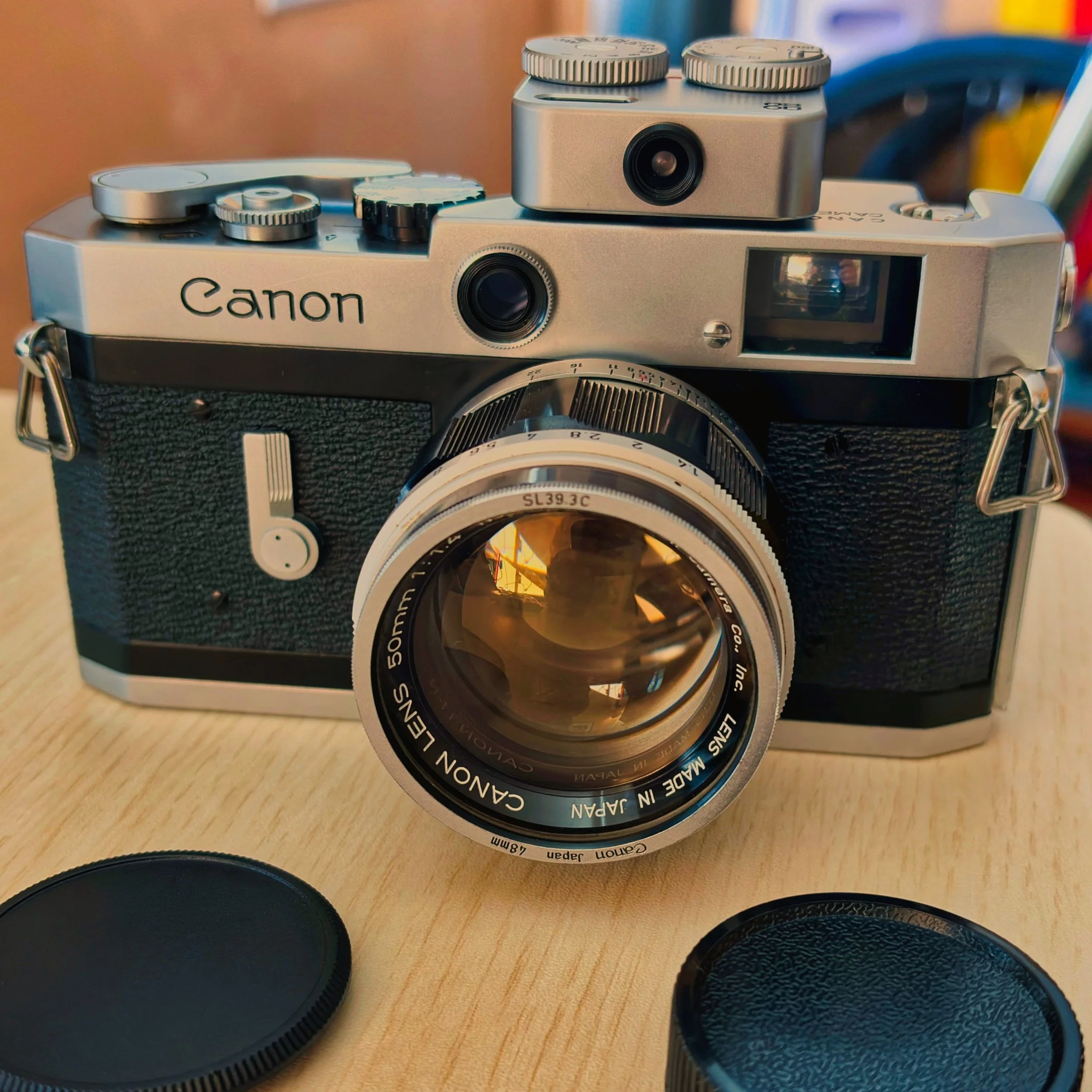
The Canon P : a fully mechanical rangefinder and its fast lens.
What drew me in
It wasn't nostalgia.
I spent my twenties with a developing tank in my hands and a timer on the counter. That was forty years ago. I have no desire to relive it, let alone pretend everything was better back then, because it wasn't.
What drew me in was the slowness of the process. A thirty-six exposure roll developed by hand. A print on photographic paper watched as it emerges in the developer tray. Precise gestures, details that matter, and a result you don't see until you've done the work.
The exact opposite of the relentless stream of content that defines social media today. Dozens of images produced and published every day, consumed in a fraction of a second, instantly forgotten. I don't say this with contempt. I simply find myself more at ease on the other side of that divide, where things are done slowly and where details carry weight.
It's the same disposition that led me to slow photography and SOOC. Not a rejection of progress, but a preference for what requires attention.
A pilgrimage, not a return
I want to be honest about what this is, and what it isn't.
I'm not going back to film. I have no plans to spend every Saturday morning making prints in a darkroom. This isn't a conversion and it isn't a rejection of digital either. My X100VI will remain my main camera and my JPEG recipes will remain my way of working.
What I'm doing is a pilgrimage. You go on a pilgrimage to reconnect with something essential, not to stay, but to come back changed. You make the journey, you find what you left behind, and you return carrying something you didn't know you were looking for.
What I hope to find in that Plateau darkroom is a certain awareness of the gesture. The photographic gesture before automation, the one that comes before the shutter, that reads the light before capturing it, and that knows there is no fixing things afterward. It's a discipline that digital makes optional. Film makes it mandatory.
What's ahead and what's already begun
Club 3e Œil has around a hundred and fifty members. It has a darkroom, a white room, and the equipment needed for printing. The course I'm taking runs over eight three-hour sessions: an introduction to the facilities, two sessions on developing film, four on printing on photographic paper, and a final one on advanced techniques. There are six of us following it.
The course has already begun. I don't yet know what these twenty-four hours in a darkroom will teach me — probably technical things I'd forgotten, and perhaps something about the way I see that I couldn't have learned any other way.
That will be the subject of a future post.
- Louis-Martin Ouellet