
Seeing without agenda: photography as a practice of meditation
What Chögyam Trungpa understood about the act of seeing
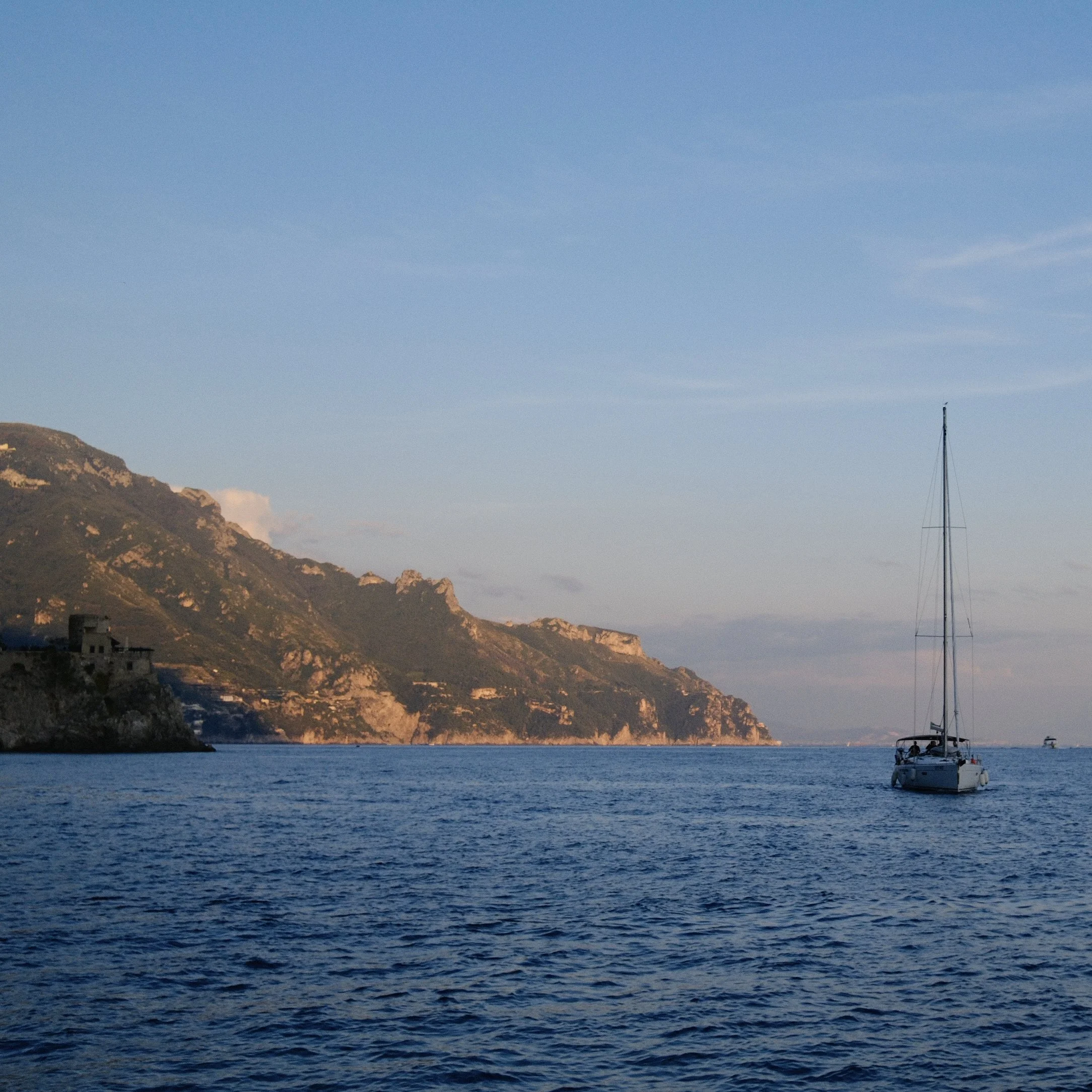
A sailboat off the coast of Positano (Recipe: CW - Q3 Analog)
The honest problem
There's a reason most people who are drawn to meditation never quite settle into a regular practice. It isn't a lack of interest. It isn't a failure of will. It is the ordinary, unavoidable friction of a life that keeps moving: work, family, obligations, fatigue, and the particular kind of distraction that comes from a world designed to prevent stillness.
Formal meditation is a real practice. It asks for regularity, for a suitable environment, and for a willingness to return to the same simple instruction again and again, often without dramatic results. These are not unreasonable demands. But for many people, they are demands that real life doesn't easily accommodate.
This is not a problem to be solved by trying harder. It is worth taking seriously on its own terms.
What Trungpa understood
In the early 1970s, when Chögyam Trungpa Rinpoche began teaching Tibetan Buddhism to Western students, he understood something that many teachers before him had not quite addressed: the daily life of a Westerner is structured very differently from that of a monk. The cushion, the monastery, and the community of practitioners are not available to most people in the same way. Something else was needed.
His response was not to lower the bar. It was to recognize that contemplative practice can be woven into activities already present in a person's life. From this understanding emerged what became known as the Dharma Art teachings, a body of work exploring how an ordinary activity, approached with the right quality of attention, can become a genuine contemplative practice.
The forms he developed or drew from are varied: Kyudo, the Japanese art of archery practiced as a form of standing meditation rather than sport; Kalapa Ikebana, a school of flower arranging he founded in 1982, working explicitly with space, form, and the relationship between heaven, earth, and human; Mudra Space Awareness, a set of movement exercises designed to develop genuine presence in the body and in space; and Miksang, a contemplative approach to photography rooted directly in his teachings on the nature of perception.
The common thread is not the activity itself. It is the quality of attention brought to it.
The central principle
What Trungpa taught about meditation applies here directly. The practice is not about achieving a particular state. It is not about suppressing what arises. It is about learning to meet experience as it is, in the present moment, without immediately reaching for interpretation, correction, or improvement.
He put it simply: having nothing to suppress is freshness.
This is not a passive instruction. It takes genuine discipline to stop reaching for the editorial reflex: the impulse to adjust, to second-guess, and to improve on what is actually there. That reflex is so habitual that most of us don't notice it. We relate not to what we see, but to what we think about what we see.
The contemplative practice, in any form, is an invitation to close that gap.
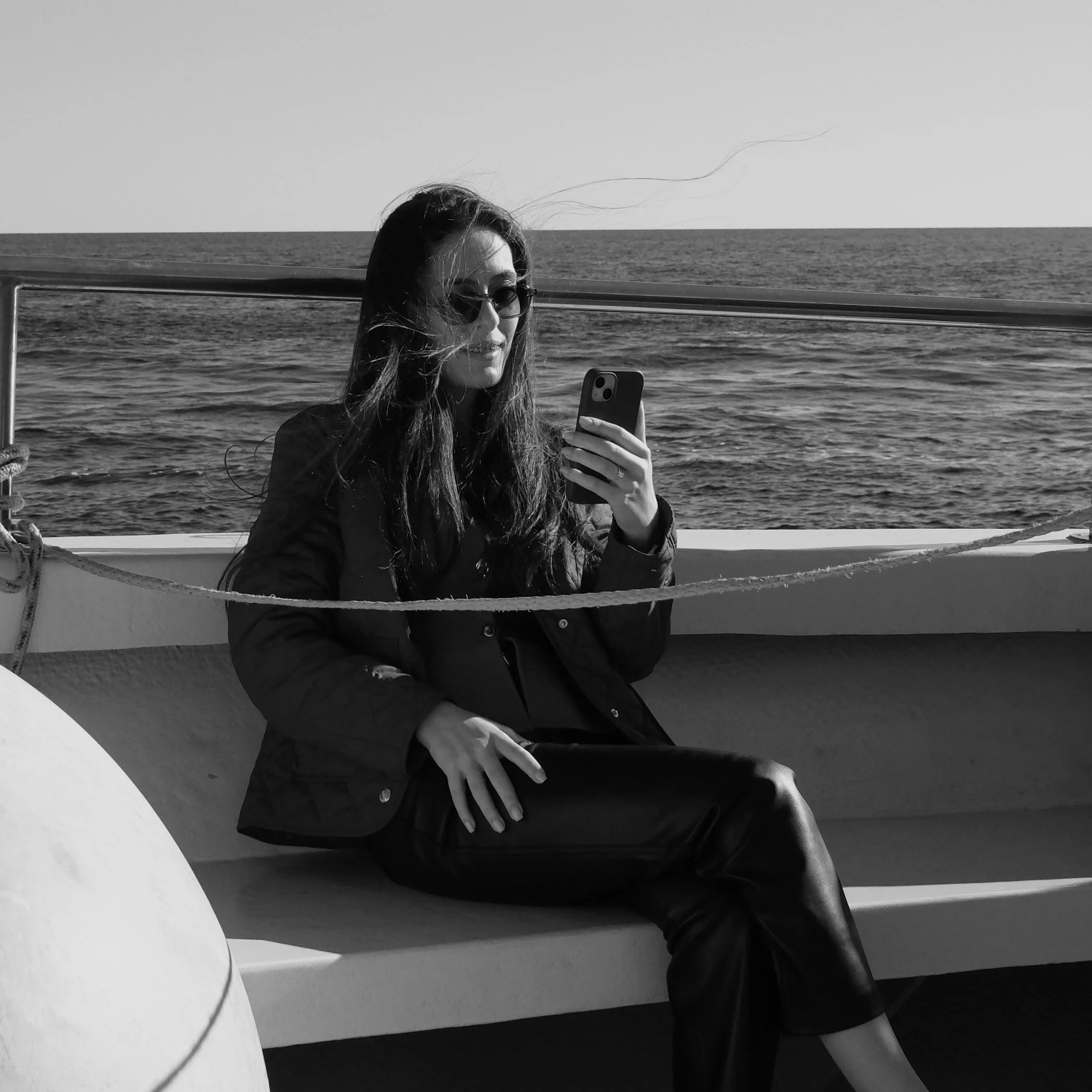
A woman and her iPhone (Recipe: CW - Mono Simple)
Miksang and the photographic door
Miksang is a Tibetan word that translates as "good eye." It is a contemplative photography practice developed directly from the Dharma Art teachings of Chögyam Trungpa, specifically his work on the nature of perception.
The "good" in Miksang does not refer to technical skill. It refers to the world as it actually is: inherently rich, vivid, and available. The "eye" refers to the capacity to meet that world directly, without the filter of concepts, preferences, and agendas.
The practice is built around what Miksang teachers call the flash of perception: that fraction of a second when something in the visual field stops you before your mental commentary has time to organize it into meaning. A patch of colour against a wall. The fall of light across a surface. A shape you cannot immediately name. Something simply arrests the eye, and for a moment, you are fully there.
The Miksang instruction is to work from that moment, to make the photograph that corresponds to what was actually seen, and not to what you decided to see afterward. The camera becomes an instrument of presence rather than production.
A legitimate objection
One might reasonably object that choosing a film simulation recipe before going out to photograph is deciding in advance how the world will be rendered, and therefore intervening on the moment before it has even occurred.
The objection deserves a direct answer.
A recipe is not an intervention on the moment. It is a choice of instrument. The film photographer who loads an Ektachrome or a Tri-X before heading out is not pre-editing reality: they are choosing the medium through which they will receive it. A recipe works in exactly the same way. It defines the sensitivity of the instrument before the exposure, not after.
What distinguishes the SOOC approach from editing is precisely the absence of intervention on what has already occurred. The recipe is a commitment made before the moment. The shutter release is the moment itself. And the acceptance of what the light and the recipe produced together, without correction afterward, is the contemplative act. You do not rework what you saw. You receive it.
One can go further still: choosing which recipe suits a particular light before pressing the shutter is itself an act of reading the present moment. It is the attention that precedes the gesture, and that is precisely where the contemplative practice begins.
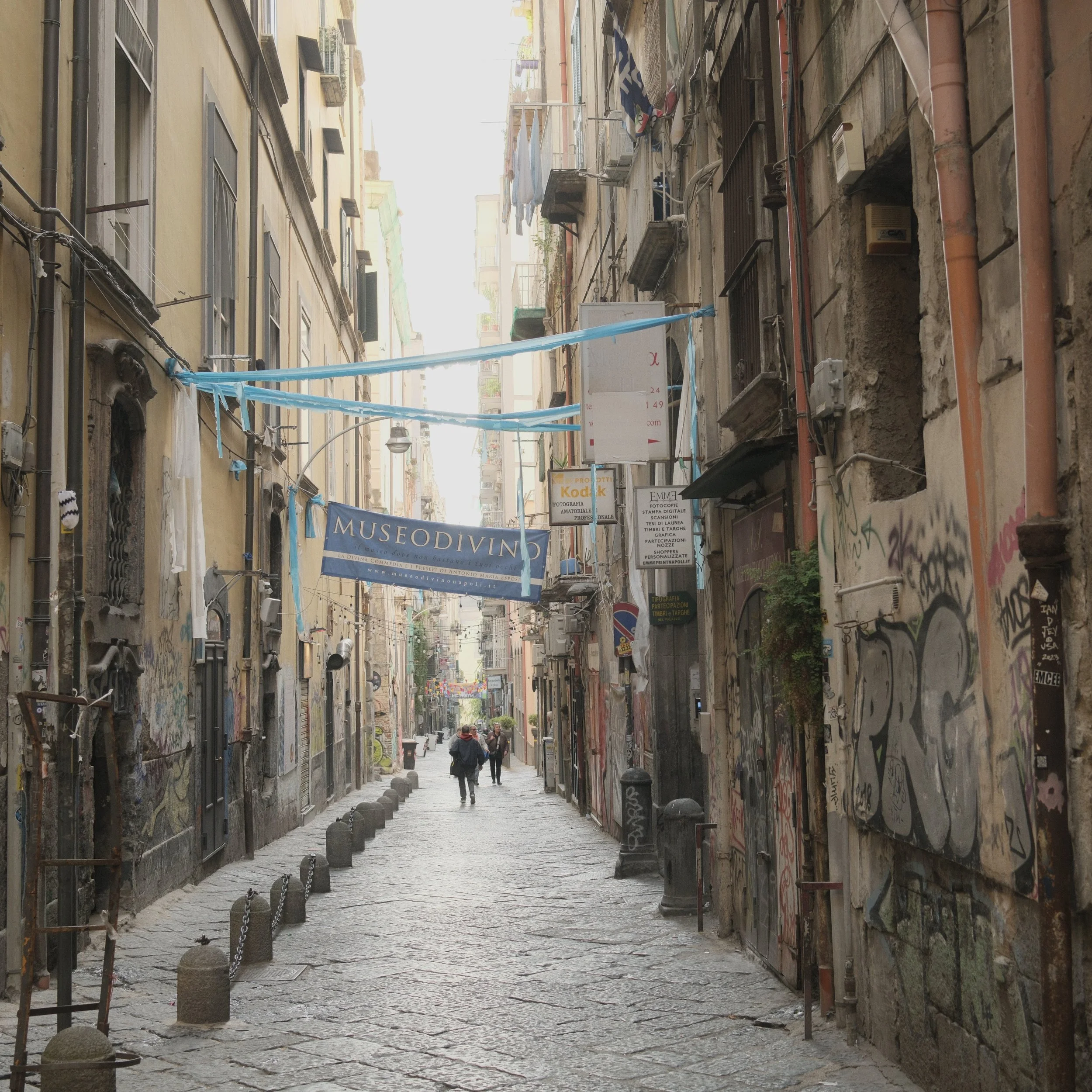
The historic district of Naples (Recipe: CW - Victor Séguin)
What this changes for the photographer
If you are reading this, you likely already know something about what it means to look carefully at the world. The act of picking up a camera implies a certain quality of attention. You have already chosen, however casually, to be present to what is in front of you.
The question is where that attention lives. Does it arrive before the shutter: in the reading of the light, the recognition of the moment, and the decision that something here is worth meeting? Or does it arrive after: in the selection, the adjustment, and the interpretation of what the image should have been?
These are not the same practice.
Slow photography already leans toward the first. Shooting SOOC, accepting the image as the camera and the light produced it without revision, is a commitment to the moment of seeing rather than to the moment of editing. It is not a technical constraint. It is a posture. The photograph is what happened. You were there. That is enough.
None of this requires a conversion to Buddhism or a familiarity with Tibetan terms. It requires only a willingness to bring to photography the same quality of attention that Trungpa recognized in archery, flower arranging, and movement: the quality of meeting what is actually there, without agenda, without suppression, and without the need to improve on what presented itself.
That quality, practiced regularly and genuinely, is a form of meditation. And meditation, in whatever form it takes, tends to migrate. The eye trained on a patch of afternoon light eventually brings that same quality of attention to a conversation, a meal, and the ordinary texture of a day.
That is not a small thing.
- Louis-Martin Ouellet