
X Raw Studio : the software nobody wants to use, and why I keep coming back to it
An ungrateful tool, an unassailable logic
There are tools you adopt out of enthusiasm, and others you adopt out of reasoning. X Raw Studio belongs firmly to the second category.
Let's begin with what's off-putting: the ergonomics are from another era. The interface is austere, barely intuitive, and makes no effort to seduce. If you're used to a modern editing application — fluid, organised, built to support a workflow — X Raw Studio will feel like stepping back a decade. That impression is not wrong.
And yet I use it. Every time.
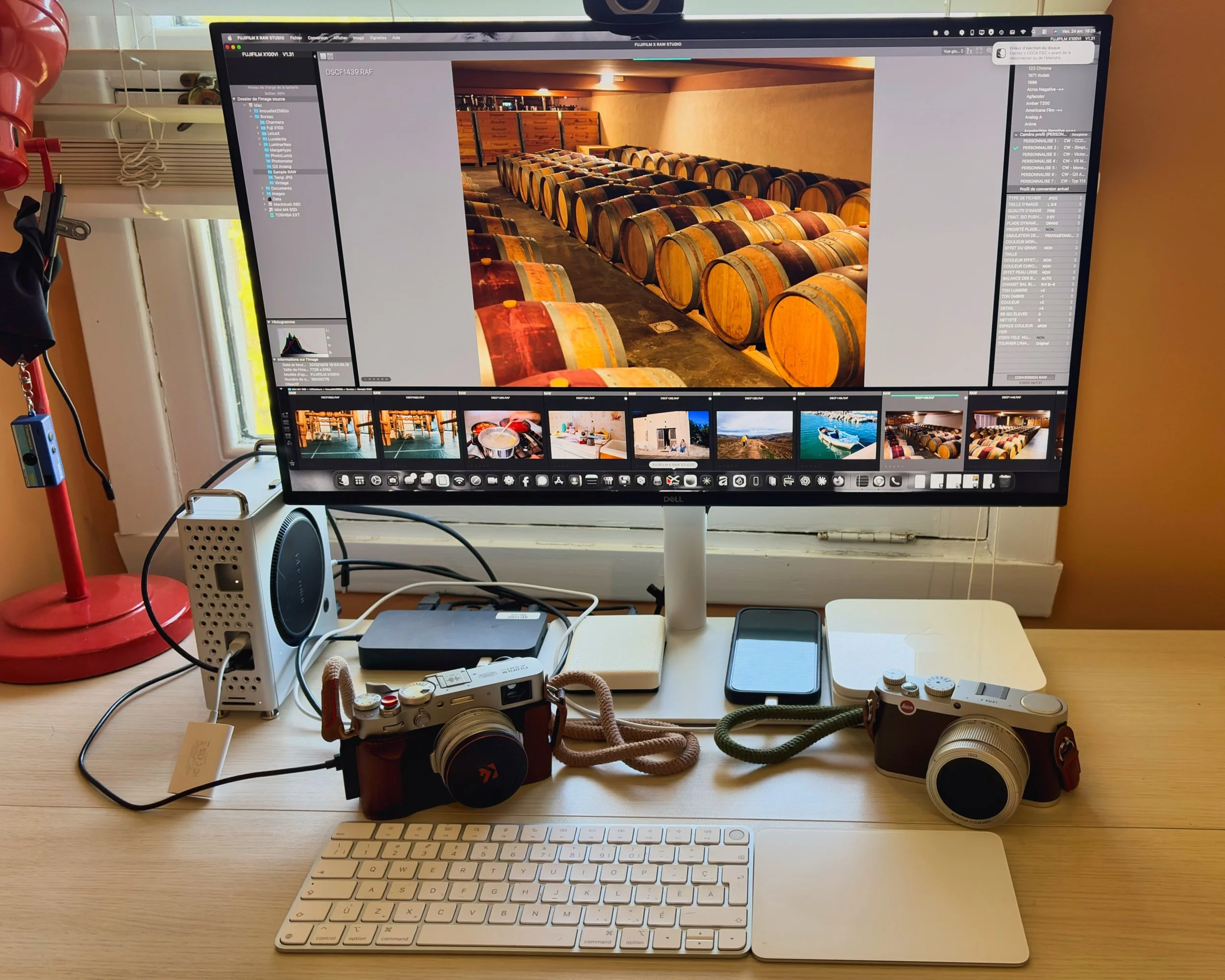
A working session with X Raw Studio
The wrong argument against X Raw Studio
The first objection you hear — and one I made myself at the beginning — goes roughly like this: any editing application will surely offer more creative latitude, so why burden yourself with such a limited tool?
The argument seems solid. It isn't.
It rests on a confusion between two approaches with entirely different aims. An editing application interprets the RAW file according to its own algorithms — it does its best to reconstruct an image from the raw sensor data, using its own colour models, its own decisions about sharpness, noise, highlights. That is interpretation work, and it is valid work. But it is not what I'm looking for.
What I'm looking for is for the camera itself to develop the file. And for that, there is only one tool.
What X Raw Studio actually does
X Raw Studio is intimately tied to the Fujifilm camera — that is both its strength and its constraint. The software only functions with a Fujifilm camera connected to the computer, which makes it unusable without one. That limiting factor is real, and must be accepted before going any further.
But here is what that constraint makes possible: when X Raw Studio processes a RAF file, it doesn't interpret it. It sends it back to the camera's X-Trans processor and asks it to produce the JPEG. The camera does the conversion itself, using its own algorithms, its own film simulations, its own settings. The result is exactly the JPEG the camera would have produced if those settings had been active at the moment of capture.
That is a fundamental difference. And it is why X Raw Studio is, in my approach, irreplaceable.
The SOOC logic, extended
All the photographs in the Seven Recipes for Slow Light series are SOOC, produced directly by the camera, without retouching. X Raw Studio fits precisely within that logic: it is not a matter of editing an image, but of developing it a second time with the desired parameters, letting the camera do the work it knows how to do.
It is also how I craft and test my recipes. I photograph in RAW+JPEG, examine the results, adjust the parameters in X Raw Studio, relaunch the conversion, compare. The X-Trans processor is a remarkably powerful conversion tool and X Raw Studio is simply the doorway into that processor.
The fact that it's free is not negligible either. It's a professional tool, provided by Fujifilm, at no cost. The ergonomics leave something to be desired, certainly, but the price is hard to argue with.
The school of slowness
It is in the work of crafting a recipe that X Raw Studio reveals another dimension, less obvious at first.
When you're looking for a precise result — a certain way the light falls on a surface, a particular saturation, a balance between shadows and highlights — working on a large screen changes everything. What you can barely perceive on the camera's rear display becomes readable, analysable. A tiny adjustment to shadow tone, a single step on sharpness: the differences are subtle, and that is precisely why you need to be able to see them large.
But there is more. X Raw Studio forces you to work through successive trials : change a parameter, relaunch the conversion, compare and start again. This slow rhythm has an unexpected effect: you come to understand, through experience rather than theory, what each setting actually does. You discover that lowering the highlights doesn't have the same impact depending on whether the saturation is high or not. You learn that sharpness interacts with grain in ways you wouldn't have anticipated. You internalise these relationships not as memorised rules, but as reflexes built from having watched them at work.
For someone who likes to understand — and who has the time to understand — X Raw Studio replaces any number of photography manuals. Not because it explains, but because it shows. And what you've seen for yourself, you don't forget.
What this means in practice
Adopting X Raw Studio means accepting a different way of working. Fewer gestures, fewer sliders, fewer possibilities for intervention. In return: complete fidelity to what the camera produces, and a coherence between the RAF file and the final JPEG that doesn't pass through any third-party interpretation.
For some photographers, this constraint will be intolerable. For others — those who chose Fujifilm precisely for the quality of its film simulations, and who want to make full use of them — it is, on the contrary, liberating.
I belong to the second group. Not out of ideology, but because it's what gives me the results I'm looking for.
And you?
If you use X Raw Studio — or if you've chosen not to — I'd like to understand your reasoning. That kind of decision often reveals something interesting about how you conceive your relationship to the image.
Write in the comments. I read everything and I reply.
- Louis-Martin Ouellet