
Nothing Selected : the door nobody thinks to open
Why starting with nothing is the right place to begin
On the rear display of recent Fujifilm cameras, a menu offers several slots for custom settings : C1 through C7. That's where you store your recipes, your preferred configurations, your ways of seeing. Most guides will tell you how to fill them.
Nobody talks about the option above them: Nothing Selected.
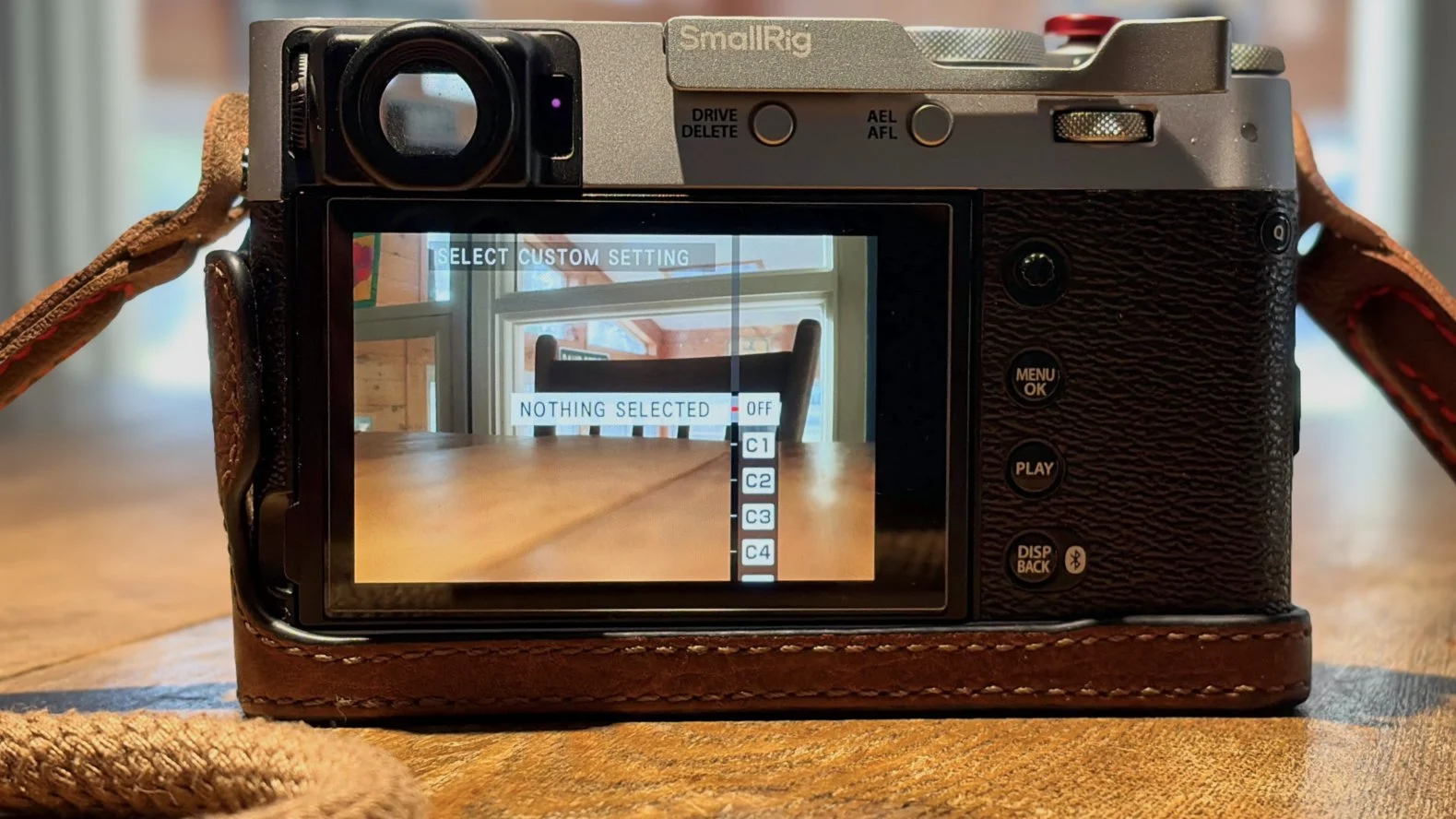
Nothing Selected
What Nothing Selected actually means
Choosing Nothing Selected means asking the camera to produce the pure, unaltered rendering of a film simulation, with no settings layered on top, no intervention, no intention beyond what Fujifilm encoded into that simulation. You select a simulation, you change nothing else, and you let the X-Trans processor do exactly and only what that simulation was designed to do.
It is deceptively simple. It is also, in my view, the obligatory starting point for any serious work with a Fujifilm camera.
Scales first
Every pianist plays scales — many of them, and for a long time — before attempting a piece of music. Not because scales are an end in themselves, but because they are the only way to truly hear each note, to understand its weight, its relationships, its resonances. You cannot interpret what you haven't first listened to.
The same holds for film simulations.
The number of simulations varies by camera model. Each has its own way of interpreting light, colours, contrasts, shadows. To understand what each one does, to grasp what distinguishes them from one another, you have to observe them in their pure state, without other settings clouding the listening.
What you'll find there, I won't tell you. That's not what this post is about, and it would deprive you of a discovery that belongs to you.
Why it prevents improvisation
Skipping this step and going straight to recipe creation is building on a foundation you haven't examined. You're adjusting parameters whose basic effects you don't yet understand, searching for a result without knowing where you're starting from. You're improvising. Improvisation, in photography as in music, only produces something worthwhile if you already know what you're doing.
Nothing Selected is the most direct way to understand, through experience and observation, what each simulation does. Not through theory, not through other people's explanations, through your own eyes, looking at your own photographs, in your own light.
It is a wide-open door onto everything a Fujifilm camera can offer. It would be a shame not to walk through it.
The reference settings
To faithfully reproduce the conditions of Nothing Selected and observe each simulation in its pure state, here are the settings to use as a starting point. The aim is simple: to have the X-Trans processor do nothing other than render the chosen simulation.
| Parameter | Value |
| ISO | Auto — 125 to 3200 |
| White balance | Auto — 0R / 0B |
| Dynamic range | DR100 |
| Tone curve — highlights | 0 |
| Tone curve — shadows | 0 |
| Colour | 0 |
| Sharpness | 0 |
| High ISO noise reduction | 0 |
| Clarity | 0 |
| Grain effect | Off |
| Color Chrome Effect | Off |
| Color Chrome Effect Blue | Off |
| Smooth skin effect | Off |
These settings are not factory defaults in the strict sense. They are the minimal conditions for letting the simulation work alone, without interference. The ISO range of 125–3200 is particularly important: beyond it, the noise introduced by higher sensitivity risks masking what the simulation is actually doing. That neutrality is what makes this useful.
Apply these settings, choose a simulation, photograph. Then start again with another. Discovery has its price.
And you?
Did you take the time to observe your simulations in their pure state before starting to modify them? Or did you go straight to recipe creation? I'd be curious to know what that process — or its absence — changed in the way you work.
Write in the comments. I read everything and I reply.
- Louis-Martin Ouellet