
The Fujifilm X100vi, six months, 800 photographs, and an unexpected lesson
What you learn when you take the time to get to know a camera
There are objects you choose for what they do, and others you choose also for what they are.
The Fujifilm X100vi belongs to the second category. Its silhouette recalls the film cameras I used in my twenties : the viewfinder, the dials and the compactness in the hand. The build quality is serious, almost as good as Leica. And behind the object, there is a company whose history is deeply bound up with film: Fujifilm knows what an emulsion is, what a film simulation is and what colour management means. It is no accident that their simulations are so successful. It is a form of expertise that comes from a long way back.
When I finally managed to get hold of one — the X100vi is very much in demand, used by a wide range of photographers, and sometimes you have to wait — I told myself: if I don't like it after using it, I'll probably be able to sell it without a loss. There was an element of exploration, certainly. But there was also a quiet conviction that this object and I had a decent chance of getting along.
I was not wrong. The road just turned out to be longer than expected.
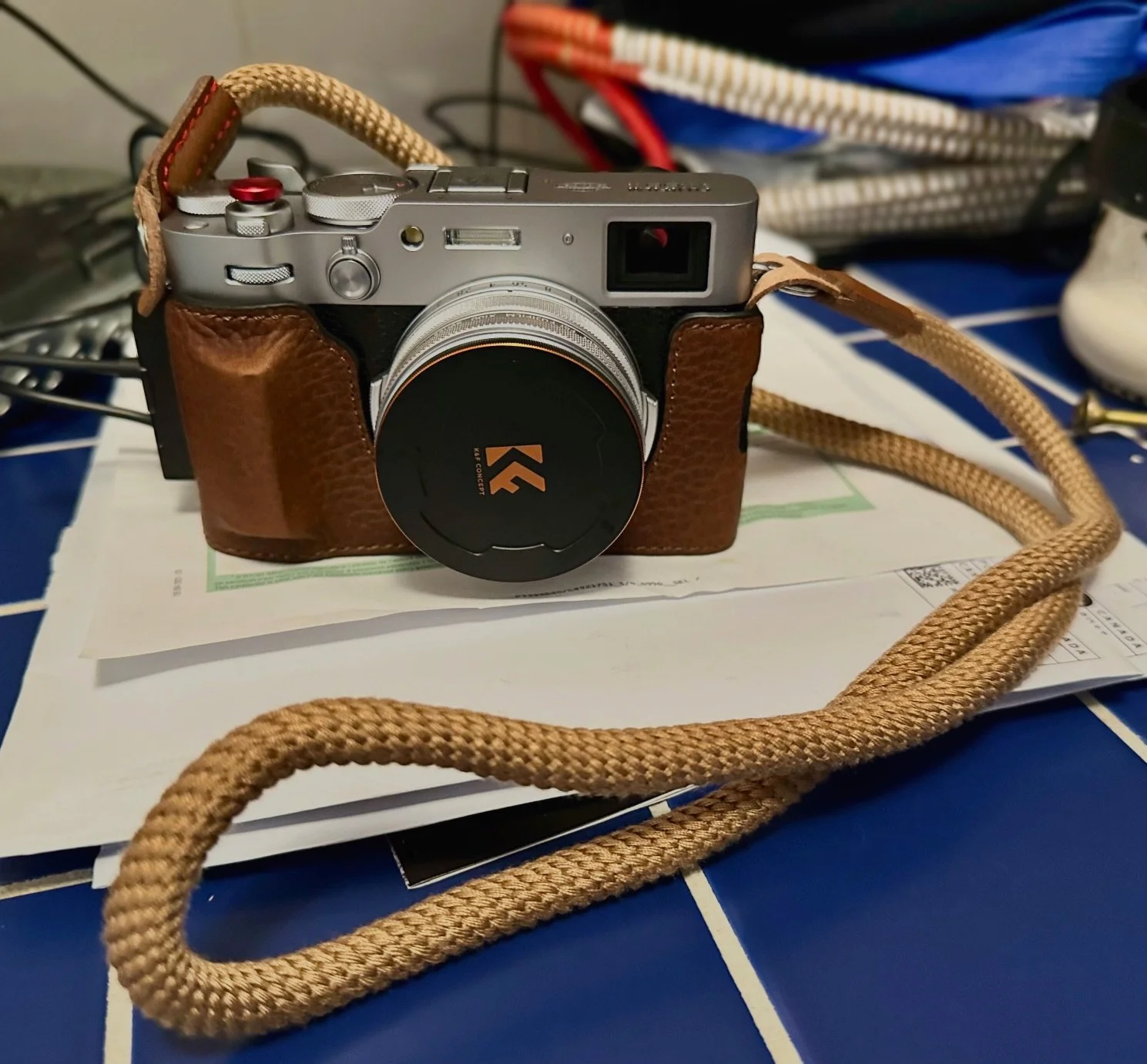
My X100vi
Six months and 800 photographs
Mastering a camera like this takes time. I say that not to discourage anyone, but to be honest about what getting to know such a highly customisable instrument actually involves.
From June to November 2025, I made 800 photographs, including 360 during a trip to Italy that became my main learning ground. It was only at the end of that period that I had enough confidence to craft my first recipe.
The first obstacle was the function buttons. The X100vi lets you assign almost all its controls according to your own preferences and that is both its strength and its initial complexity. What is striking is that every Fujifilm camera owner ends up with their own configuration. In practice, it is very difficult to use another owner's camera. Your hands look for controls that aren't where they're supposed to be. The camera becomes a fingerprint.
The second obstacle was more philosophical, and it occupied me longer.
Degrading to give soul
The X100vi produces, with Provia and no particular adjustments, technically perfect photographs. Correct exposure, precise colours, detail preserved in the highlights and shadows. It is a remarkably capable camera.
And yet, those images left me cold.
It was by comparing the X100vi files to those of the Leica X Typ 113 that I understood something essential. The Typ 113 was released in 2014. With a 16-megapixel sensor, it holds its own perfectly against the X100VI, despite ten years separating the two. Not because it is technically superior — it isn't — but because its images have something that the X100VI's default settings don't: a soul.
I realised then that to approach that rendering, I had to work backwards. To start from technical perfection and, through precise and deliberate adjustments, temper it : soften the highlights, desaturate the colours slightly, reduce the sharpness and introduce texture. To humanise, in a sense, what was too clean. This thinking is at the heart of the entire CW series.
The megapixel count, in this context, matters little. What matters is how the light is interpreted.
The fixed focal length, what you lose, what you find
The X100vi has only one lens — 23mm, equivalent to 35mm on a full-frame sensor. This constraint has a real cost: I missed moments. Landscapes that needed more distance. Architecture better embraced at 28mm or 21mm. Portraits that would have benefited from 85mm and a particular bokeh.
But this same constraint led me somewhere I hadn't anticipated.
Table photographs. Meals shared with people I love, good wine, warm light, unhurried conversation. The 35mm focal length is exactly right for this kind of scene : close without being intrusive and natural in its rendering of perspective. It has become my preferred subject, and I would not have discovered it had I had the option to change lenses.
Constraints, in photography as elsewhere, sometimes have the good taste to surprise us.
An object that creates connection
One morning on a pier, someone approached me thinking my X100vi was a film camera. The conversation that followed lasted a good while.
That, too, is what a well-made object does. It opens doors. And there is something genuinely pleasing about using something designed with care, that responds well in the hand and that makes you want to use it.
I should mention that I don't use the X100vi's video capabilities, and I have no intention of doing so. I see it as a photographic camera, full stop. That deliberate choice probably contributes to the way I've grown attached to it. I ask one specific thing of it, and I ask it with everything it offers.
And you?
The X100vi is just one camera among many in the Fujifilm world, a world with passionate devotees, each with their own instrument and their own reasons for having chosen it.
If you use a Fujifilm camera — whichever one — I'd like to know why you chose it, what it taught you, what it surprised you into doing. Conversations between photographers who share the same image DNA are always worthwhile.
Write in the comments. I read everything and I reply.
- Louis-Martin Ouellet