
What film demands
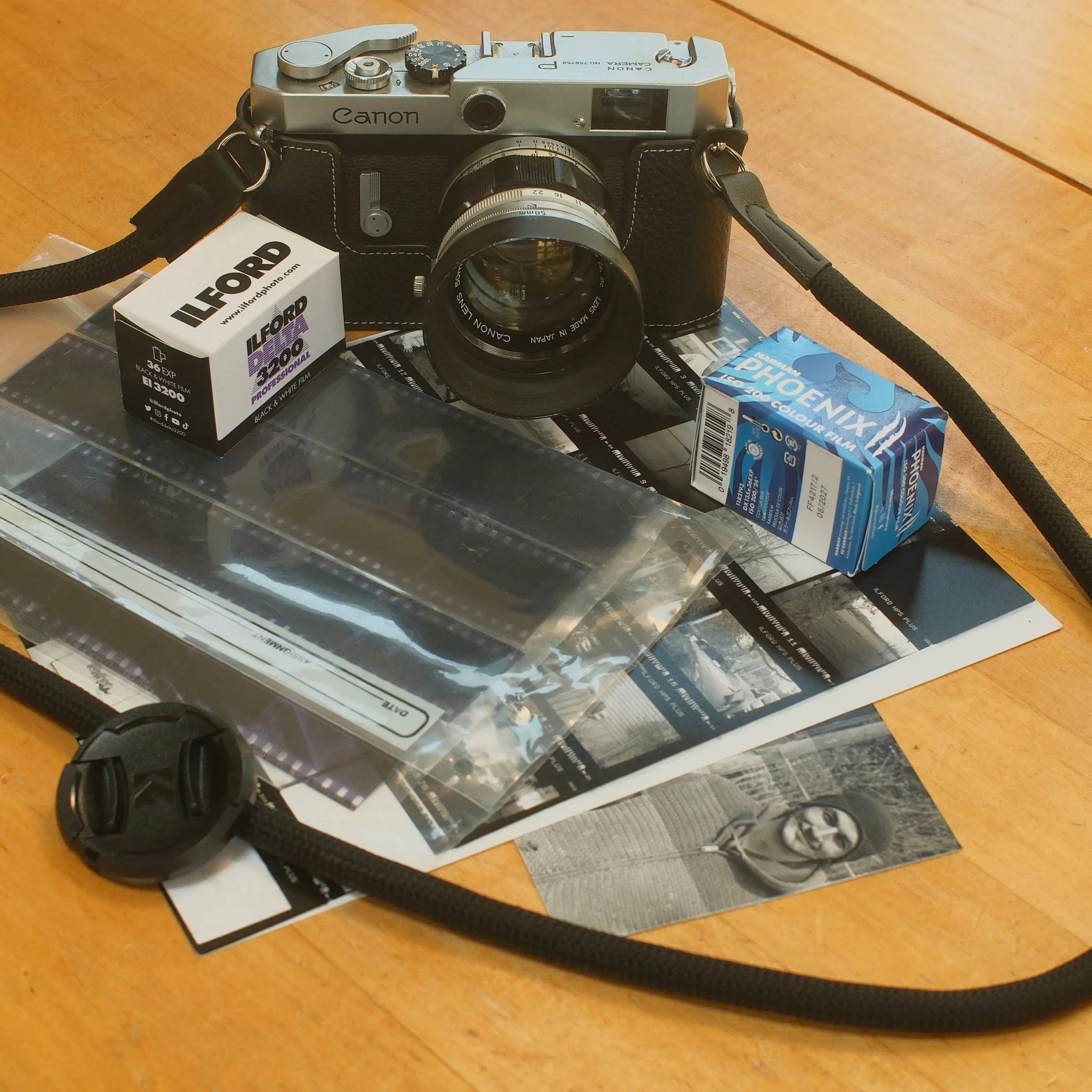
My Canon P loaded with Delta 3200 film (Film recipe: CW - Mono Simple)
Seven limitations that teach you to see again
A few weeks ago, I'm standing on a sunlit sidewalk with the Canon P in hand. The light is strong, almost harsh. I want to shoot wide open at f/1.4 to separate my subject from a blurred background, but the camera's maximum shutter speed is 1/1000 of a second. Opening that wide in full sun means overexposure. I close down to f/8 and reframe.
With my X100vi, I would have simply activated the built-in ND filter. The problem would have vanished in a second.
Here, there is no filter. No adjustment. You have to decide differently.
That is what film does, and what digital has often let us forget: a constraint is not an obstacle to be worked around. It is a school.
ISO locked into the film
With a digital camera like the X100vi, ISO can be adjusted from one frame to the next. Light drops, you raise the ISO. The scene changes, you adapt. The adjustment is so fast and so unobtrusive that you eventually stop thinking about it.
With film, ISO is whatever you loaded into the camera before heading out, and it stays that way through the last frame. If you chose ISO 400 for interiors and find yourself in bright sun, you work with that ISO 400. If you chose ISO 100 for daylight and the sky turns grey, you work with that ISO 100.
There is no fallback. There is only the film in the camera and the light in front of you.
This constraint forces a decision made in advance: what kind of light am I expecting on this outing? It pushes you to read the environment before you step out, rather than reacting in real time from a camera menu.
Depth of field at wide aperture
The Canon 50mm f/1.4 can produce a striking background blur. But at f/1.4, the zone of sharpness is so thin that a distance estimate off by a few centimetres is enough to miss focus entirely.
With a digital camera and autofocus, that kind of problem is largely absorbed by the machine. The lens calculates, the camera confirms. On the X100vi, subject and face detection makes focusing at wide apertures nearly invisible.
On the Canon P, focusing is done by hand through rangefinder coupling: you align two overlapping images in the viewfinder until they coincide. It's precise once you've internalized it, but it takes time, and at f/1.4, the slightest movement of your subject between focus and shutter release can shift the plane of sharpness.
You learn to anticipate. You learn to work at more reasonable apertures. You learn not to stake everything on blur.
A maximum shutter speed of 1/1000
Most modern digital cameras can exceed 1/4000, or even 1/8000 of a second. The X100vi also has an electronic shutter that reaches 1/32000. These high speeds allow you to shoot wide open even in bright light without overexposing.
The Canon P stops at 1/1000. That's not nothing, but it's not enough to shoot at f/1.4 under midday sun with ISO 400 film.
You relearn to think in terms of the triangle: ISO, aperture, and shutter speed are three linked variables, and you can't adjust either of the first two mid-roll. You work with what you loaded before heading out and what the light is giving you now.
It's simple arithmetic, and yet it's arithmetic we had forgotten.
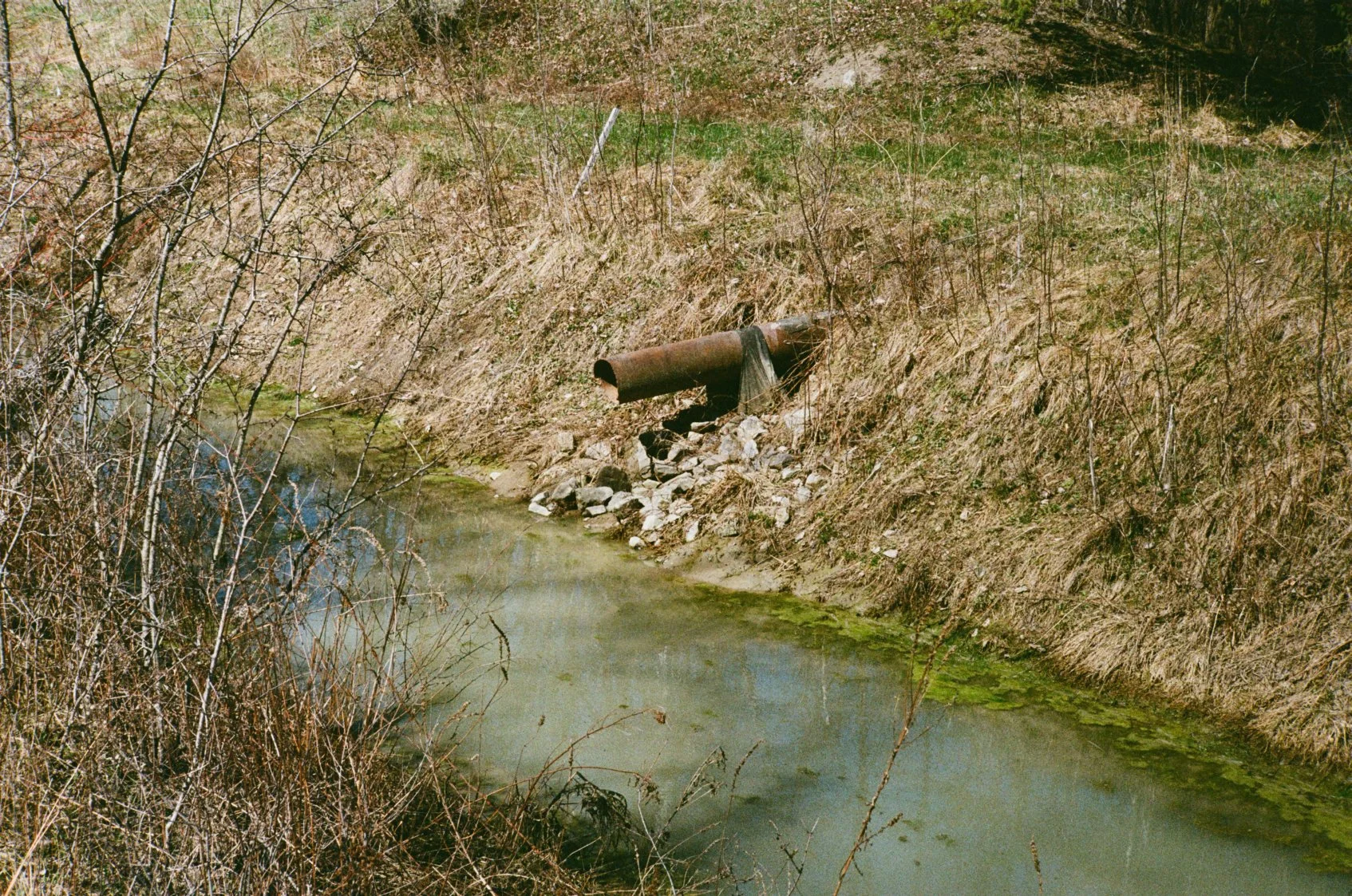
The boundary ditch and spring waters (Photo taken with a Canon P on Flic Street Savvy 400 film)
The light meter
With a digital camera, light metering is built in and automatic. The X100vi displays the exposure in real time through the electronic viewfinder, with a live histogram that lets you confirm the result before you even press the shutter.
The Canon P has no built-in light meter. You have to measure the light separately, before each shot or whenever the lighting changes. In my case, that means an iPhone app.
The sequence becomes: take out the phone, open the app, point it at the scene, read the recommended values, put the phone away, set aperture and shutter speed on the camera, compose, and shoot.
It's slower. That isn't a criticism: it's a description. This added step is part of the film process in the same way as all the other constraints: it forces you to stop, to measure rather than assume, and to make an informed decision before acting.
Rangefinder focusing
A reflex camera or a modern mirrorless lets you see exactly what the lens will see, often with visual or automatic focus assistance. On a rangefinder camera like the Canon P, the viewfinder is optical and offset from the lens axis. You don't see through the 50mm. You see beside it.
Focus is achieved through mechanical coupling: a second frame inside the viewfinder overlays the primary image, and their alignment indicates sharpness. The technique is precise once mastered, but it requires sustained attention and a certain confidence in the gesture.
It also requires accepting a degree of uncertainty. On the X100vi, focus is confirmed visually and immediately. On the Canon P, you press the shutter hoping you read the distance correctly, and you won't know until the film comes back from development.
That gap between act and confirmation turns every shutter release into a considered wager.
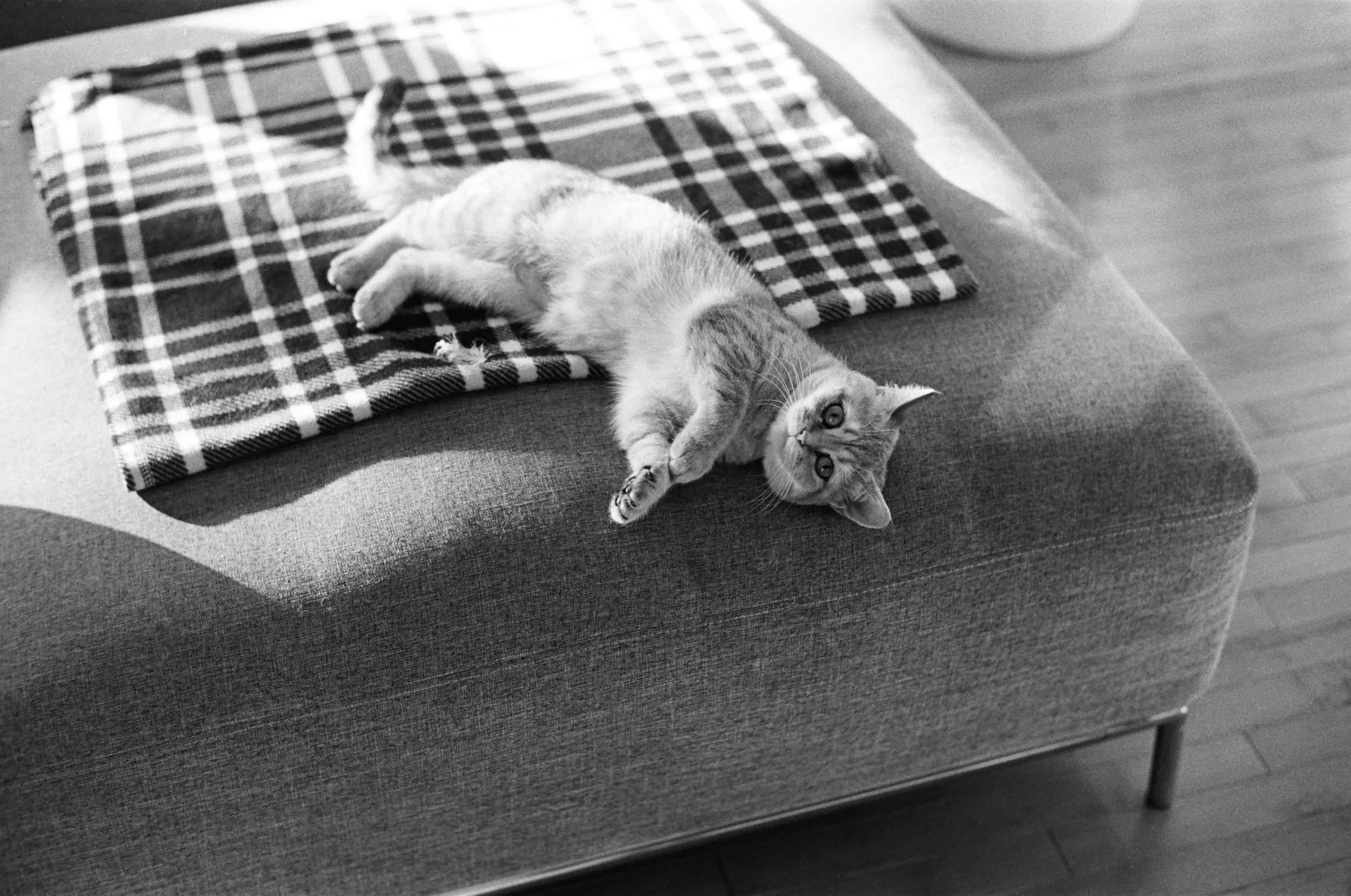
Beth ready to play. (Photo taken with a Canon P on Ilford HP5+ film)
The lens cap
There is one mistake that everyone makes with a rangefinder camera, at least once: pressing the shutter with the lens cap on.
With a reflex or a modern mirrorless, this is practically impossible. The viewfinder shows what the lens sees, and an opaque cap turns the frame black. The mistake announces itself before you shoot.
On the Canon P, the viewfinder is optical and offset from the lens axis. You see the scene clearly, you compose, you shoot. The cap is invisible from the viewfinder. The frame is lost.
Knowing the mistake is possible doesn't prevent it from happening, because the number of things to manage before pressing the shutter is enough to let that one slip through. ISO, aperture, shutter speed, light reading, focus, and composition: a sequence of checks to run through before each frame. It is less a beginner's error than an honest demonstration of what film photography demands.
Composing with a 50mm and a 1:1 viewfinder
The Canon P's viewfinder has a 1:1 magnification: what you see corresponds roughly to what your naked eye would see from the same position. The 50mm frame is indicated by luminous brackets inside the viewfinder, but the rest of the scene — what falls outside the frame — remains visible.
It's a different way of seeing. You're not looking through a tunnel. You're looking at the world, and deciding what to keep.
The 50mm, for that matter, isn't an intuitive focal length for everyone. It neither compresses like a telephoto nor widens like a wide-angle. It renders things more or less as they are. What you make of it depends entirely on where you position yourself.
With the X100vi and its 35mm equivalent, I had grown used to a particular angle of view. The shift to the Canon P's 50mm demands constant physical repositioning: moving closer to fill the frame, stepping back to include context, finding the angle that the 35mm would simply have absorbed.
Your legs replace the zoom. Your position in space replaces the adjustment.
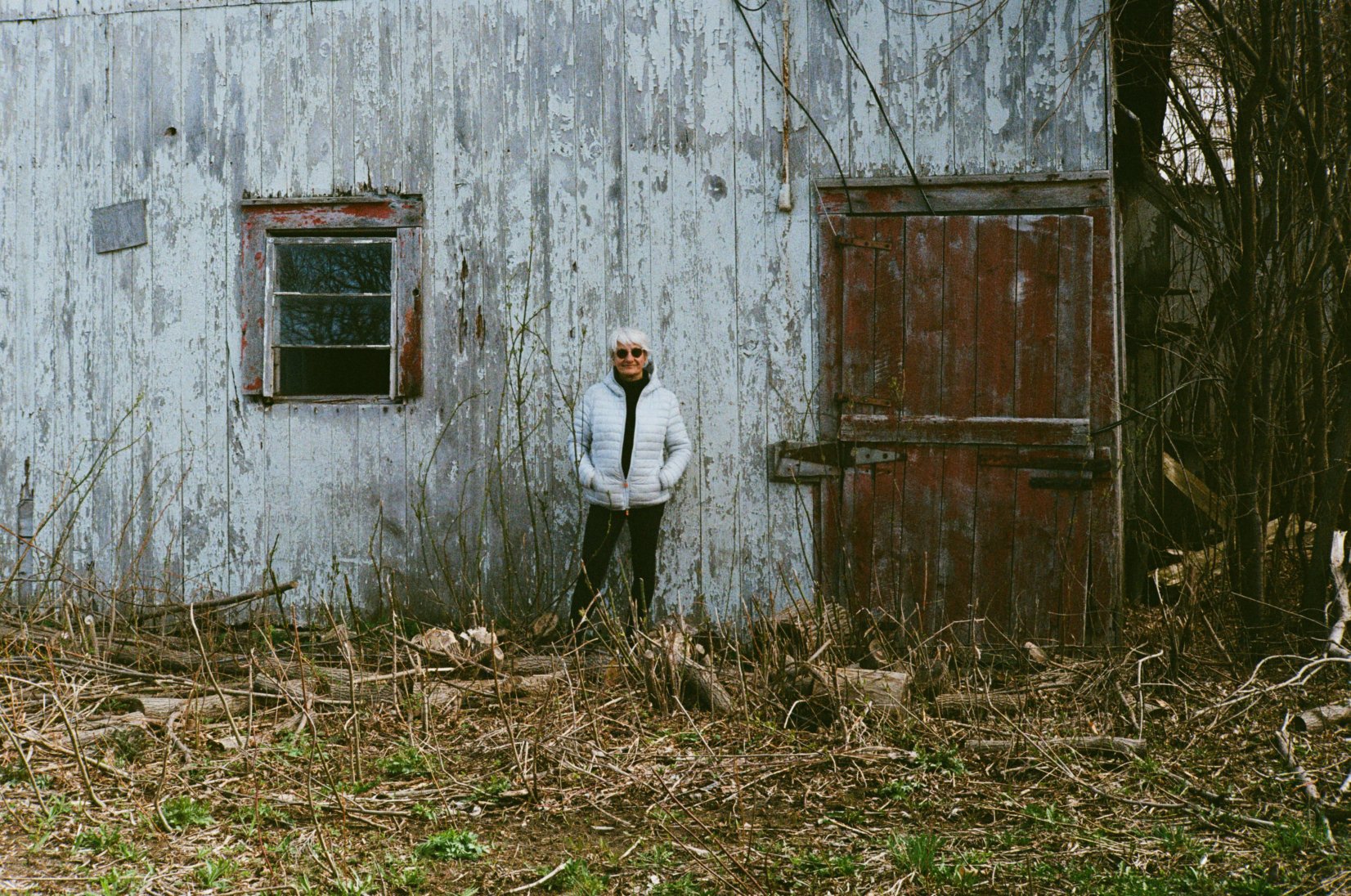
The desaturated colors of spring (Photo taken with a Canon P on Flic Street Savvy 400 film)
What constraint teaches
This is not an argument that film cameras are better than digital. They aren't, and I wouldn't defend that position.
What they do is remove the safety nets. Fixed ISO, a capped shutter speed, manual focus, and a decoupled viewfinder all force you to decide before you shoot, to read the light rather than correct it, and to accept that each frame is, to some degree, irreversible.
The X100vi gives me the freedom to adjust in real time. The Canon P gives me the discipline not to need to.
These two ways of working don't oppose each other. They complement each other, and perhaps each one teaches something to the other.
— Louis-Martin