
Yun: what the world offers before the first gesture
A concept from Chögyam Trungpa, and a way of entering slow photography
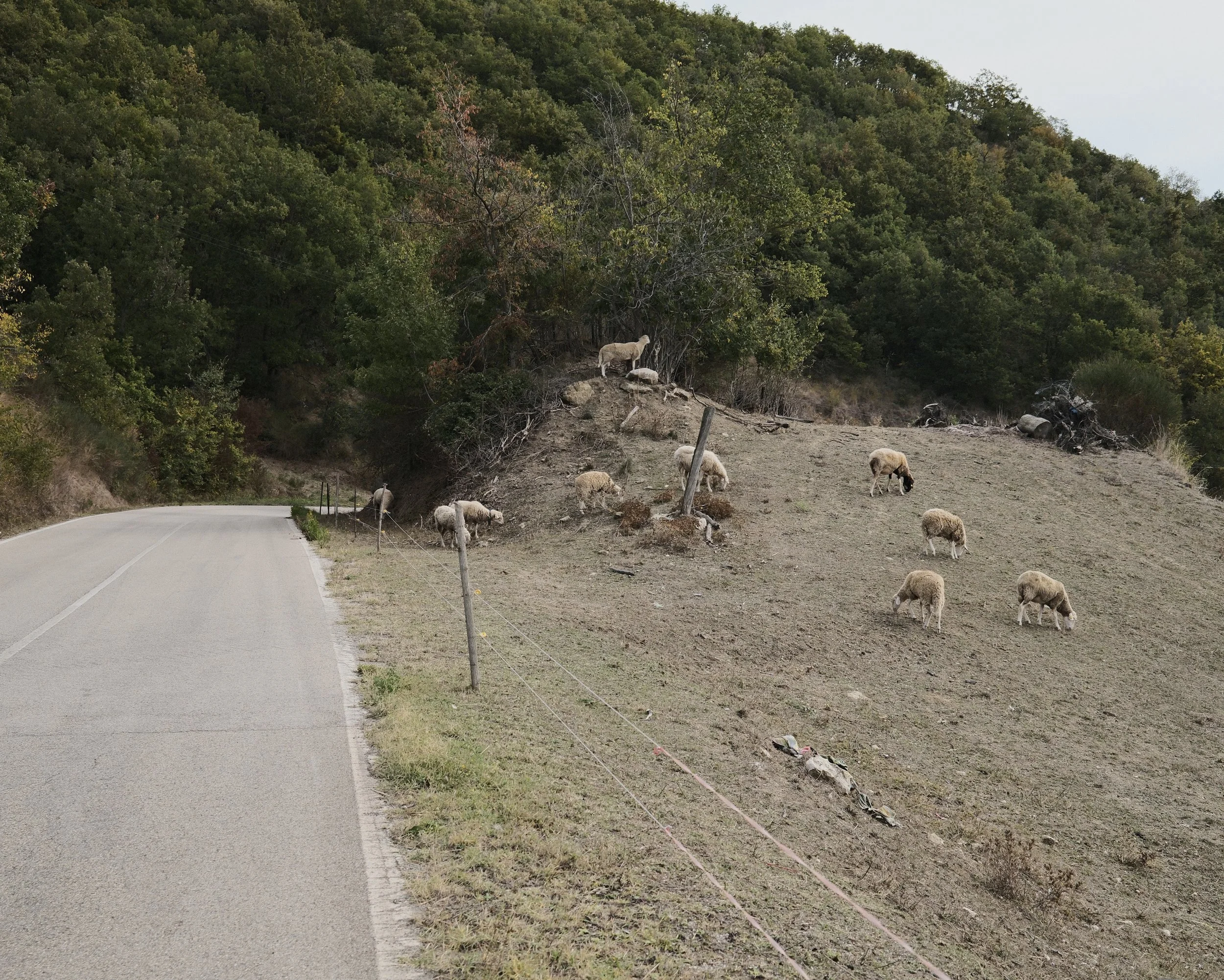
In the countryside, near Avellino. (Film recipe: CW - CCD KAF - 18500)
Before the camera comes up, there is a moment. You enter a room, settle at a terrace, walk down a street, and something in the environment presents itself. Light falls in a particular way across a surface. An ordinary object takes on a presence you hadn't noticed in it before. A familiar situation reveals a density you didn't know it held.
This moment precedes everything: the recipe chosen, the focus, the framing. It even precedes the intention to make a photograph. It is a moment of recognition, not decision.
There is, in the Tibetan tradition that Chögyam Trungpa transmitted to the West, a word for what this moment reveals.
The word
Yun. The most direct definition found in the archives of Trungpa's teaching is this: the natural or inherent richness that exists in the phenomenal world. It can refer to the power particular to a specific location, or to the quality of richness in a particular object.
This is not material wealth. It is not beauty in the ordinary sense of the word. It is something more precise: a quality the world already possesses, independent of our gaze, and which certain moments, places and objects concentrate more than others.
The idea may seem abstract. An anecdote makes it concrete.
The Colorado road
Picture a long drive through an arid landscape: scrubby pines, sagebrush, and dry earth under a hard sun. The kind of terrain an ordinary eye would cross without pausing.
Trungpa begins pointing out areas through the car window. There, a yun spot. Further on, another. His companions look where he indicates: they see nothing particular, the same undifferentiated terrain in every direction. He also points to what is not one: a false yun spot. The distinction appears to be immediately available to him.
They stop. He describes what will be found by walking toward a cluster of trees: a clearing, and at its center, the yun. His companions go to check. The clearing is there, exactly as described. At its center, a circle of gray-white soil, the consistency of dry clay. They return with their collection. Third class, he says. At a second stop, a yellowish powder scraped from the surface: second class. First class he has only encountered in Tibet and Nova Scotia.
What matters in this scene is not its extraordinary quality. It is, on the contrary, its entirely ordinary precision. Trungpa perceives something in the landscape that his companions do not yet perceive, not because it is hidden or mysterious, but because their attention has not yet learned to recognize it. The yun was there for everyone. It was visible only to the one whose gaze had been trained to look for it.
What this means for a photographic practice
In an earlier post, I tried to describe photography as a meditative practice, a way of entering into relation with the present moment without seeking to improve or correct it. What Trungpa calls yun is its visible counterpart: the richness that is already there, in the world, waiting to be met.
It is not something you produce. It is not a composition you build, a light you invent, or a subject you choose because it is photogenic. It is something you recognize, or have not yet learned to recognize.
The photographic practice, in this sense, begins before the shutter. It begins in the silent question posed to the environment: where is the yun here?
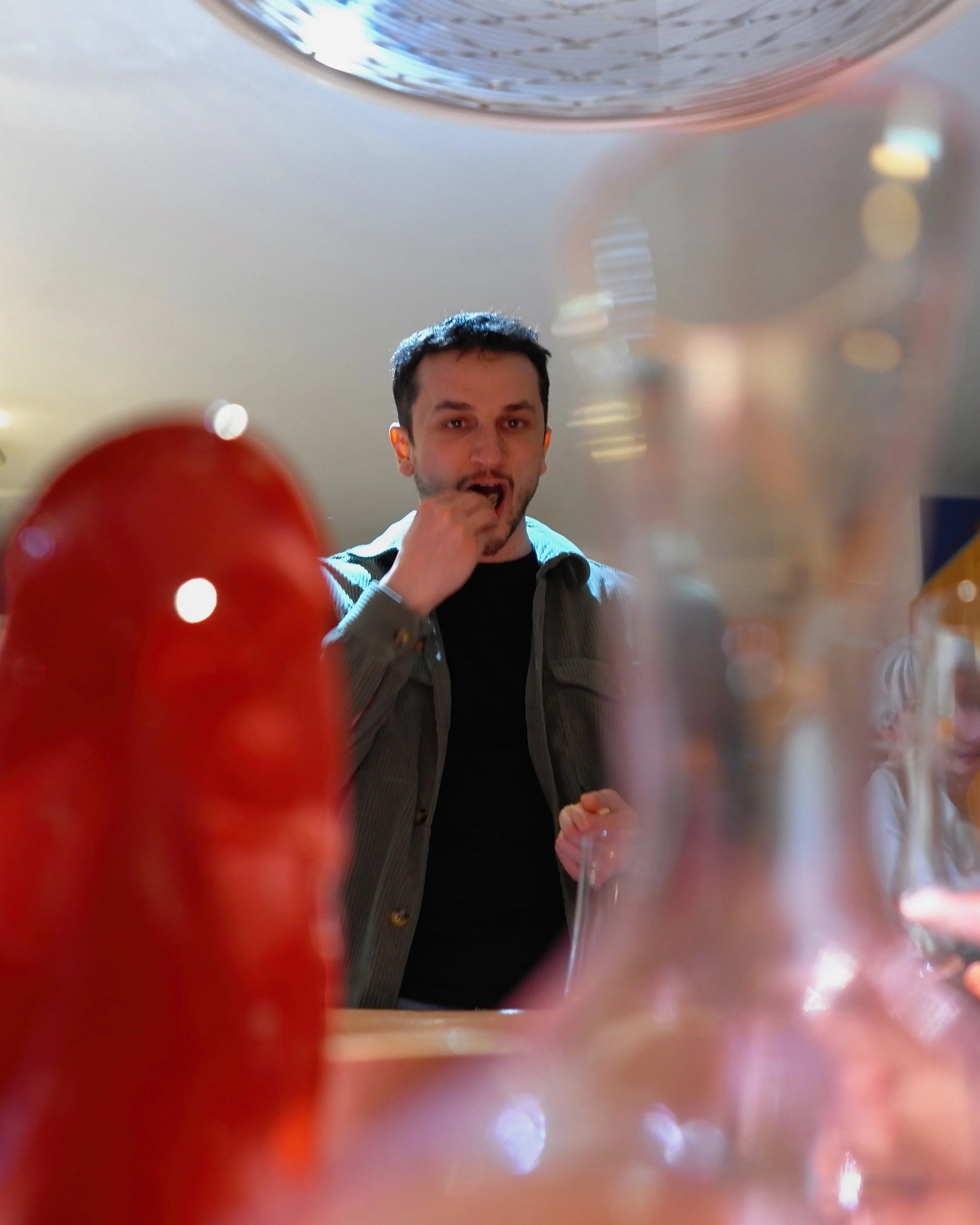
My son joining a conversation with people seated at a table (SOOC photo from a Leica X Typ 113)
Table photography and the richness of the ordinary
I did not expect to become a photographer of tables. It wasn't in my intentions. It was my fixed 23mm lens that brought me there: the short distance, the physical proximity to subjects, and the necessity of finding, within the immediate situation, something that justifies the image.
What I discovered is that tables are natural yun spots. This is not a metaphor: a table around which people eat and talk concentrates exactly what the word describes: a richness particular to that place, that moment and those objects. Light on a glass. The remains of a meal. Someone's hands. All of it holds something that cannot be planned, but that one can learn to recognize.
The camera, in that situation, invents nothing. It receives what is already there.
Seeking yun before pressing the shutter
What I am proposing here is not a procedure. It is a disposition.
Before beginning a photographic session — whether at a meal, on a walk, during a trip, or in an hour of particular light in a familiar room — there is a simple and often overlooked gesture: to look, before deciding what to do.
Not to scout for subjects. Not to assess the light in technical terms. Just to look, without agenda, and ask: what has richness here?
It is a question that changes the nature of attention. Rather than arriving with a programme — I am going to photograph that, in that direction, with this recipe — one arrives open to what the environment has to offer. And the environment, almost always, offers something.
The notion of yun helps me articulate what I had already felt confusedly: the richness is there before I look for it. My work is not to create it: it is to learn to perceive it.
Recipes as instruments of reception
In the Seven Recipes for Slow Light series, I tried to describe how each film simulation creates a particular sensitivity to light. A recipe built around Eterna Cinema receives the world differently from one built around ACROS. These are not the same eyes.
I realize now that the question "which recipe for this situation?" is itself a way of seeking yun. Not abstractly, but concretely: what is the nature of the light that is here? What tonality, what density, what quality of richness is present? And which simulation naturally corresponds to it?
The answer doesn't come from calculation. It comes from the same quality of attention Trungpa demonstrated by pointing to a clearing in the arid Colorado landscape.
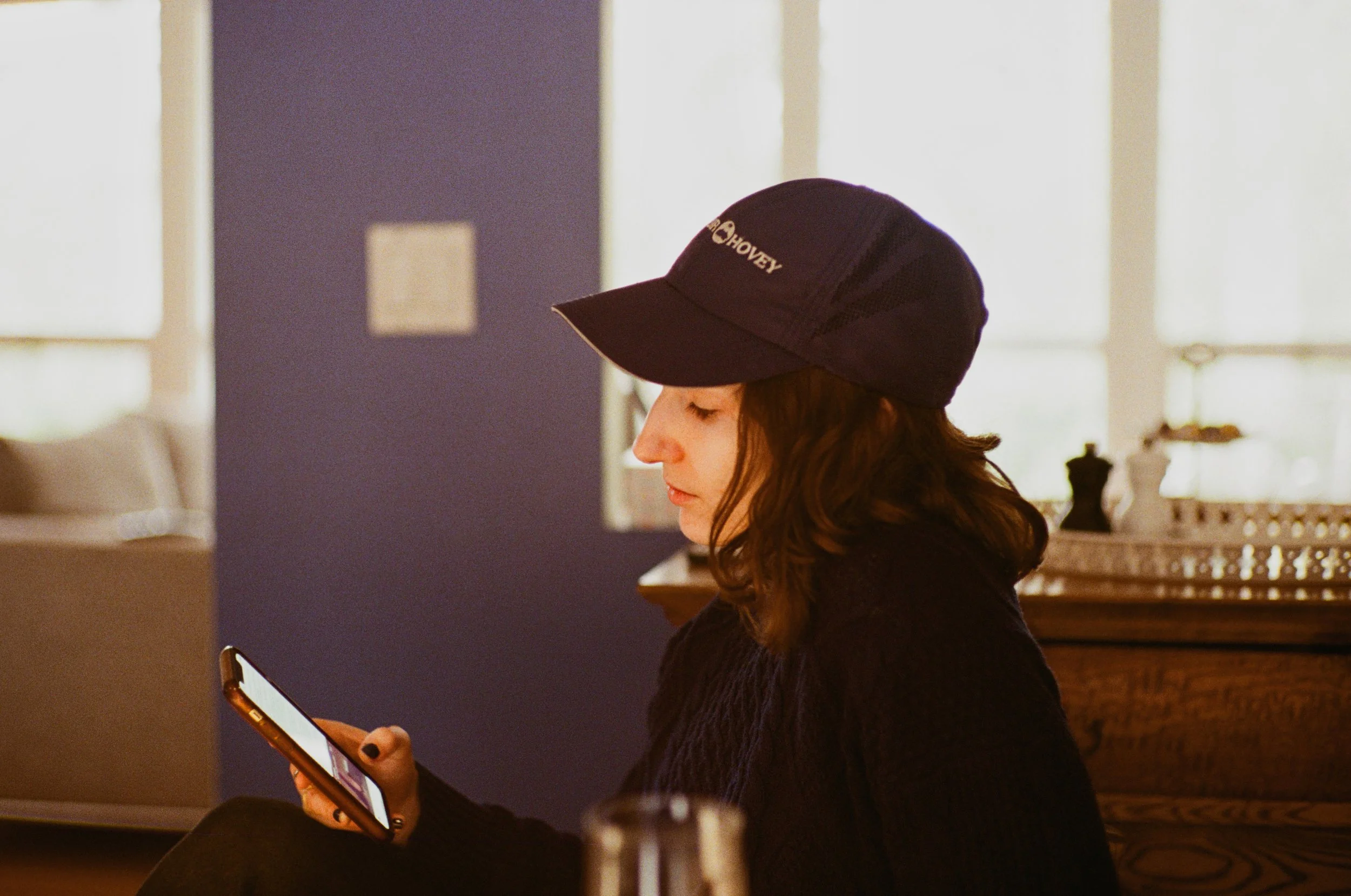
My daughter checking her phone (Photo taken with a Canon P on Flic Street Savvy 400 film)
A word on preparation
Slowness is not only in the photographic gesture. It is also in what precedes the gesture.
Taking the time to seek yun before a session is choosing to enter the practice through perception rather than execution. It is not an additional step in an already loaded process. It is, in fact, the first step, the one that conditions all the others.
A well-configured camera, a carefully chosen recipe, solid technical command: none of it serves much if you are not first present, attentive to what the world is proposing.
Yun is an invitation to arrive before you begin.
— Louis-Martin
Chögyam Trungpa Rinpoche (1939–1987) was a Tibetan meditation master, poet, and artist. He introduced Tibetan Buddhist teachings to the West beginning in the 1970s, and developed what became known as the Dharma Art teachings, an exploration of how ordinary artistic disciplines, approached with the right quality of attention, can become genuine contemplative practices. The notion of yun belongs to his Shambhala teachings, specifically to his commentary on The Letter of the Golden Key.