
The X100vi's OVF Used Like a Rangefinder
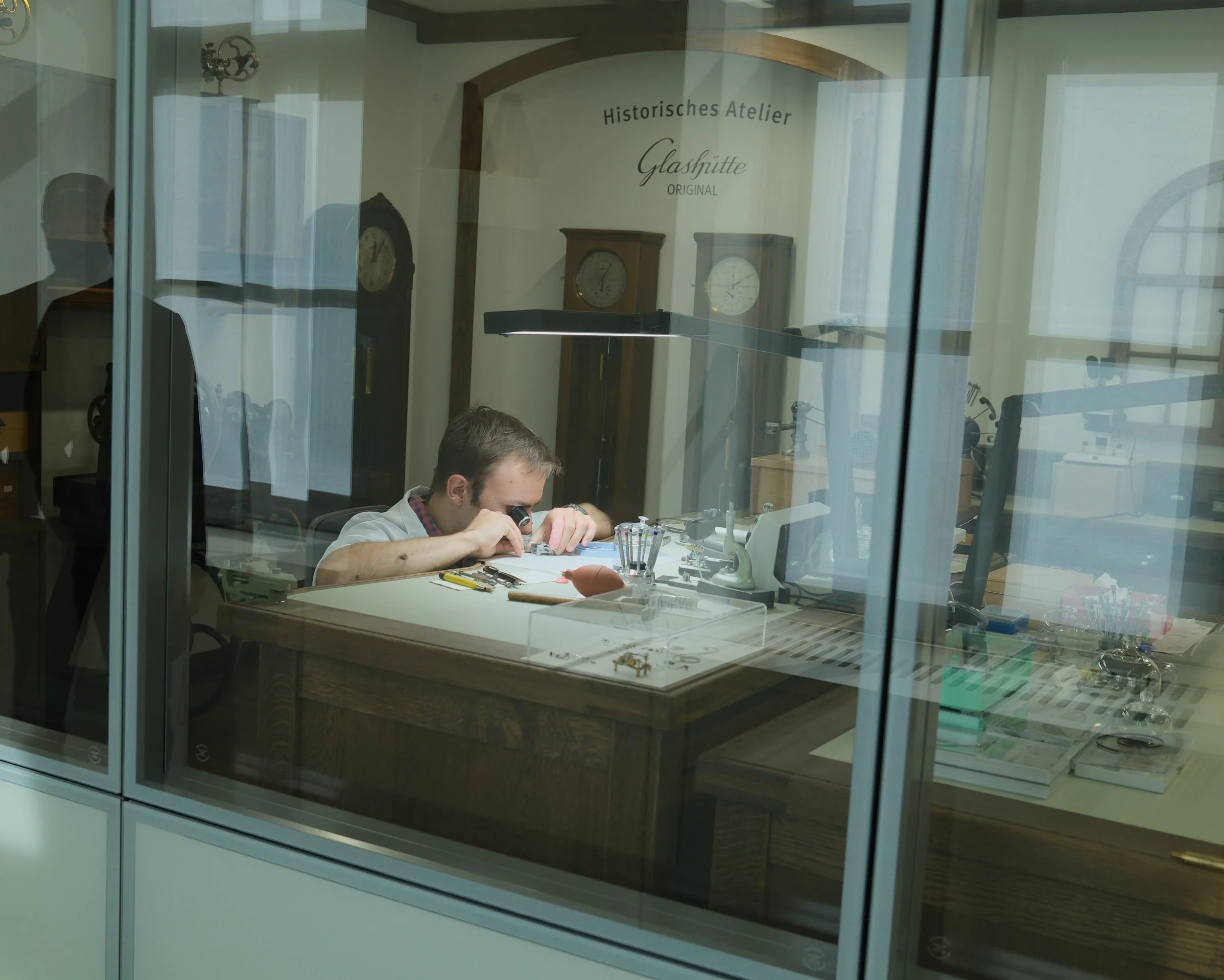
Glashütte, historic workshop of the German Watch Museum, October 2026
The Small Window in the Corner
Beth won't stay still. I turn the X100vi's focus ring, my eye to the optical viewfinder, and every time the outline of her ears lights up red in the small window in the corner, she has already moved. That's exactly what used to happen with the Canon P.
The difference is that my thumb would only have to push the selector on the side of the camera for autofocus to take over, should it ever become truly necessary.
A little earlier, that same small window had stayed black. I had forgotten to remove the lens cap. With a rangefinder, you discover that kind of lapse when the film comes back from development. With the X100vi, you discover it before pressing the shutter, and you smile.
What an Optical Viewfinder Shows
The X100vi's optical viewfinder is not a screen. It is a small glass window, set above and to the left of the lens, that shows the world as the eye sees it. A bright frame is superimposed on it to indicate what the photograph will keep. Around that frame, the scene carries on: you see what is about to enter the image before it does.
Because the window isn't on the lens axis, the two don't see quite the same thing. At a few meters, the difference is negligible. Up close, it becomes visible, and the camera shifts the frame to compensate. This is called parallax, an old companion of rangefinders.
The frame is also cautious. It covers only about ninety-five percent of the image: the photograph always contains a little more than what it outlines. Since the gap between the window and the lens changes with distance, a frame that was exact at one distance would be wrong at every other. Fujifilm preferred a frame that guarantees whatever you place inside it will be in the photograph, even if it delivers a little more. The bright-line frames of Leica M cameras follow the same convention, calibrated for a focus distance of about two meters. Like a rangefinder, the optical viewfinder doesn't lie: it promises less than it delivers.
In the corner, a second window, an electronic one this time, shows what the sensor sees. Fujifilm calls it the electronic rangefinder (ERF).
I once wrote, about my Canon P, that with a rangefinder you don't see through the lens, you see beside it. The X100vi has kept that way of looking.
A Rarity at Fujifilm, and an Origin
The X100 was born from a viewfinder. Its chief designer, Masazumi Imai, recalled that the camera was originally meant to have only an optical viewfinder. Halfway through the project, the engineers invented the hybrid viewfinder, and it decided everything else: the X100 would look like a rangefinder, not an SLR.
Fifteen years later, this viewfinder remains a rarity. At Fujifilm, only the X100 and X-Pro series have received it. The GFX medium format line has never had one, not even the GFX100RF, which nonetheless has the silhouette of a rangefinder. Fujifilm explained that the hybrid viewfinder, being more complex, could not offer enough magnification there.
In other words, one of Fujifilm's most popular cameras rests on a technology the company itself reserves for only a very few models.
Two Viewfinders, Two Ways of Being Present
The X100vi's two viewfinders don't show the same thing. The electronic one shows the photograph before it is taken: its exposure, its depth of field and the rendering of the recipe. The optical one shows the world, with what surrounds it, knowing nothing of the photograph.
Each has its strengths. The electronic one tracks a face, stays precise up close and doesn't lie about exposure. The optical one has no lag, lets you see what is coming into the frame and keeps the eye in the scene rather than on a screen. Each also has its limits: the optical one loses face detection, darkens in low light and says nothing about the recipe.
Not everyone finds it worthwhile. Many users always go back to the electronic viewfinder, and one published review sees almost no reason to use the optical one. Needless to say, I don't share their view.
The OVF isn't the default setting of a photographer in a hurry. It's a choice.
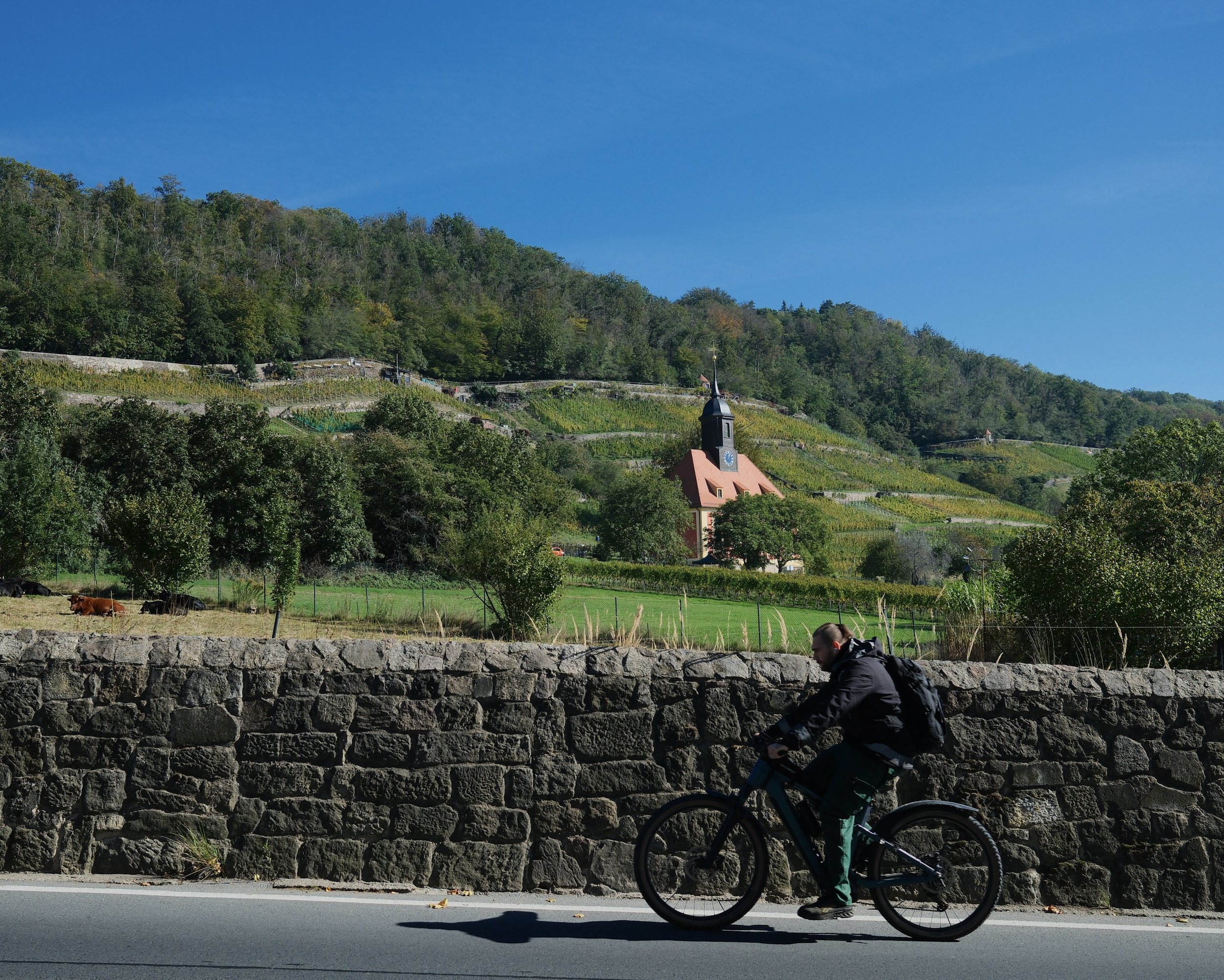
Pillnitz, near Dresden, the vineyard church (Weinbergkirche), October 2026
On the Other Side, the M11 and the M EV1
Leica and Fujifilm made opposite choices. To offer both the direct vision of a rangefinder and the precision of an electronic viewfinder, Leica offers two cameras. Fujifilm offers one, with a lever.
The M11 is the classic rangefinder: a glass window, a bright frame, and two images that merge at the center when focus is right, through a mechanical link between the lens's focus ring and the viewfinder.
The M EV1, launched one year ago to the day, on October 23, 2025, is the first M without a rangefinder. It divided critics. Richard Butler, of DPReview, remembered his first encounter with a Leica rangefinder, a technology superseded several times over without ever becoming obsolete, and found that the M EV1 offered none of that experience. Andy Westlake, of the British magazine Amateur Photographer, found the camera more practical, but felt part of the M mystique slipping away. And Macfilos put its finger on the essential: with a rangefinder, you see around the camera, not through it.
Macfilos even recommended the M EV1 as a second camera, alongside an M11. Two cameras, then, for what the X100vi does with one.
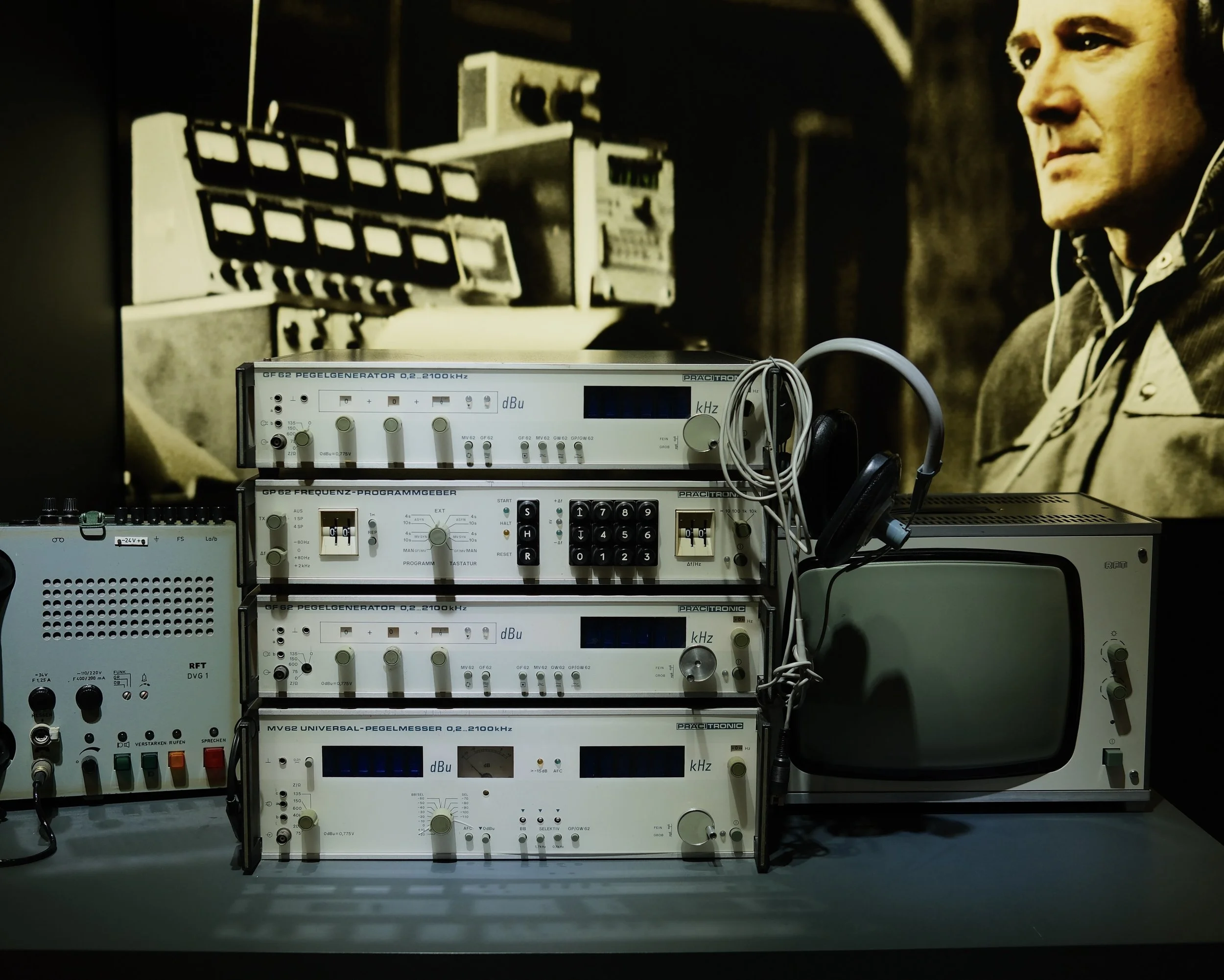
Leipzig, Zeitgeschichtliches Forum, October 2026
Focus Aids, the Eye and the Hand
A manual focus camera is judged on two things: what it shows the eye and what it gives back to the hand.
For the eye, the X100vi is generous. It offers focus peaking, image magnification, a digital split image that takes up the principle of the rangefinder and a microprism borrowed from old SLRs. The M EV1 offers only the first two. A YouTuber who sold his M EV1 to go back to the M11 drew from this a question Leica should hear: if any company should have the best electronic manual focus system in the world, shouldn't it be Leica?
In the field, though, I learned that, at Fujifilm, these aids are not equally useful everywhere. In the small window of the electronic rangefinder (ERF), the split image and the microprism become hard to read. Red focus peaking, at high intensity, stays clear. The same YouTuber complained that the M EV1's peaking lights everything up as soon as you stop down past f/4. In the X100vi's electronic rangefinder, I saw nothing of the kind: from f/2 to f/16, it behaves the same way. For me, it is the one that plays the role of the rangefinder.
For the hand, Leica keeps the advantage. The X100vi's focus ring is electronic: no hard stop, no engraved scale, none of that resistance that lets you know the distance with an M lens before you even look. I have still brought the two gestures closer by setting the ring to respond linearly and reversing its direction of rotation. My X100vi now turns like the 50mm on my Canon P. And lacking an engraved scale, it displays one. I have turned it on in the optical viewfinder only: at the bottom of the window, a distance bar shows the zone that will remain sharp, calculated as on the old film lenses. I don't use it to zone focus, a technique designed for the street and for speed, which isn't mine. Rather, it confirms what focus peaking has already shown me: a second, slower look at the same sharpness.
The day before I left, I added a small slip-on ring with a Leica M style focus tab, 3D printed by 3DPLCanada. It stayed on the lens for the whole trip. Since the X100vi's ring has no hard stop, the tab has to be realigned with the distance every time the camera is turned back on, and I often forgot. It didn't matter: most of my focusing took only a small turn, and focus peaking did the rest. Above all, it helps me find the ring without looking, and it gives the X100vi a lovely look. Pleasant, then, but not essential.
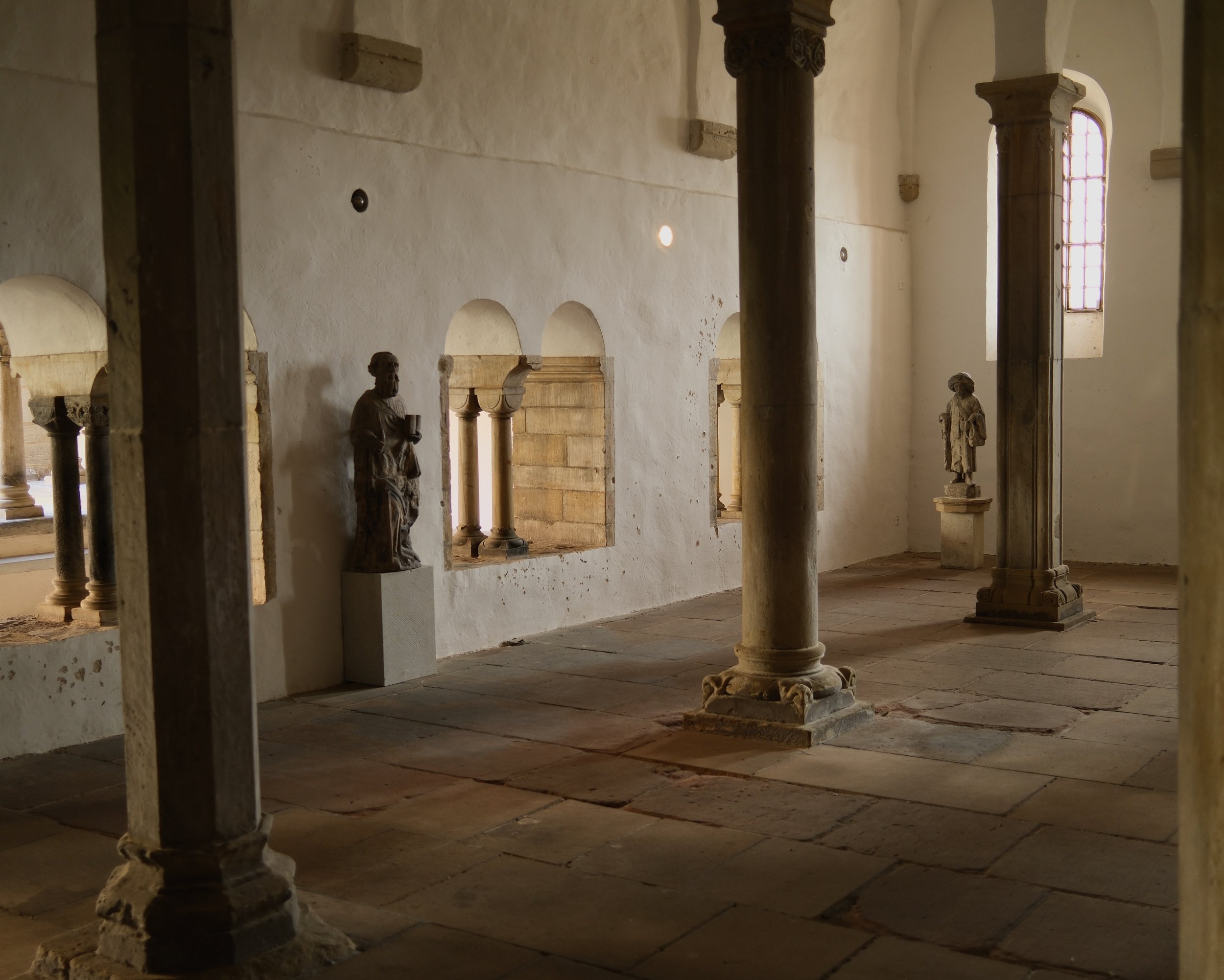
Magdeburg, Monastery of Our Lady (Kloster Unser Lieben Frauen), October 2026
Those Who Opened the Way
Others opened this path before me, and I owe it to them to say so.
In 2020, Steven Bleistein was trying to recover, on his X100F, the gesture of his Leica M3. He had reversed the direction of the ring, as I did, and had also stuck a small tab on it so he could handle it like an M lens. The optical viewfinder, on the other hand, struck him as "more of a novelty," "a lot of fun and not really that important." He worked with the electronic viewfinder and preferred shooting RAW over using film simulations.
In 2023, Honza Pokorný did almost the opposite. He used his X100V as a film camera: optical viewfinder only, image review turned off, autofocus disabled and a recipe borrowed from Fuji X Weekly. He went as far as using tiny memory cards, each just large enough to hold the equivalent of a thirty-six-exposure roll.
One kept the gesture and gave up the viewfinder. The other kept the viewfinder and imitated film.
I found nowhere an approach that brings the two together: the optical viewfinder and the rangefinder's gesture, in the service of a recipe of one's own making and of a photography that seeks slowness rather than the imitation of film. That third way is what I'm proposing.
The Protocol
Before heading out, I choose the recipe. It won't change for the rest of the day, like the film you load before leaving. Then I flip the lever to the optical viewfinder and turn on the electronic rangefinder in magnified view, so that it shows only the focus area.
I switch to manual focus. In that small window, focus peaking, set to red at high intensity, tells me what is sharp. I've placed it in the Q Menu so I can change it without searching. The ring responds linearly and turns in the same direction as my film lenses.
Aperture, shutter speed and ISO stay on automatic. The friction I'm after concerns seeing and focusing, not exposure.
Should the subject move too fast, my thumb would then push the selector, and autofocus would take over.
I've set the display so that only the viewfinder lights up, the moment my eye comes near it. The rear screen stays off. After the shot, the image appears for a moment in the small window in the corner, without the optical view disappearing. Later, when I want to look at it more carefully, I press the playback button. Not to check sharpness, but to see whether the framing holds and whether the people are at their best.
From Dresden to Magdeburg, by way of Glashütte, Leipzig, Erfurt and Weimar, I followed this protocol for more than six hundred photographs. Autofocus stayed under my thumb. It was never used.
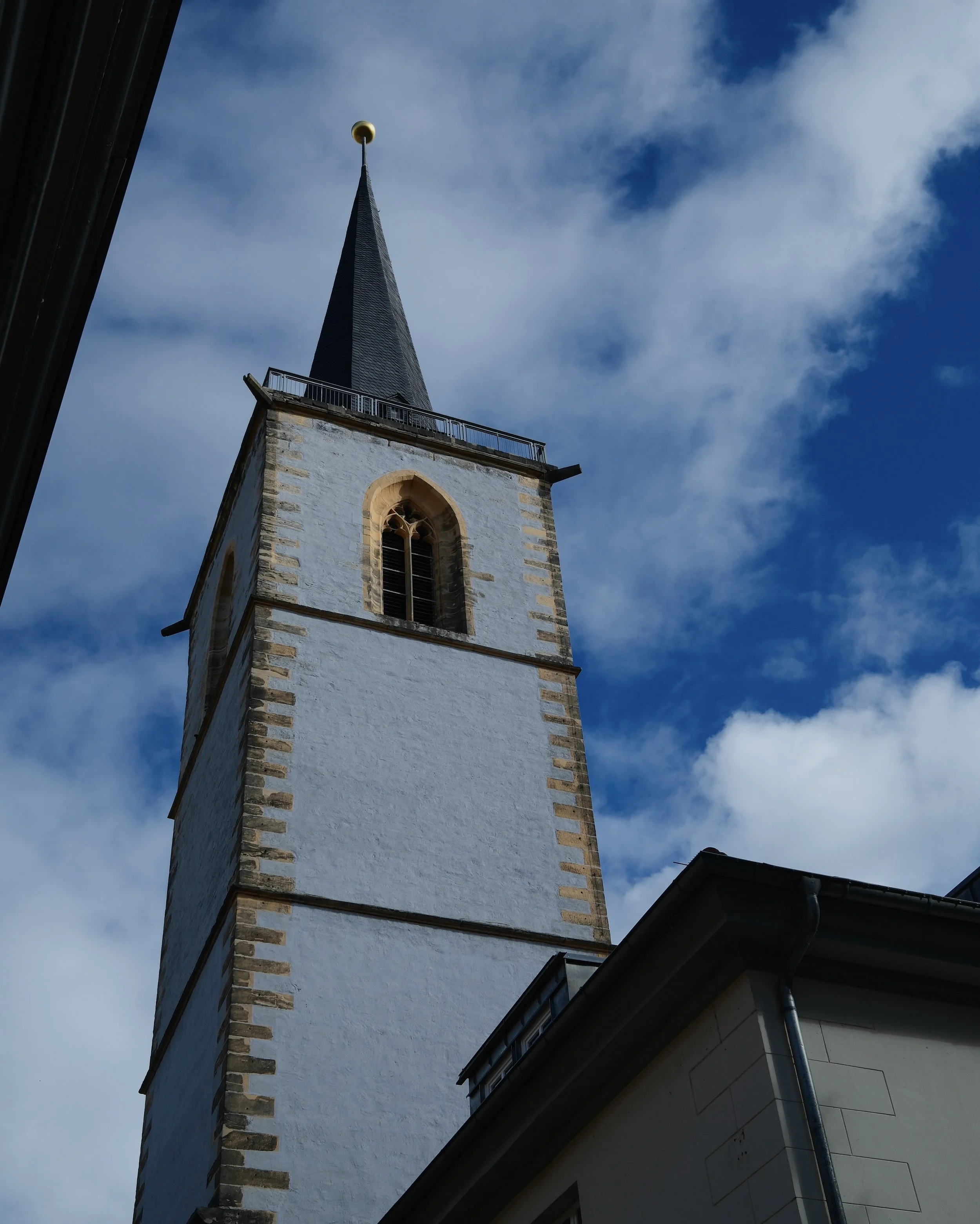
Erfurt, St. Nicholas Tower (Nikolaiturm), October 2026
The Invisible Recipe
An attentive reader of this blog might point out a contradiction. I wrote that I had left my conversion lenses at home because they added a friction that broke the thread of attention. And here I am deliberately seeking the friction of an optical viewfinder.
The difference lies in the direction of one's gaze. Screwing on a conversion lens means leaving the scene to attend to the camera. Composing through a glass window is the opposite: you leave the screen to return to the scene. The first friction takes you away from the world. The second brings you back to it.
It has another, quieter consequence: in the optical viewfinder, you don't see the recipe. You see the light as it is, not as the photograph will render it. The electronic viewfinder can offer the same thing, with Natural Live View, which shows the scene without the recipe. The optical viewfinder does it without anything to set. I wrote that a recipe is not an intervention in the moment, but a choice of instrument. In the OVF, this is no longer an idea: it is an experience. You choose the recipe before heading out, then you trust it, as you would a roll of film.
Still, I don't borrow everything from the rangefinder. On an M11, the aperture is always set by hand. On my X100vi, it stays automatic. I keep from the rangefinder what serves attention, and nothing more.
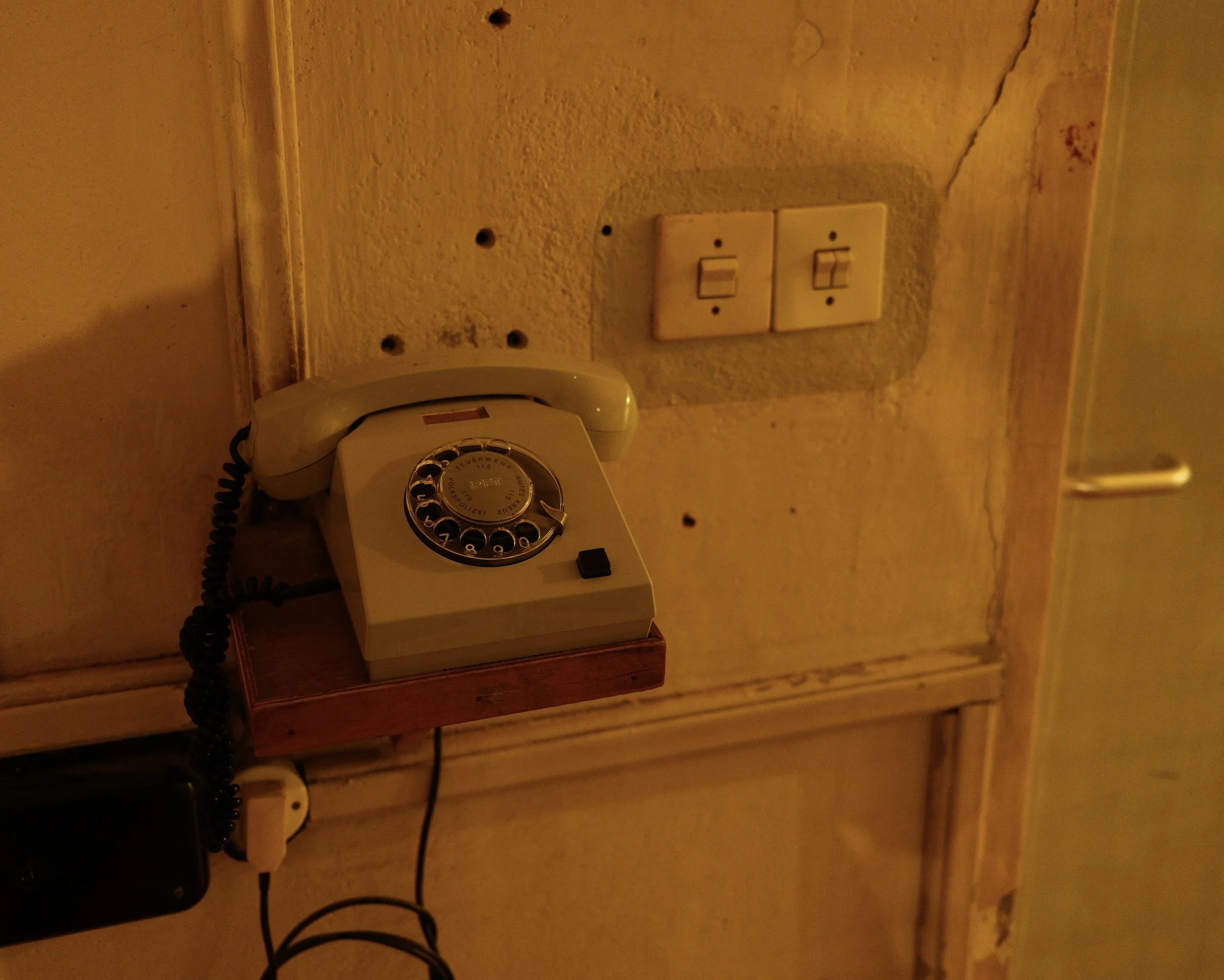
Dresden, former Stasi prison (Gedenkstätte Bautzner Straße), October 2026
What Each Does Better When It Comes to Focus
When it comes to focus, the M11 offers the certainty of the gesture, and the X100vi, flexibility.
Certainty is a larger, brighter viewfinder, a rangefinder mechanically linked to the lens, and a ring whose every distance the hand eventually learns. With an M, you can zone focus without even raising the camera.
Flexibility is an electronic rangefinder that shows what the sensor sees, and so avoids the small errors of focusing at the center and then recomposing, which reviews of the M11 sometimes point out at wide apertures. It is a focus point you can place anywhere in the frame, an electronic viewfinder for close subjects, and, if the subject refuses to wait, autofocus under the thumb.
Neither camera makes the other useless. They simply don't answer the same question.
A Friction You Choose
Gerard Needham loves the ritual of his M11. Alex Cooke, whom I've quoted before on this blog, reported his experience: every turn of the focus ring felt like a conversation with the camera. And yet, when traveling, it was a Fujifilm he ended up taking along.
That may be the best explanation for the X100vi's success. The M11 imposes friction. The M EV1 removes it. The X100vi offers it. It forces no one to slow down, but it allows it, and slowness holds up better when it remains a choice.
One day, perhaps, an X-Pro4 will take the idea further. Cooke puts forward the hypothesis that the X100vi's success, by tying up its viewfinder, is delaying that successor. If it comes, the manual lenses of the X mount would bring the gesture closer to that of an M, without quite matching it, since the optical viewfinder would still not be linked to the lens.
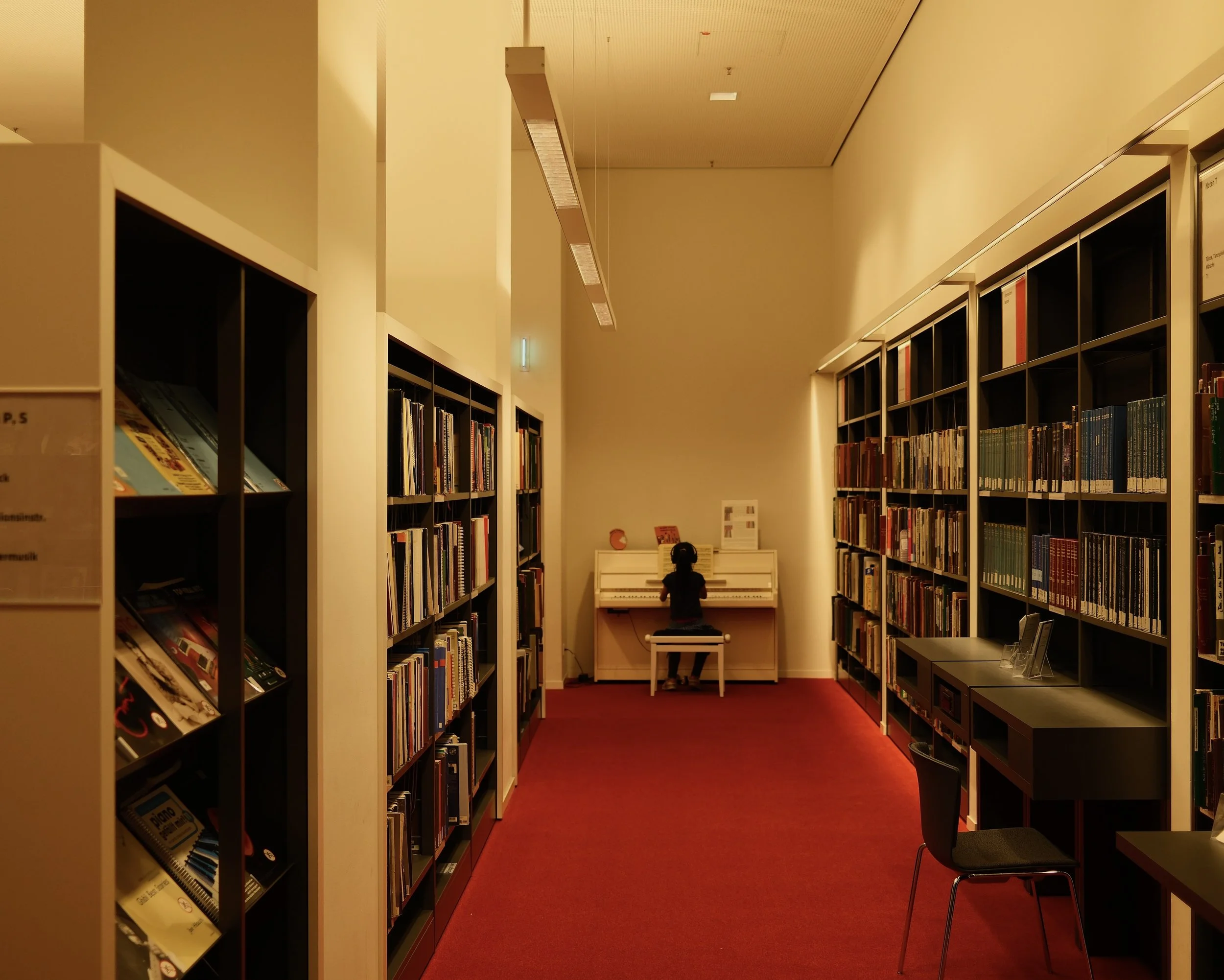
Dresden, Kulturpalast library, October 2026
In the meantime, I go on seeing beside. The lens cap is in my pocket, Beth is finally asleep, and the recipe is waiting for me somewhere I can't see.
Two weeks ago, I wrote that I was going to slow down and that I didn't know what would come next. This post is its first step. I still don't know what comes next. But I now know through which window I'll watch it come.
— Louis-Martin Ouellet
The photographs in this post were all made with the same recipe. Its turn will come next week.
This blog's twelve recipes, the seven CW and the five NS, all live in the Recipe Cellar, a space where they simply wait to be discovered.
This blog's four technical posts are gathered together in X-Trans V in Detail, for anyone who'd like to read them straight through.