
CW – Typ 113
A recipe born from borrowed light
My brother owns a cemetery of cameras.
That is how he describes it himself, a shelf in a closet stacked with cameras he acquired with enthusiasm and abandoned with relative speed. He is the kind of person who buys the latest thing, and loses interest as soon as something more practical and functional comes along. His current camera is a Fujifilm X100vi. His previous one sits in the dark, waiting.
The Leica X Typ 113 is a 2014 camera. It has a fixed 23mm f/1.7 Summilux lens — equivalent to 35mm in full frame — a menu system so minimal it borders on spartan, and an autofocus that takes its time. By my brother's standards, it felt limiting to him. By mine, it turned out to be something else entirely.
I asked him if I could borrow it. He accepted without hesitation and with the quiet generosity of someone who knows that objects are made to be used.
What the Typ 113 does
The Leica X Typ 113 produces images with a character that is difficult to name precisely but easy to recognize. Colors are slightly less saturated than modern digital cameras tend toward. Skin tones are extraordinarily natural. Contrast is moderate, supported by blacks that are rich without being crushed. Highlights roll off gradually, almost reluctantly, they give up their detail slowly and gracefully.
The Summilux f/1.7 lens gives the camera an exceptional ability to render out-of-focus areas with a warmth and smoothness that faster modern lenses often lack.
There is no trick to it. No film simulation engine, no recipe system and no layers of computational processing. It is simply a sensor — the Leica-tuned version of a 16MP APS-C — rendering light the way Leica intended it to be rendered. Gently. Honestly. With a kind of depth that modern cameras, for all their technical superiority, often struggle to replicate.
The camera's limitations — the slow autofocus, the minimal menu, the absence of in-body stabilization — turned out to be irrelevant to how I photograph. I work slowly. I think before I shoot. I do not need speed. I needed exactly what the Typ 113 was offering.
Fearing the day my brother might remember he lent it to me, I started asking a different question: could I make my X100vi render images that felt like this?

The moment that changed everything
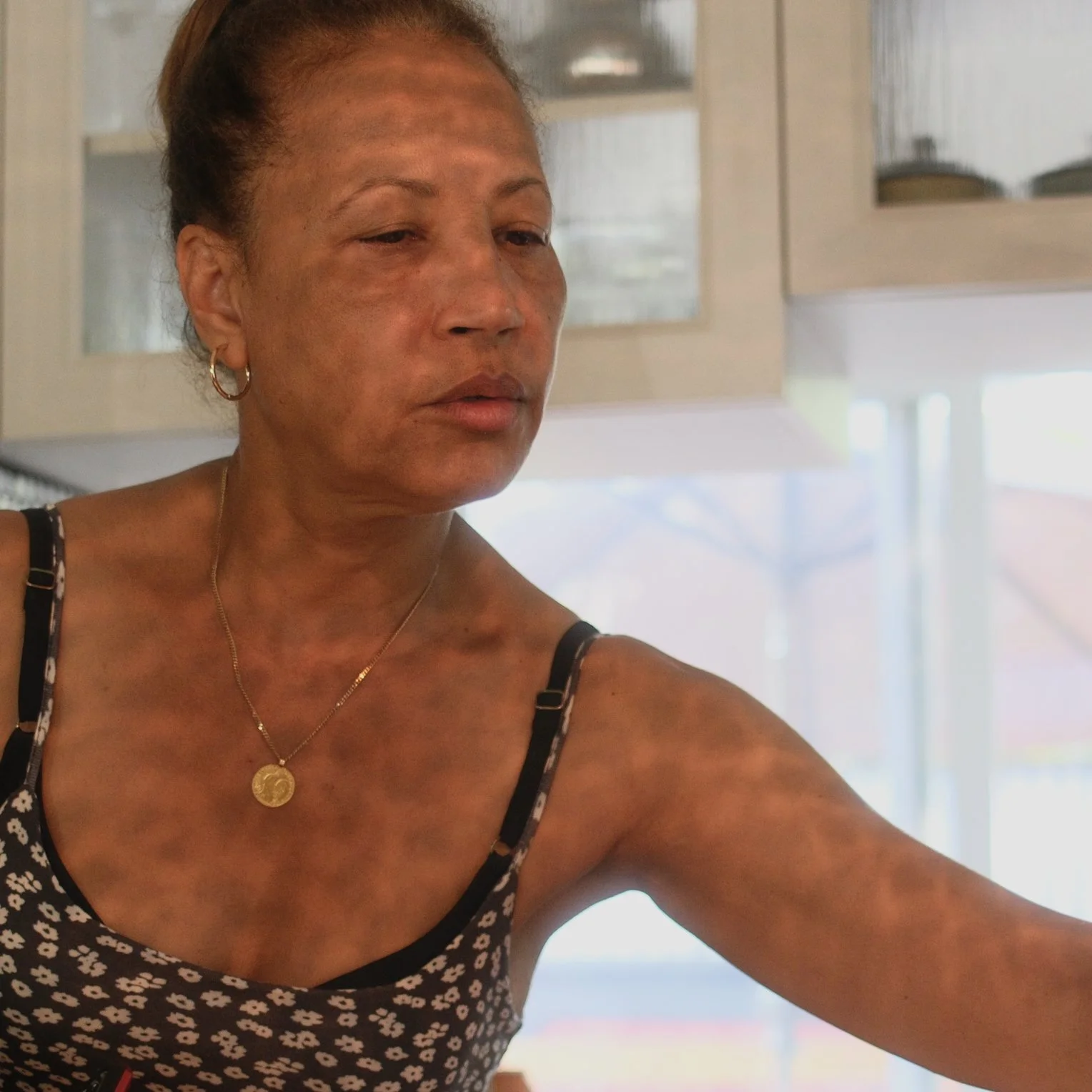
It was late afternoon, a few days after the family oyster gathering. The light was fading behind me, coming through the windows in that particular way it does near the end of the day, soft, directional, slightly warm, not quite golden but close. I photographed my wife standing in the living room, the Christmas lights on the mantle glowing softly behind her, a wreath catching the last of the day.
When I looked at the image, I stopped.
The skin tones were unlike anything my X100vi had produced. Natural in a way that felt almost analogue, not processed, not optimized, just honest. The colors around her were slightly less saturated than what I was used to seeing, which somehow made everything feel more real. The highlights rolled off gently toward the Christmas lights. The shadows held their detail without effort. The image was quiet and warm and entirely itself.
I stood there thinking: this sixteen-megapixel camera from 2014 is making images that move me more than my brand-new forty-megapixel camera. I began, briefly, to question everything.
Building the recipe
CW – Typ 113 is my answer to that question. It will never be a perfect replica. No recipe can reproduce what happens at the hardware level of a different sensor. But it comes closer than I expected and it does something the original cannot: it runs on a camera I own without anxiety.
Reala Ace was the natural base simulation. Of all Fujifilm's color simulations, it is the most oriented toward natural, organic color reproduction, less stylized than Classic Chrome, less neutral than Provia, with a quality of light transmission that feels closest to the gentle rendering of the Typ 113.
Highlight –2 is the most significant departure from my foundational recipes. Where CW – Simple Standard lifts highlights to +2 for an open, airy feel, this recipe pulls them back hard. The Typ 113's highlight rolloff is one of its defining characteristics, gradual, soft, never harsh.
Sharpness –1 softens the rendering slightly, the Typ 113 is precise but never clinical.
Clarity –2 reduces local contrast, contributing to the organic, film-like quality that makes the Typ 113's files feel less digital than they technically are.
Color Chrome Effect: Weak adds a subtle microcontrast in saturated areas without pushing the image toward more aggressive rendering.
High ISO NR –4 preserves texture and natural grain at higher ISOs, the Typ 113's sensor has a characteristic texture at elevated ISO that is part of its character, not a flaw to be corrected.
White Balance Auto with R+2 / B–3 introduces a gentle warm shift, more restrained than in the foundational recipes, calibrated to the Typ 113's slightly warmer native rendering.
Full settings
- Film Simulation: Reala Ace
- Dynamic Range: DR400
- Grain Effect: Off
- Color Chrome Effect: Weak
- Color Chrome Blue: Off
- White Balance: Auto, R+2 / B–3
- Highlight: –2
- Shadow: 0
- Color: 0
- Sharpness: –1
- High ISO NR: –4
- Clarity: –2
- ISO: Auto, 500 to 3200
- Exposure Compensation: +1/3
When to use it
CW – Typ 113 performs best in soft, diffused light, window light, overcast skies and the gentle illumination of late afternoon. It is particularly well suited to portraits and environmental shots where natural skin tone rendering matters more than technical perfection.
It is not a recipe for harsh midday sun or high-contrast scenes. Like the camera that inspired it, it works best when the light is kind.
I still have the Typ 113. My brother has not asked for it back.
I hope he forgets he lent it to me.