
NS – Céladon, or how a recipe is born differently
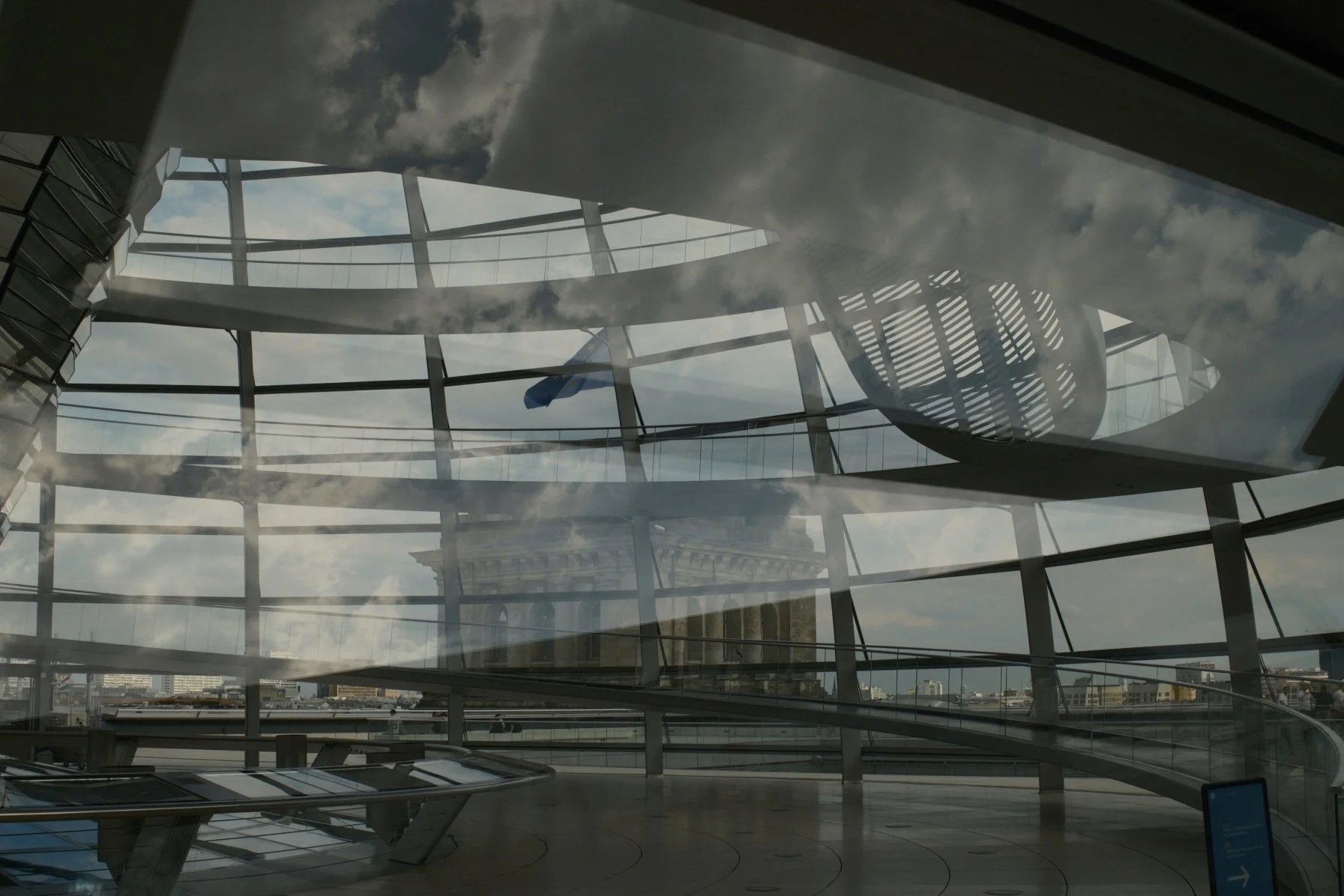
The Reichstag dome in Berlin.
A colour that waited
A few weeks ago, in Hamburg, my wife stopped in front of a cup. Not for the coffee it held, though that was why we were there, but for its colour. That pale, slightly milky blue-green, neither quite blue nor quite green but something in between. A colour that has a name: céladon.
We talked about it that evening. And in the days that followed, I noticed that something had quietly settled into my way of seeing.
Some time later, scrolling through images on social media, I came across a series of photographs that held my attention. Indoor pools, pale stone, filtered light and that same colour, everywhere, in the water, in the reflections and in the shadows. The author of the post mentioned a Lightroom preset. I looked at those images for a long time and thought: could a SOOC recipe do that?
That isn't usually how my recipes are born. Normally, a recipe is a decision made before the trip, before the light, before the subject. An instrument chosen for what one senses about a situation. NS – Céladon was born differently: from a colour glimpsed in a cup and found again on a screen, and from a question posed to the camera before a single frame had been taken.
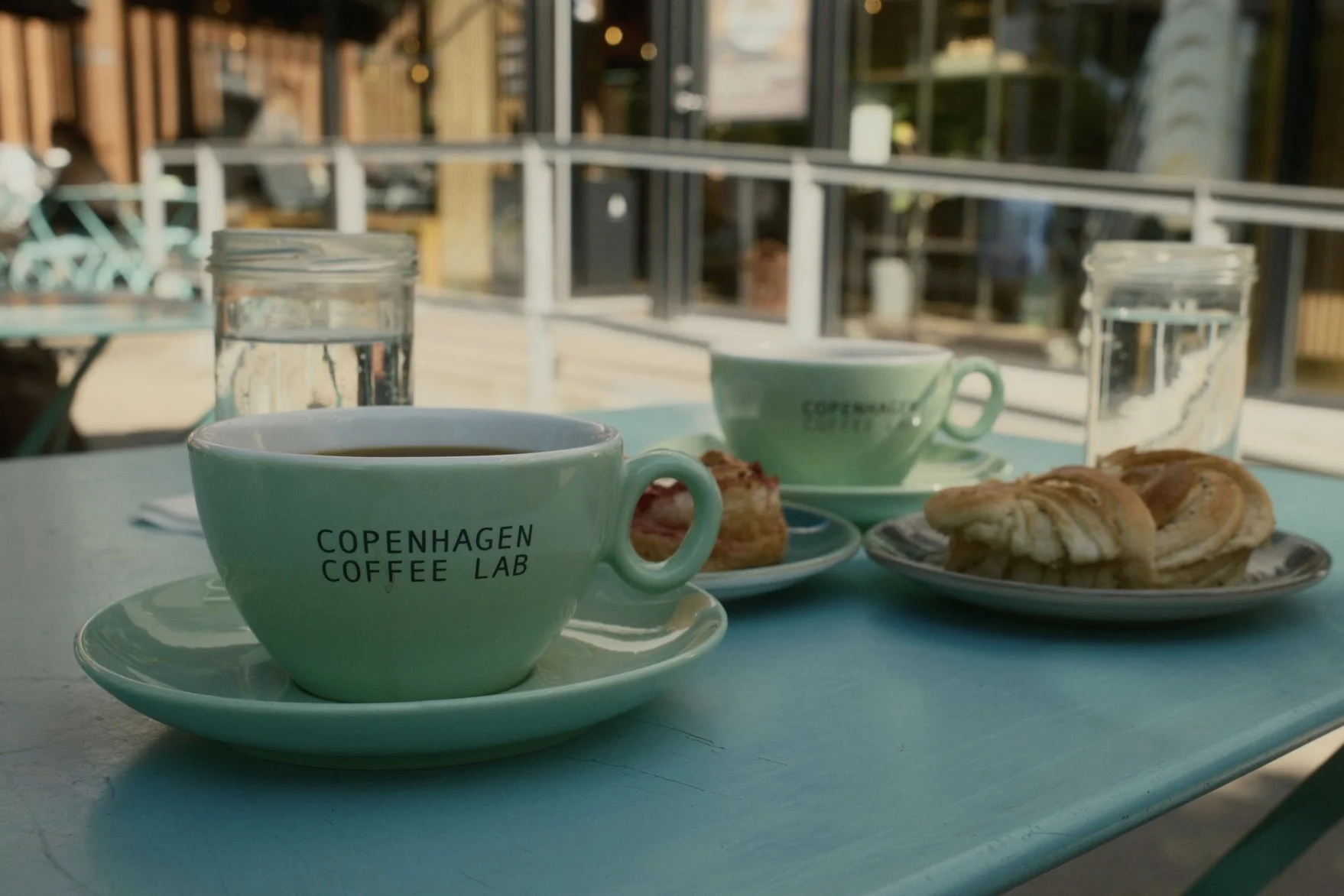
The cup that inspired the recipe.
The NS family and why Nostalgic Neg.
The CW series contains seven recipes. It is complete, seven was the right number, and I wrote about that in the afterword. But seven custom settings also means seven film simulations used among those the X100vi offers. Nostalgic Neg. is among the simulations that didn't make it in.
Nostalgic Neg. is a demanding simulation, one that requires precise conditions to give its best. I hadn't found the right context for it in the CW series. But I didn't want to leave it aside indefinitely either.
That is where the camera's Nothing Selected slot comes in. If you aren't familiar with that space, I wrote about it in an earlier post and it's worth a detour. In my practice, that slot can hold my own exploratory recipes or recipes developed by others that I want to test in my own light.
NS – Céladon is the first recipe in this family. NS for Nothing Selected, the space where it can temporarily reside. Nostalgic Neg. was the natural first candidate.
This is not an eighth CW recipe. It is something else, a way of exploring what the series didn't cover, without forcing the frame of what is already complete.
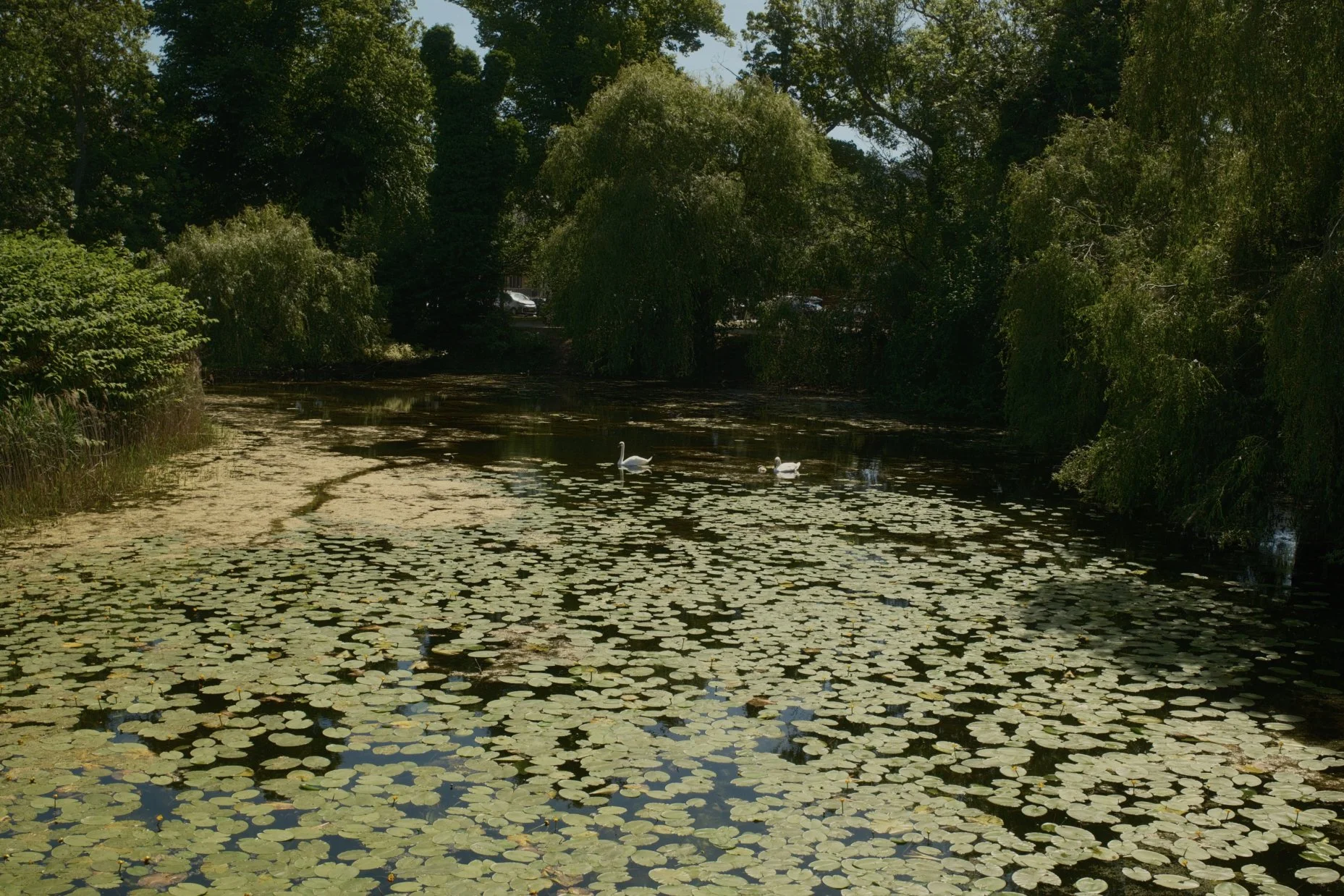
A pond near the Kastelet in Copenhagen.
Building NS – Céladon
The recipe came together fairly quickly. The objective was clear: to achieve in SOOC that aquatic aesthetic I had seen in post-processing. Warm and restrained skin tones, water that pulls toward blue-green, soft highlights and shadows that don't collapse.
Nostalgic Neg. has a natural tendency toward warm tones and a particular way of handling low light. To bring out that blue in the water and reflections, I needed to push the white balance firmly toward blue, with a shift of R+2 and B–5. Dynamic range at DR400 with highlights at –2 ensures that softness in the bright areas. Color Chrome Effect set to Strong holds the colours without oversaturating them, and noise reduction at –4 preserves the natural texture of the image.
The Clarity at 0 deserves a note. On the X100vi, I use a K&F Black Mist 1/8 filter almost permanently. That filter already introduces a slight diffusion in the highlights. Bringing Clarity below zero would have produced a result that was too soft. Zero is the right balance. If you don't have a Black Mist filter, I suggest bringing Clarity down to –2.
The minimum ISO of 500 is required by DR400, which needs a sensitivity threshold to function correctly.
Here are the full settings:
| Parameter | Value |
| Film Simulation | Nostalgic Neg. |
| Dynamic Range | DR400 |
| Grain Effect | Weak / Small |
| Color Chrome Effect | Strong |
| Color Chrome FX Blue | Weak |
| Highlight | –2 |
| Shadow | –1 |
| Color | –2 |
| Sharpness | –1 |
| Clarity | 0 with Black Mist filter / –2 without |
| Noise Reduction | –4 |
| White Balance | Daylight |
| WB Shift | R +2 / B –5 |
| ISO | Auto — 500 to 3200 |
| Exposure Compensation | 0 to –1/3 EV |
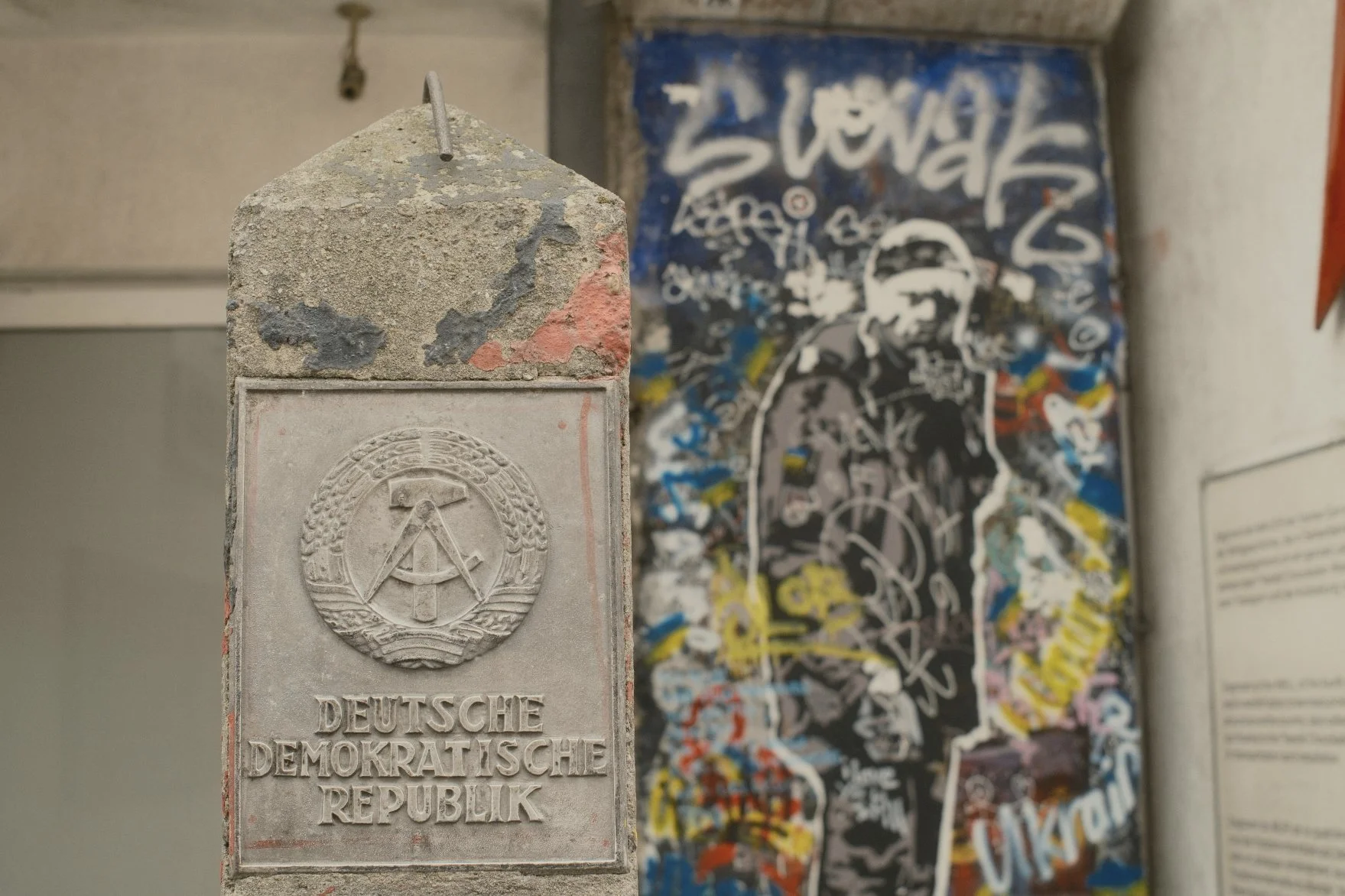
Relics of the former GDR.
The regret of Potsdam
Two days after Hamburg, we spent a day in Potsdam.
Sanssouci. The park, the fountains, the June light on golden stone, the lakes reflecting the sky. The Dutch Quarter with its red brick facades and quiet streets. I photographed that day with another recipe, and I don't regret the images I made. But something had been accumulating since Hamburg: that colour in a cup, those images seen on social media, and now these reflections in the water at Potsdam, this light filtered through leaves and this pale stone under the afternoon sun.
It is a feeling that photographers who work with recipes chosen in advance know well: seeing with a recipe that doesn't exist yet. Potsdam was the final trigger.
That evening, back in Berlin, I built NS – Céladon and loaded it into the Nothing Selected slot of the X100vi.
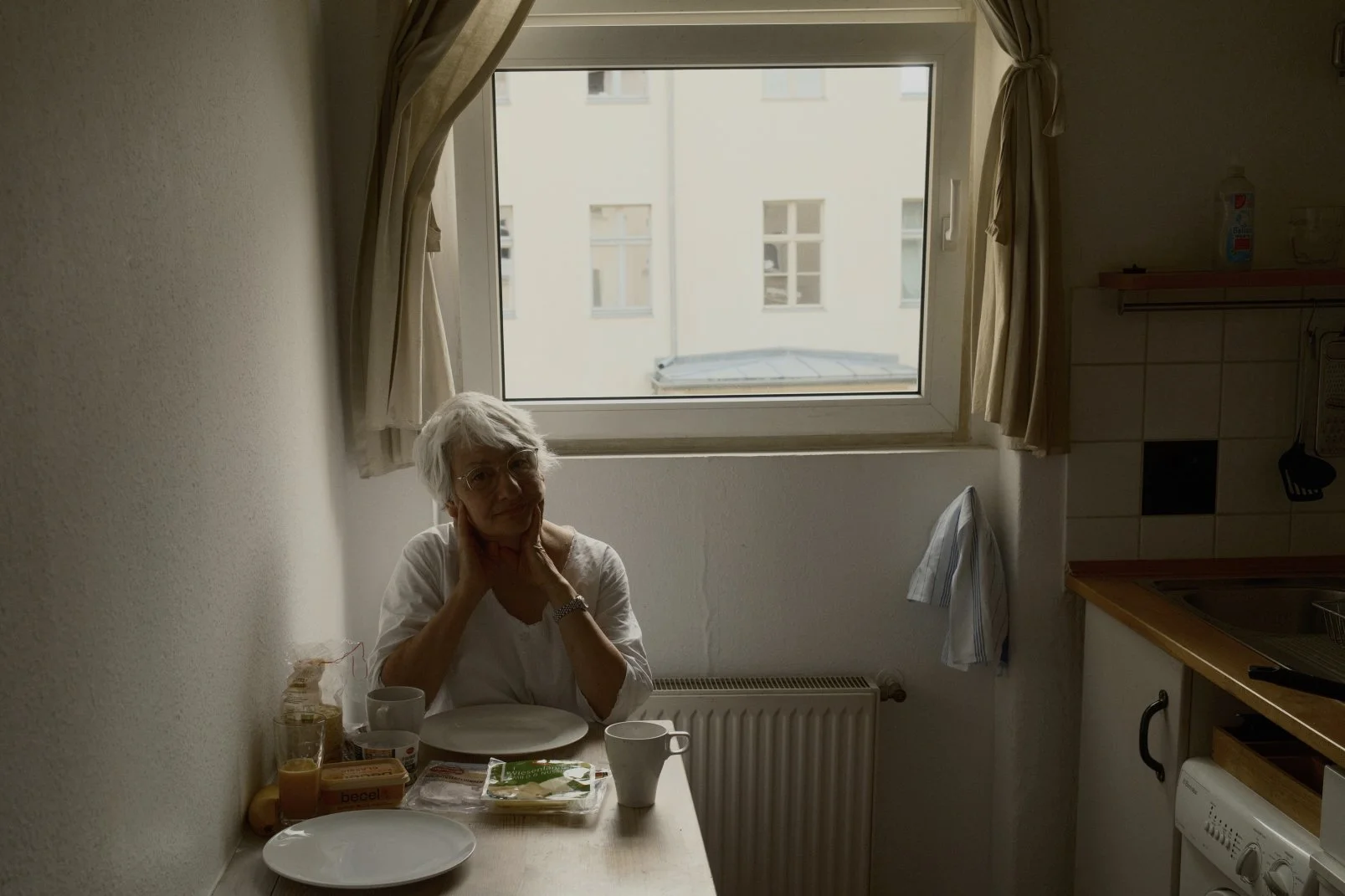
Breakfast in our Berlin accommodation.
Berlin with NS – Céladon
The next morning, the recipe was in the camera. Berlin was going to be its first testing ground.
The day covered a lot of territory: the Tiergarten, the Bundestag dome, Checkpoint Charlie, the area around the Brandenburg Gate and the Spree. Very different light, very different subjects. It was, without having planned it, a fairly complete test.
A few honest observations, in the order they presented themselves.
In diffuse light and under an overcast sky, NS – Céladon does not produce the blue-green aquatic quality one might expect. On the Spree that morning, the water was a dense, deep green, almost neutral. That isn't a flaw. It is information: the recipe needs direct light or active reflections to reveal its characteristic colour.
In direct light, the response is entirely different. Skies open up, bodies of water come alive and the blue appears where one expected it. The Tiergarten under a partly clear sky produced images very different from those of the Spree that morning.
Skin tones are consistently warm and restrained, regardless of lighting conditions. A portrait taken at the breakfast table, in window light, surprised me with its softness. NS – Céladon handles interiors with an elegance I hadn't anticipated.
In backlight, with warm late afternoon sun, the recipe holds well. Exterior highlights don't blow out and silhouettes retain their texture.
And then there was a surprise I hadn't anticipated. Near the Brandenburg Gate, on an adjacent building, Quebec flags were flying from a facade. The Quebec Government Office in Berlin. The camera didn't know what to make of that geographical coincidence. Neither did I.
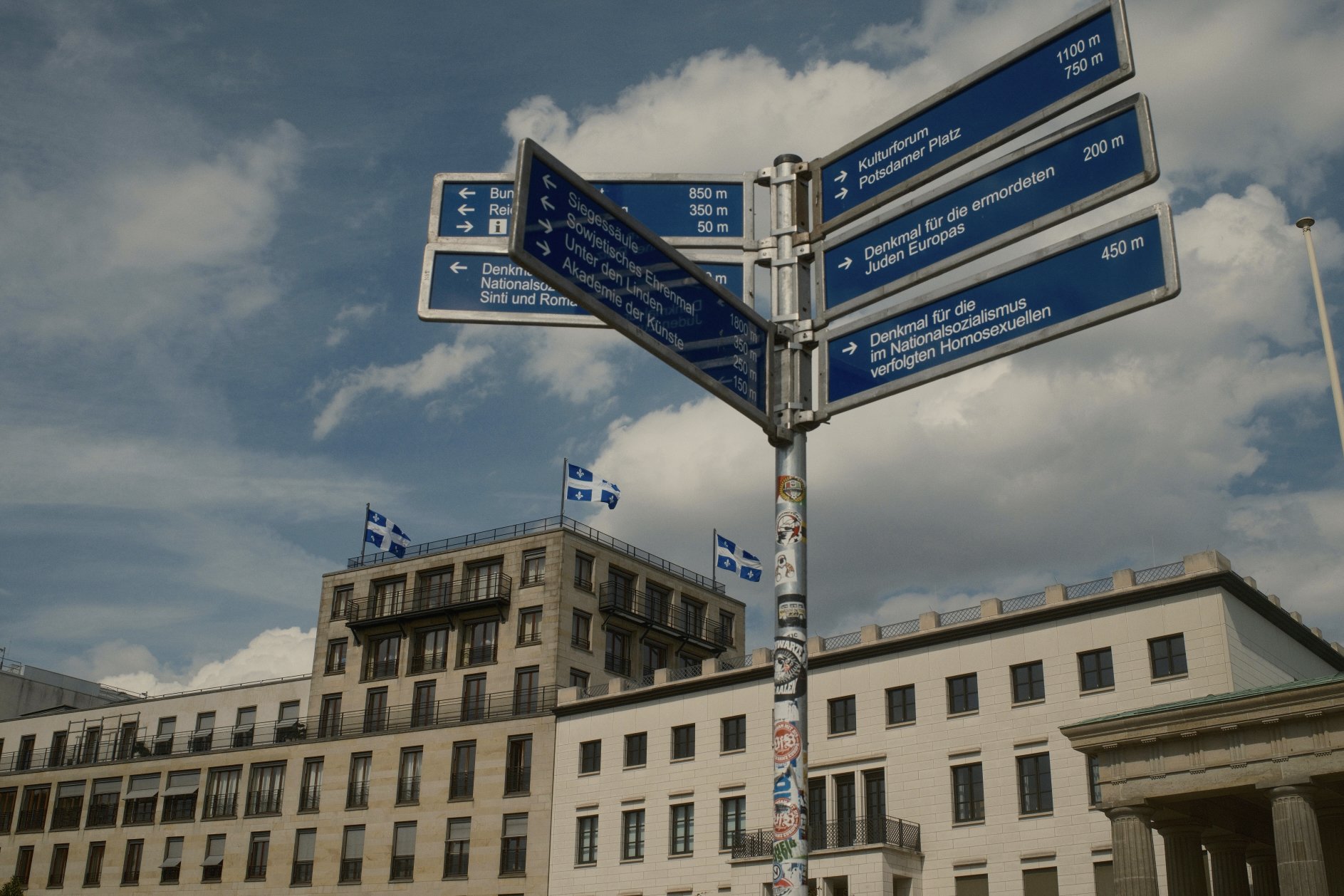
Quebec, very much present in Berlin.
Aarhus and Copenhagen
The journey continued. NS – Céladon stayed in the camera.
In Aarhus, at ARoS, I photographed two works under conditions I couldn't have anticipated. Olafur Eliasson's Your Rainbow Panorama, that circular corridor of coloured glass at the top of the museum, produced something unexpected: NS – Céladon transformed what the eye was seeing into something else, an image that was not a faithful reproduction of the experience but an interpretation of its own. The blue-violet of the recipe blended with the warm orange of the tinted glass to produce a sunrise light over the city of Aarhus. That wasn't what I had in front of me. It was what the camera decided to do with it.
I also photographed inside James Turrell's Skyspace, inaugurated the day before. The calibrated artificial light of that installation produced warm, soft colour casts I hadn't expected. NS – Céladon under coloured artificial light is a subject in itself, and one I will return to in the next post.
In Copenhagen, the light was finally what the recipe had been waiting for since Berlin: direct, clear, under an open sky. Bodies of water revealed that characteristic blue-green that the overcast Spree had not been able to show. And I found, at a Copenhagen Coffee Lab, the cups that had started everything back in Hamburg. I photographed them with NS – Céladon. The circle was complete.
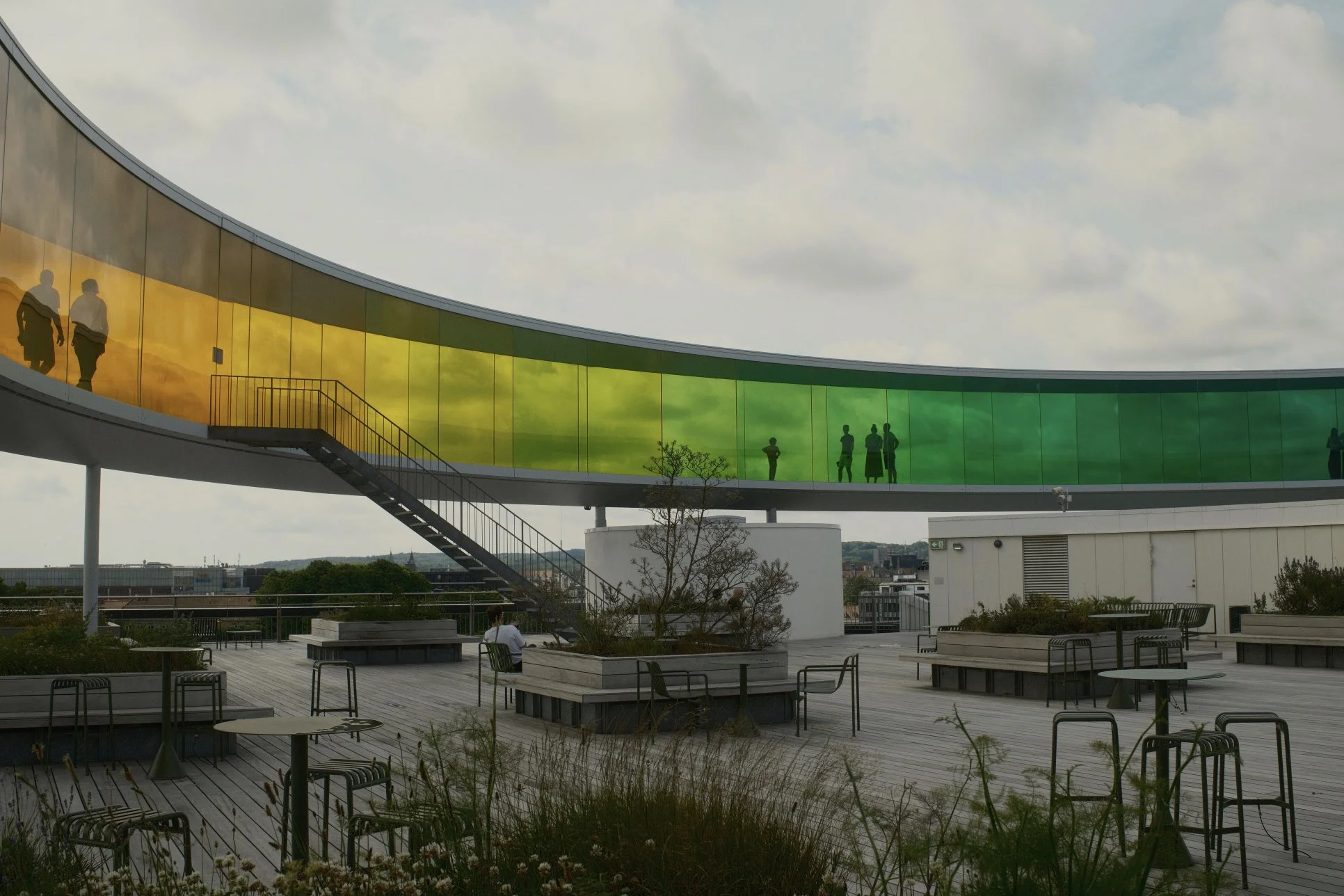
Your Rainbow Panorama seen from outside.
What NS – Céladon announces
A recipe is never a guarantee. It is a hypothesis about light, made before pressing the shutter. NS – Céladon was born from a colour glimpsed in a cup, shaped by images seen on a screen and confirmed over several days in Germany and Denmark. It has its preferred conditions and its honest limits.
What Quebec light in full summer will do with it, I don't yet know. The light of June and July is direct, often overhead. It has none of the Nordic softness of Aarhus nor the oblique light of Berlin at the end of the day. If something different emerges, I will come back to it in a future post.
What it announces above all is the NS family. Other recipes may follow. The Nothing Selected slot is small, but it is available.
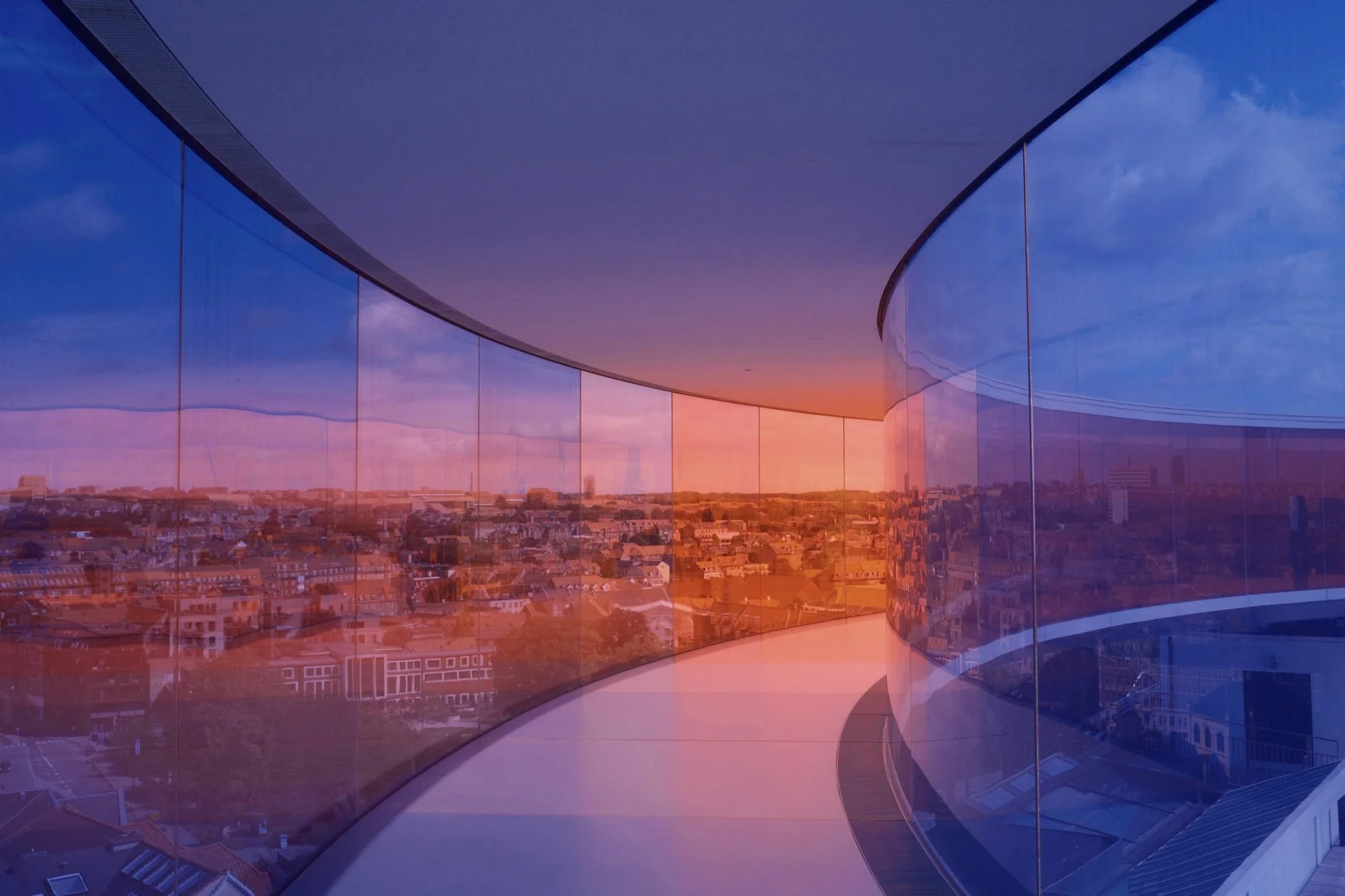
Your Rainbow Panorama seen from inside.
Encore
The journey was over. The images from Berlin, Potsdam, Aarhus and Copenhagen were in the camera. NS – Céladon had proven itself over several days and in very different light. It was time to go home.
A few days after returning, my brother invited me to Rôtisserie La Lune, in Little Italy. A belated birthday dinner, I had been in Hamburg on the day itself. Rôtisserie La Lune is a recent address, opened in December 2024 by the team behind Mon Lapin, awarded a Michelin Bib Gourmand in 2025 and among the highest-ranked newcomers on Canada's 100 Best list in 2026. A reimagined Québécois rotisserie, in a warm room with dark wood panelling, free-range poultry slowly turning on the spit and a carefully chosen wine list.
I had the X100vi with me. NS – Céladon was in the camera.
My brother is the owner of the Leica X Typ 113, that camera nobody looks at, which I wrote about in an earlier post. It is its particular rendering — natural skin tones, softness in the highlights and a tonal quality that is difficult to name but immediately recognisable — that led me to build the three recipes in the CW series paying tribute to Leica cameras. And it is the accumulation of those recipes that justified lucelenta.art. He didn't quite know it yet that evening, or perhaps he was beginning to sense it. We talked about the site. He let me know that his loan would be a long one.
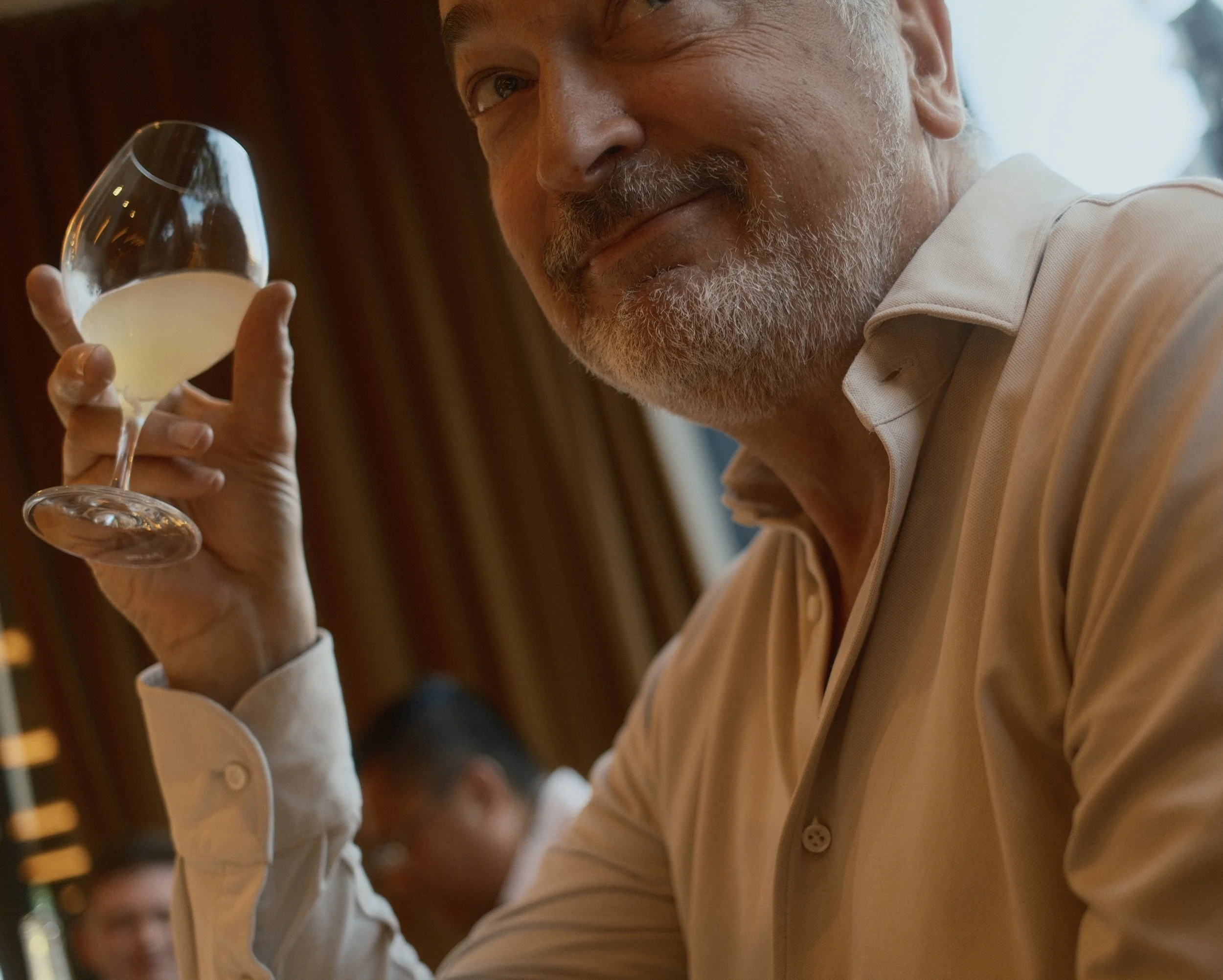
My brother holding a glass of Chardo Disco, a wine produced by Les Sœurs Racines in Saint-Ignace-de-Stanbridge, Québec.
The room at Rôtisserie La Lune is exactly the kind of environment where NS – Céladon should not perform: warm, dim artificial light, no direct source and no active reflections on water. Yet the skin tones held, warm and restrained, and the room settled into a rich amber I hadn't anticipated. A portrait of my brother, a glass of white wine raised, the dark wood of the room behind him. And an image of my table seen from table level, my wife in the depth of the frame, the room's points of light in bokeh behind her, a glass in the foreground. Two very different ways of photographing the same meal, with the same recipe.
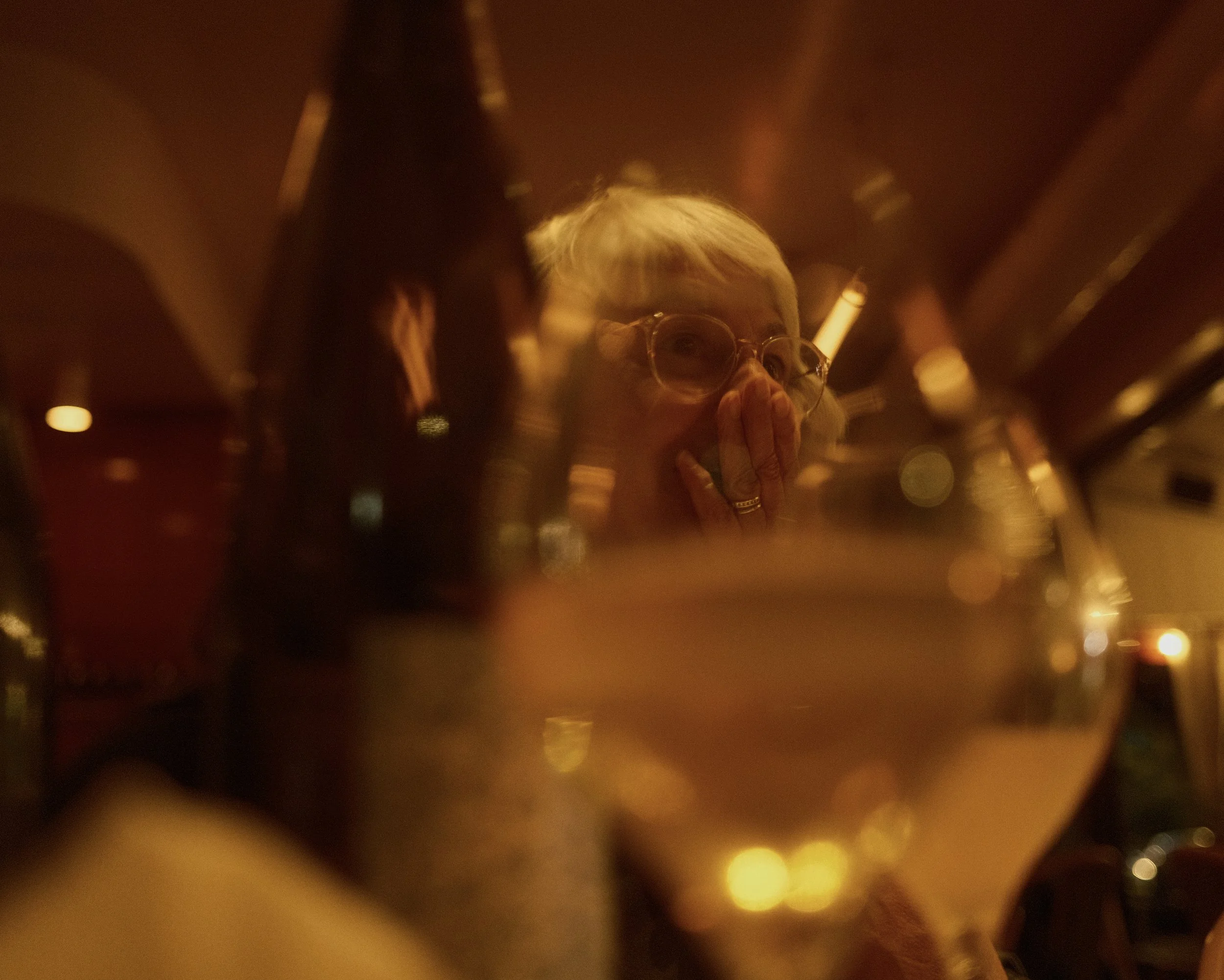
A true table photograph that does not document, but restores the atmosphere.
An encore, then. Not to add something to the journey. To confirm that NS – Céladon also works where one least expects it.
If you try NS – Céladon, I would be curious to know what it does with your light. And if a colour glimpsed somewhere, an image seen in passing, has ever led you to build a recipe in a similar way, write to me in the comments. I read everything and I reply.
- Louis-Martin Ouellet
All photographs in this post are SOOC — NS – Céladon settings.