
One Camera. One Focal Length.
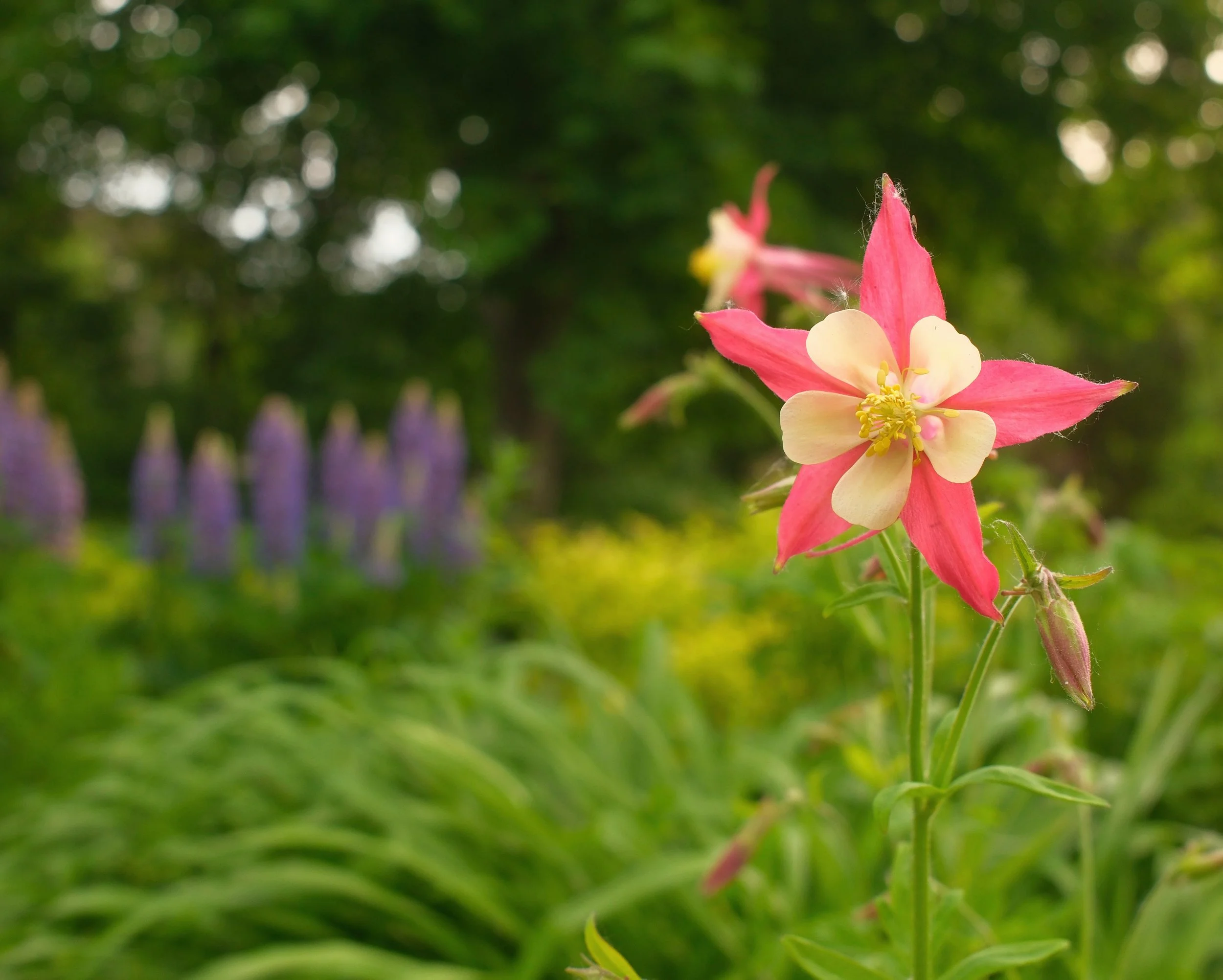
A pink and cream columbine with lupins in the background (CW - Simple Standard film recipe)
The question of which camera to bring no longer arises. The X100vi is the only one I carry, and its fixed 23mm lens is the only one I have. In that sense, part of the dilemma that many photographers face is foreign to me, but the dilemma does not disappear entirely. It shifts and becomes more subtle.
Even with a single camera and a single focal length, questions remain. Do I bring my conversion lenses? Do I travel only with my usual recipes, or do I leave room for experimentation? And more deeply: do I trust what I have already become as a photographer?
The Open Suitcase
For the photographer who owns several lenses, this moment can be wrenching. What unfolds before the open suitcase is not a simple question of optimization. It is a decision that shapes the kind of photographs one will make, the number of images one will produce and the opportunities one will inevitably miss.
One does not photograph the same way when travelling light as when travelling heavy, and the images one does not take define a style as much as the ones one does.
Focal Length and Photographic Identity
There is no wrong answer to the question of focal length. There are only answers that correspond more or less to who one is.
The wide angle places the photographer inside the scene. It embraces, it includes. It is the focal length of immersion, of the one who wants to be in the world being photographed rather than observing it from a chosen distance. The normal focal length sees approximately as the human eye does, without dramatizing. It is the focal length of conversation, of daily life observed in its quiet truth. The telephoto compresses planes, isolates and allows discreet observation from one step back.
Each of these focal lengths says something about the identity of the photographer, about the way one inhabits the space and time of a photographic outing.
The Focal Length That Found Me
I did not choose the 35mm. The 35mm found me, and that distinction matters to me. It says something essential about the way a photographer develops a vision: through gradual recognition of what belongs naturally to oneself, rather than through rational decision.
For a time, I wanted to expand my possibilities. I acquired two Freewell conversion lenses designed for the X100vi, one offering an equivalent of approximately 24mm, the other approximately 50mm. On paper, it seemed like the ideal solution, but in practice, unscrewing the adapter ring, attaching the converter and mentally reconfiguring one's frame was enough to break the flow. The inner availability that slow photography requires evaporated in the handling, and in the meantime, the moment passed. I missed photographs because of those converters, and that reality eventually made itself undeniable.
The constraint of the fixed focal length, which I sometimes experienced as a limitation, revealed itself to be something else: a liberation. Without a zoom, the photographer becomes the framing instrument. One moves, steps closer and steps back. The body participates in the vision.
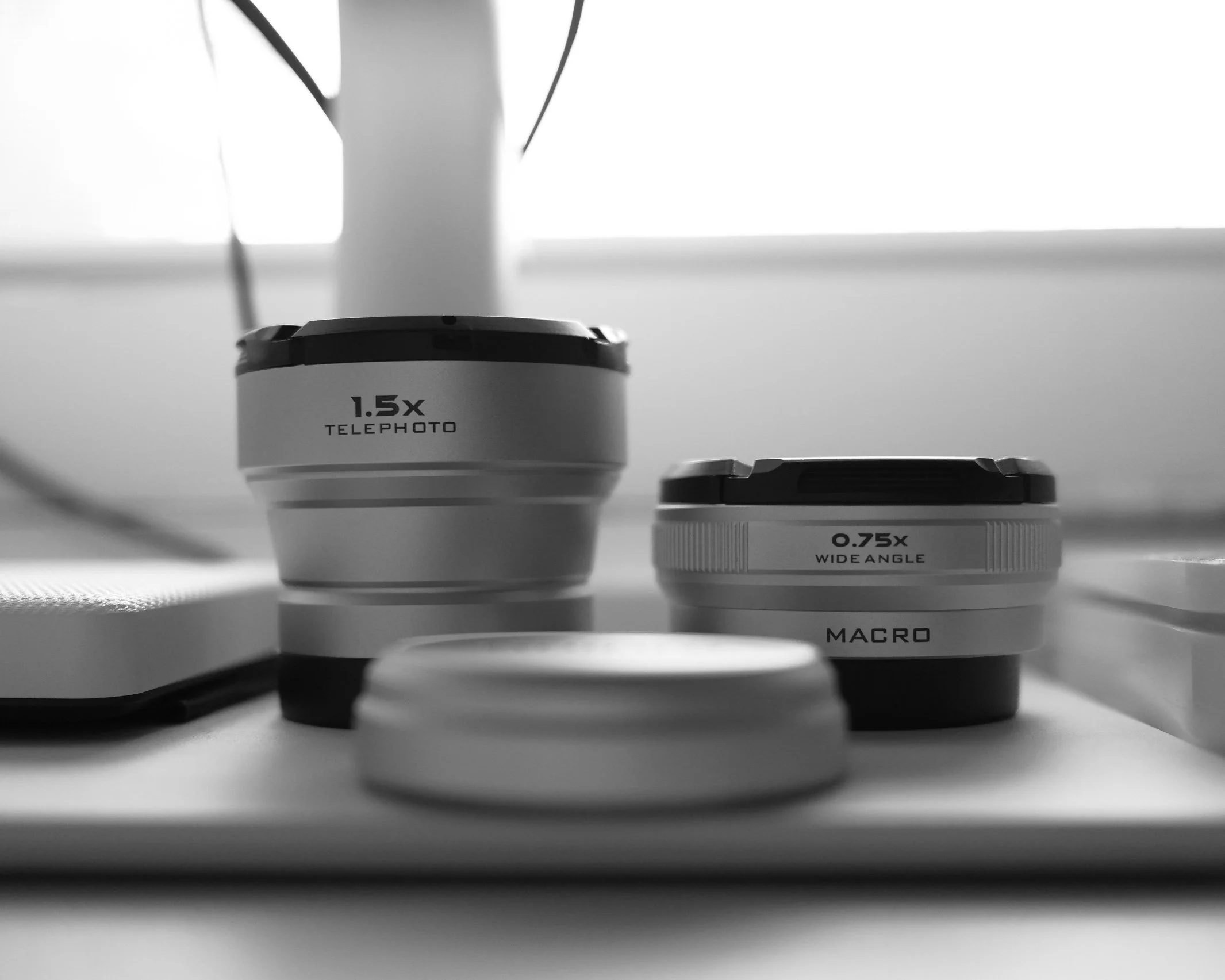
The Freewell converters that stayed home (CW - Mono Simple film recipe)
A 43mm Photographer Who Breathes in 35mm
This experience also revealed something more intimate about the way I work. Most of my photographs are cropped after the fact, often in a 4:5 format, which yields a visual equivalent close to 43mm, to the point where I have preprogrammed this ratio directly into my recipes. The 35mm gives me the margin, and the crop gives me the image. I compose twice: first in the viewfinder and then in the digital darkroom, as a second reading of the scene rather than a correction. I am perhaps, at heart, a 43mm photographer who needs the 35mm in order to breathe.
This logic of margin also illuminates a hypothetical choice that has long occupied my thinking. Were I ever to acquire a Leica Q3, I would choose without hesitation the 28mm version over the 43mm, and for the same fundamental reason: the 28mm would give me that necessary space to work toward 43mm, exactly as the 35mm allows me to breathe before cropping. But there is also an optical reason. The rendering I seek in my photography — the one I have patiently developed through my film simulations — seems more accessible through the Summilux 1.7 of the 28mm than through the Summicron f/2 of the 43mm. I do not want a lens that renders everything with clinical precision. I want a lens that gives something, that breathes, that leaves a measure of soul in the image.
Leaving as One Is
My journey through southern Italy — which I wrote about in a recent post — offered quiet confirmation of what I had already begun to understand. The 35mm was enough for the street, the light, the facades and the shadows. It was enough for what I wanted to say.
For my trip that I am currently taking in northern Europe, the conversion lenses stayed behind in Montreal. This is an act of trust in the eye I have developed over time, and travelling with a single camera and a single focal length does not mean travelling closed.
Into the Nothing Selected position — which I described in an other post — I have loaded Copenhagen Negative, a recipe developed by Ritchie Roesch during a journey to Denmark. I tested it in Montreal under partly overcast skies: the flowers were beautiful, the vegetation deep and slightly desaturated, but the sky was blown out in the middle of the day. This recipe clearly belongs to the gentle hours: the early morning and the raking light of Nordic evenings which, at these latitudes, linger long and grow almost horizontal. It is in that light that I want to test it, in the light that inspired it.
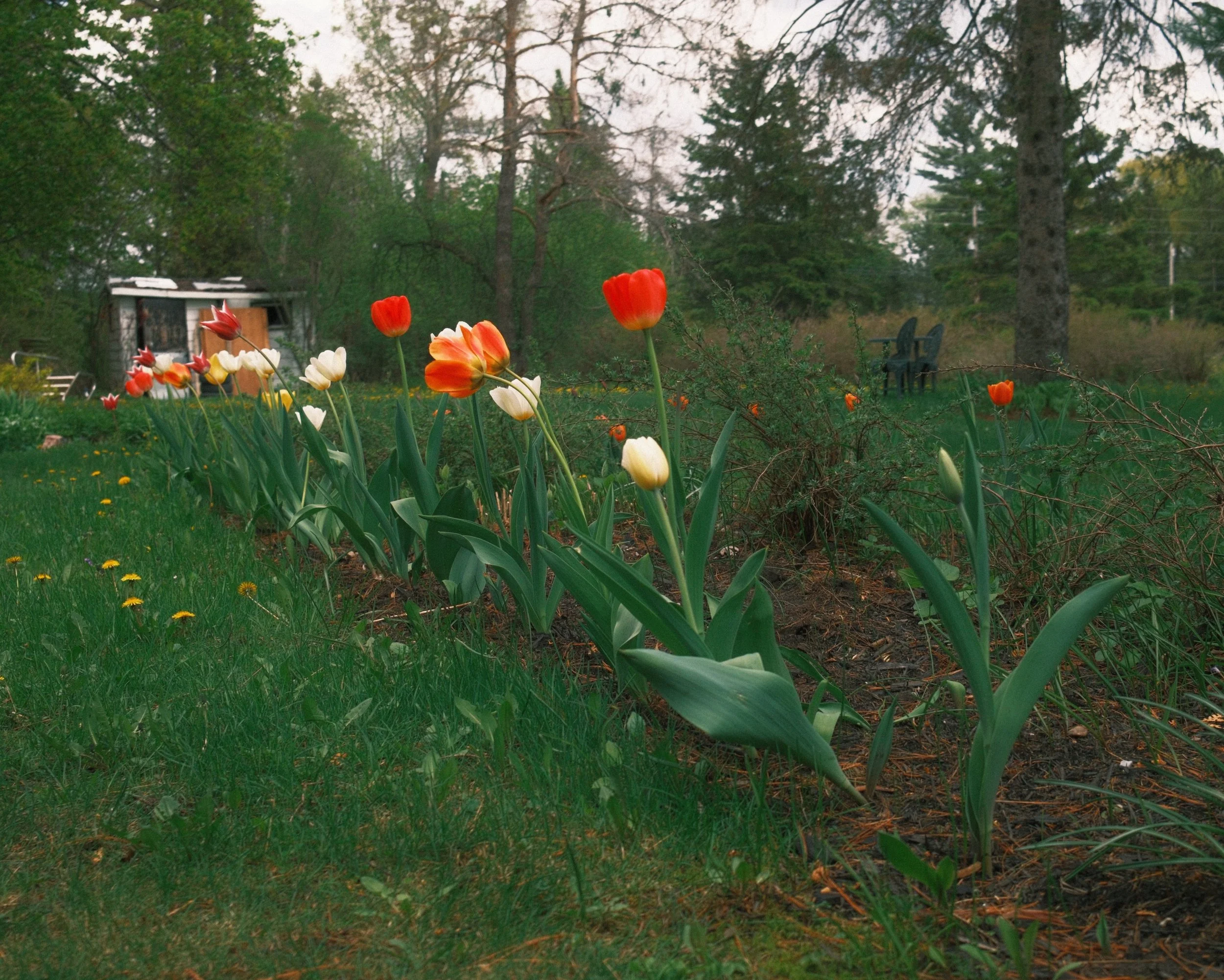
Tulips from my garden, swayed by the wind on a partly overcast afternoon. (Copenhagen Negative film recipe)
One leaves as one is, and sometimes one leaves a window open onto what one does not yet know.
This dilemma — how much to carry, how far to constrain oneself, how much to trust one's own eye — runs through every photographer's practice. You may have encountered it differently.
— Louis-Martin