
Steve's Photograph
The first sharp photograph I see come out of this M10 is the one Steve takes.
Before it, there are mine, a handful, all blurred. I'm in a café in Cowansville, my eye to the viewfinder, trying to work out what the rangefinder patch expects of me. It is nevertheless brighter and easier to read than the one on my Canon P, whose viewfinder comes back to me the moment I raise my eye to it. I'm nervous, and my images say so.
Steve tells me that, in a transaction like this one, it's normal to be nervous. It will take time before I feel at ease with this body.
Several Months
Several months. That is how long it will take me to master it to an acceptable degree, and I know it in advance.
In the meantime, I will have to start over: the gestures, the reflexes, the very basics of photography. My Canon P and the film training of my youth will help, as will six hundred photographs made in Germany, with manual focus, on the X100vi. But only practice builds reflexes, and practice takes time.
It worries me, it's true, and it motivates me just as much. These months will be full, and they will surely yield stories, anecdotes and discoveries to share here.
A Slow Decision
I wrote, in the CW series, that the philosophy of an interchangeable-lens system was not mine and that I had no interest in building a system around optical variety. I wrote it again a few weeks ago, in The Nameless Genre : my X100vi never needed anything more, and it was better to see deeply with what one already has than to accumulate what one might have. An attentive reader will notice, and will be right.
What changed is Germany. There, I imposed a precise protocol on the X100vi: optical or electronic viewfinder, manual focus only and a single spare battery in my pocket. It convinced me that the time had come to move toward the M system, the closest thing to that protocol and its natural extension. The interchangeable lens is the price to pay, not the reason.
The rest happened quickly. On Monday afternoon, a listing goes up on Kijiji. I see it the next day, very early, browsing Leica listings aimlessly, as I have been doing for some time: an M10, sold by a photographer in Cowansville, at a price that seems reasonable to me.
I offer a little less than the asking price, subject to an inspection of the body, and I mention a few points we could go over together. I say why I'm looking for an M and I leave the address of the blog: what I tell him, he can read there. Steve, the seller, replies quickly that my offer is reasonable. He is the first owner of this M10, which he bought in Montreal seven or eight years ago. We agree to meet that same evening.
It looks like a snap decision. The slowness of this purchase lies not in its duration but in what preceded it.
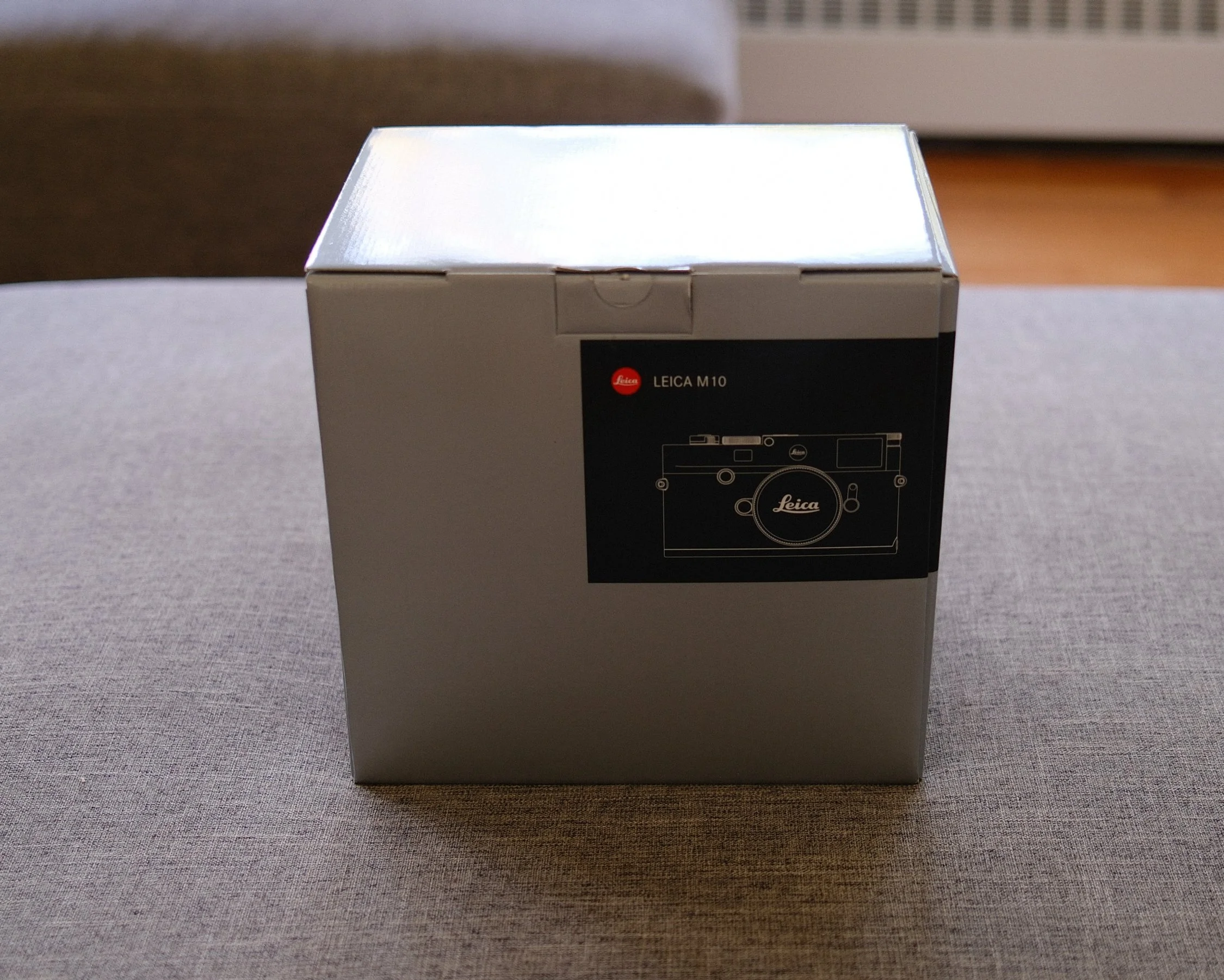
The Leica M10 box, November 2026. Photo taken with the X100vi, recipe CW – Q3 Analog.
The Backup Body
This M10 is Steve's backup body. He owns two other Leicas, a Sony and a Hasselblad, and he would rather see this one used to make images than stay in his bag. He wrote it to me before we met.
At the café in Cowansville, we settle in with an iced tea and a coffee. No meal, and yet we will stay ninety minutes at supper time, without anyone minding. The person who served me is Steve's daughter, and his son is in the kitchen.
He has brought his M10-D, the everyday one, and several Leica lenses. He goes through my list with a generosity I hadn't expected, gives me advice and mounts a Summicron-M 35mm f/2 on the M10, my preferred focal length, for my tests. He also shows me a Summilux-M 50mm f/1.4 in brass, insisting on its weight and its construction. That is the one the shop he frequents in Montreal is interested in: each time, they ask him whether he would sell it.
At the end, he shows me how to format a card. Mine, empty when I arrived, is empty again. A woman comes to sit beside him: his partner.
In my second message, I had written that I wanted this transaction to be a good experience. I believe Steve orchestrated it.
The Drive Home
During the ninety-minute drive home, I feel nothing but joy, and the sense of having been very lucky: the opportunity was rare. I have no proof that another buyer was waiting for this listing. I only know that I saw it in time, and that my preparation may have something to do with it. Luck did not give me the protocol from Germany, but it put the listing before my eyes the morning I was ready to recognize it.
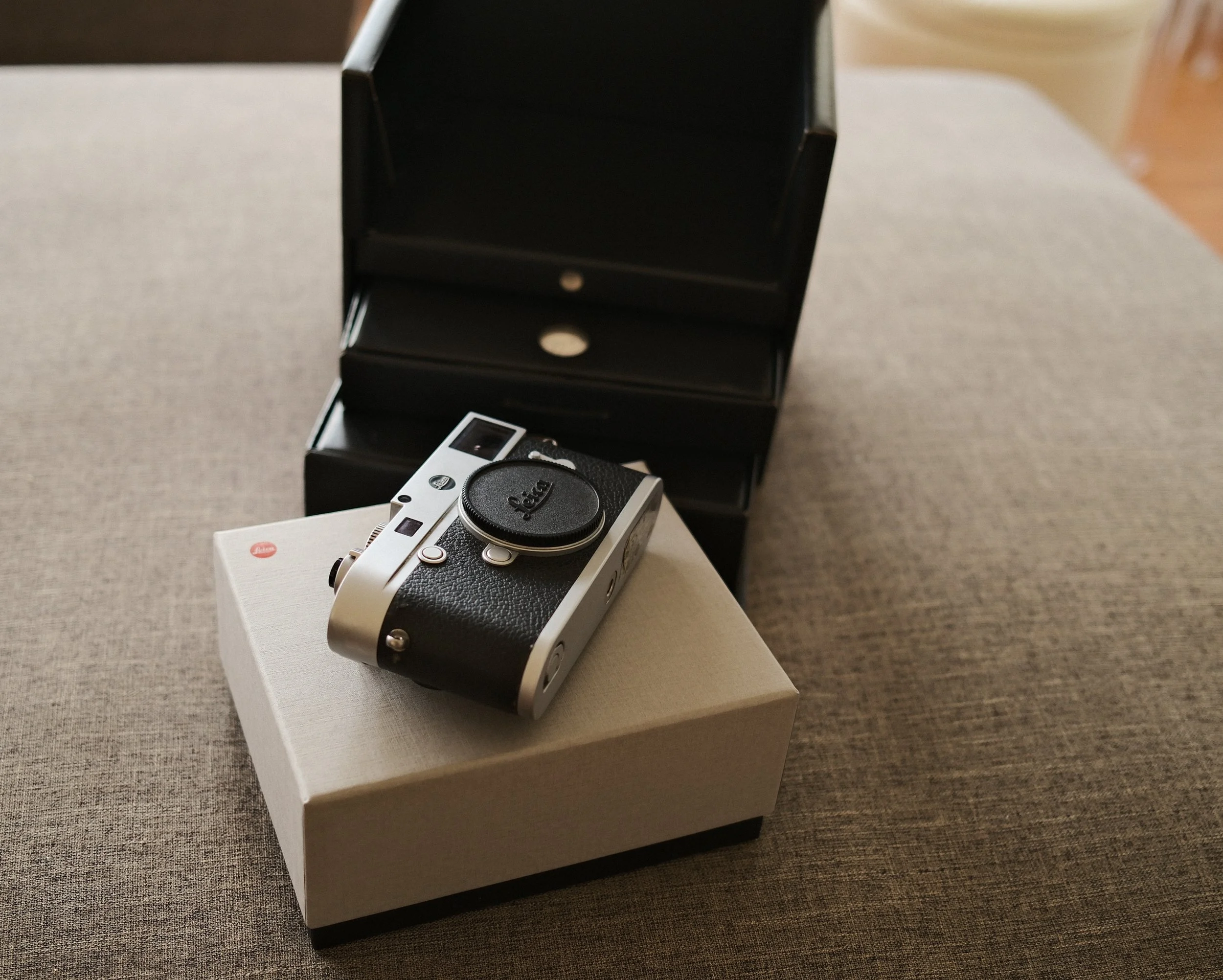
The Leica M10, November 2026. Photo taken with the X100vi, recipe CW – CCD KAF-18500.
A Thread Under Many Names
I haven't mastered anything about this body yet. It will take months, mistakes and probably a few good stories. That is the friction I have just chosen.
It is not new on this blog, but it has changed names and meanings along the way. In Seeing without agenda, in May, the word still described what keeps us from meditating: the ordinary friction of a life that keeps moving. In June, in What film demands, the Canon P removed the safety nets, and I wrote that a constraint is not an obstacle to be worked around, but a school. In One Camera. One Focal Length my converters stayed home because screwing them on broke the flow. In Very small. Very Tokio, a sushi counter for six guests taught me that constraint isn't endured but chosen, and that it is that choice which makes presence possible. In A Question of Proximity, I found it again in Alex Coghe, for whom the friction of the rangefinder keeps one present to what one photographs. In The Nameless Genre, I wrote that a slow practice is not a constraint one endures, but a deliberate choice. In Seeing Beside, I learned to tell two frictions apart: the one that takes you away from the world and the one that brings you back to it. And in What the Camera Knows About Its Grid, barely a week ago, I said it once more.
Naming the Friction
I wonder today whether this thread isn't the same from one post to the next. Perhaps this friction goes hand in hand with slow and contemplative photography, and is less its ornament than the place where it happens. I wrote, in Seeing without agenda, that the attention that precedes the gesture is where contemplative practice begins. A chosen friction would only move it forward: it asks me to decide, to look and to wait before pressing the shutter.
It is only a hypothesis, and it has a limit I don't want to hide. A friction can also become a pose, a ritual one imposes to look like one is slowing down. The M10 will help me, I believe, to tell the one that keeps me present from the one that merely delays me.
So I name it myself, as I did for slow and contemplative photography in The Nameless Genre, but as a trial this time. In the meditative disciplines, we speak of a path: a way of walking rather than a goal to reach. Here is what I mean by the friction we choose:
Chosen friction, as I practice it, is a slow and contemplative path: a resistance accepted in advance, at the very point where it brings attention back to the world rather than to the camera. It asks me to decide before pressing the shutter, to look before composing and to wait before concluding. It is not a difficulty cultivated for its own sake, nor a ritual one imposes to look like one is slowing down, but a kind of traction that keeps one present. Like a path, it is walked rather than mastered: the discomfort of the early days is part of it, and mastery is not its goal. Friction, here, is not an obstacle to be worked around. It is the path itself.
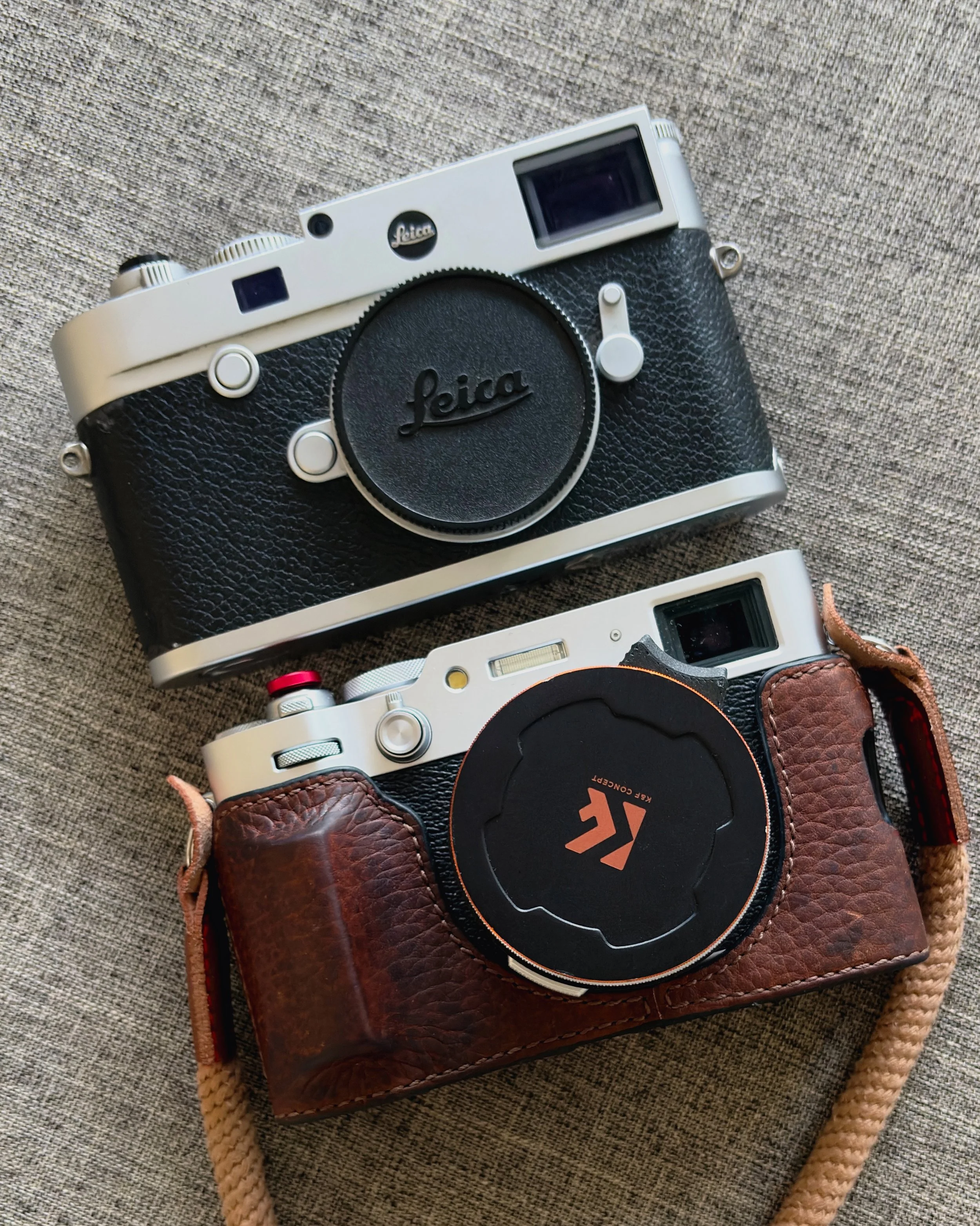
The M10 and the X100vi, November 2026. Photo taken with an iPhone
This transaction will change, in some way, the course of this blog. I will still write about the X100vi, Fujifilm and recipes, and about slow and contemplative photography. I will also tell what I explore in territory I know less well, with the discoveries and mistakes that will come.
The rest will follow in a later post, once the remaining gear has arrived.
— Louis-Martin Ouellet
The first two photographs in this post are SOOC. The third, which brings the two cameras together, was taken with an iPhone.
This blog's thirteen recipes, the seven CW and the six NS, all live in the Recipe Cellar, a space where they simply wait to be discovered.