
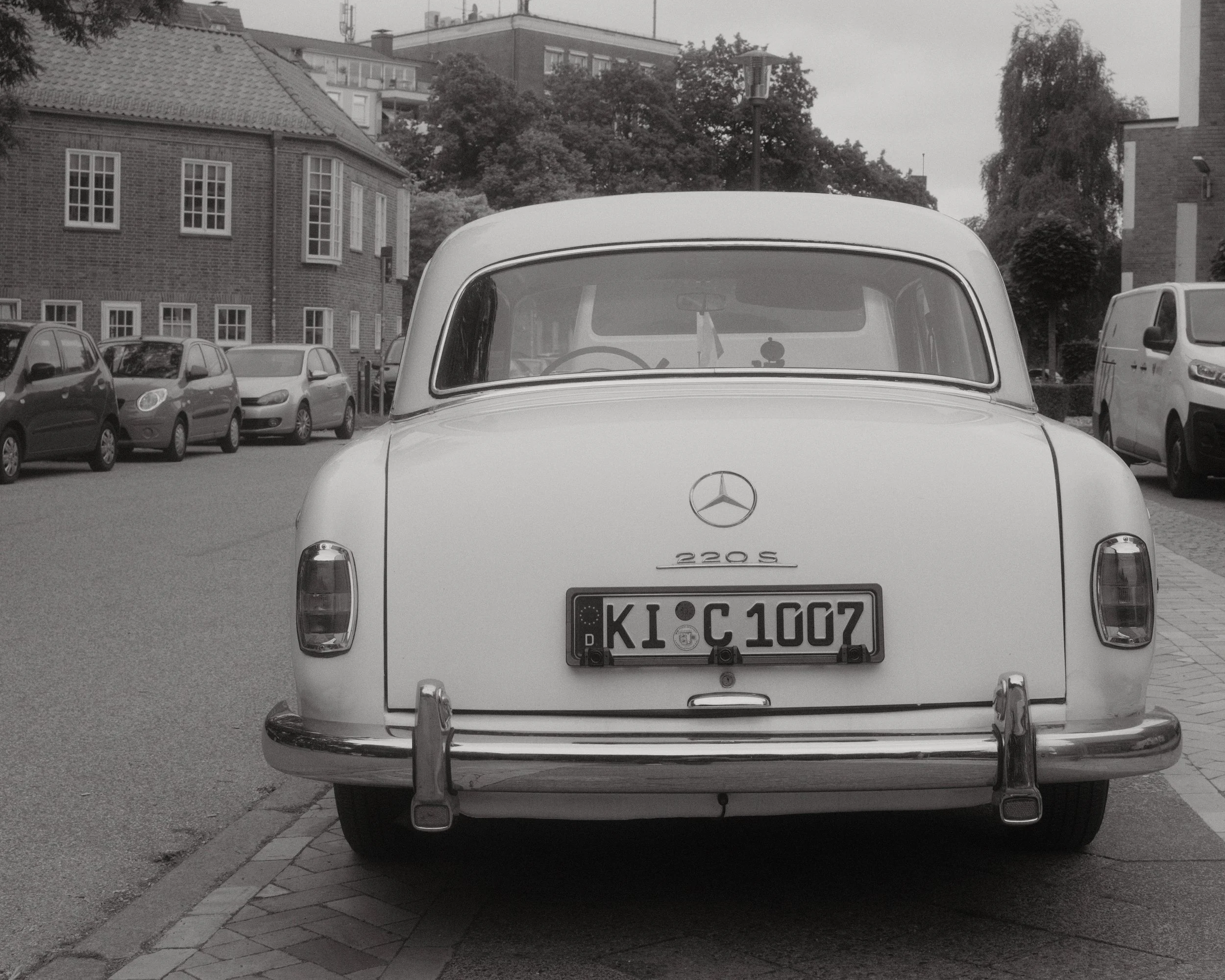
Kiel, Germany: CW – VS Mono Soft, for this Mercedes 220S found by chance on a street.
Have I ever considered another camera? The question came up once, seriously, in February 2026, while I was planning a trip, a few months before launching this site. Medium-format Fujifilm cameras tempted me. The GFX100RF, first: its f/4 aperture and its all-too-obvious kinship with my X100vi settled the matter quickly. Then the GFX100S II, with the idea of restricting myself to a single fast lens, as a way of extending the same discipline into a larger format. The more I thought it through, the less it convinced me. I eventually concluded that what I already had in hand was fully enough.
I could have believed that my February decision was simply a reflex of loyalty to my camera. It wasn't until a few months later, coming across Full Frame Isn't the Goal Every Photographer Needs, an article on Fstoppers by Alex Cooke, that I understood it as something more rigorous. His thesis: format was never a ladder to climb toward full frame or beyond, but a set of trade-offs, chosen according to what one actually photographs. He illustrates this with several well-named genres, each with its own trade-off: reach for wildlife, depth of field for macro, and weight for travel. In every case, the format that fits is never the most capable in absolute terms, but the one that best serves the work at hand.
I read back through Cooke's list, looking for where I might fit. Wildlife? No. Macro? Not that either. Travel, perhaps, in part, but that doesn't do justice to what I actually do when I photograph slowly. The truth is that my practice appears nowhere on that list. It doesn't even have a name one could search for.
So I name it myself. This blog has already made a habit of this — CW, NS, yun — rather than borrowing a vocabulary that never quite fits. Here, then, is what I mean by slow and contemplative photography:
“Slow and contemplative photography, as I practice it, rests on a disposition to welcome — that same fervor for what presents itself that Gide celebrated in Fruits of the Earth — placed in service of a limited number of tools, known in depth. Most of the choices are made before the shutter is released, so that the release itself becomes nothing more than an encounter with what has already presented itself, without seeking to improve it afterward. This isn't a constraint one endures, but a deliberate choice: the same discipline a film photographer applies to their rolls of film, the discipline that allows one to see deeply with what one already has rather than accumulate what one might have. Slowness, here, is not a working pace. It is availability itself.”
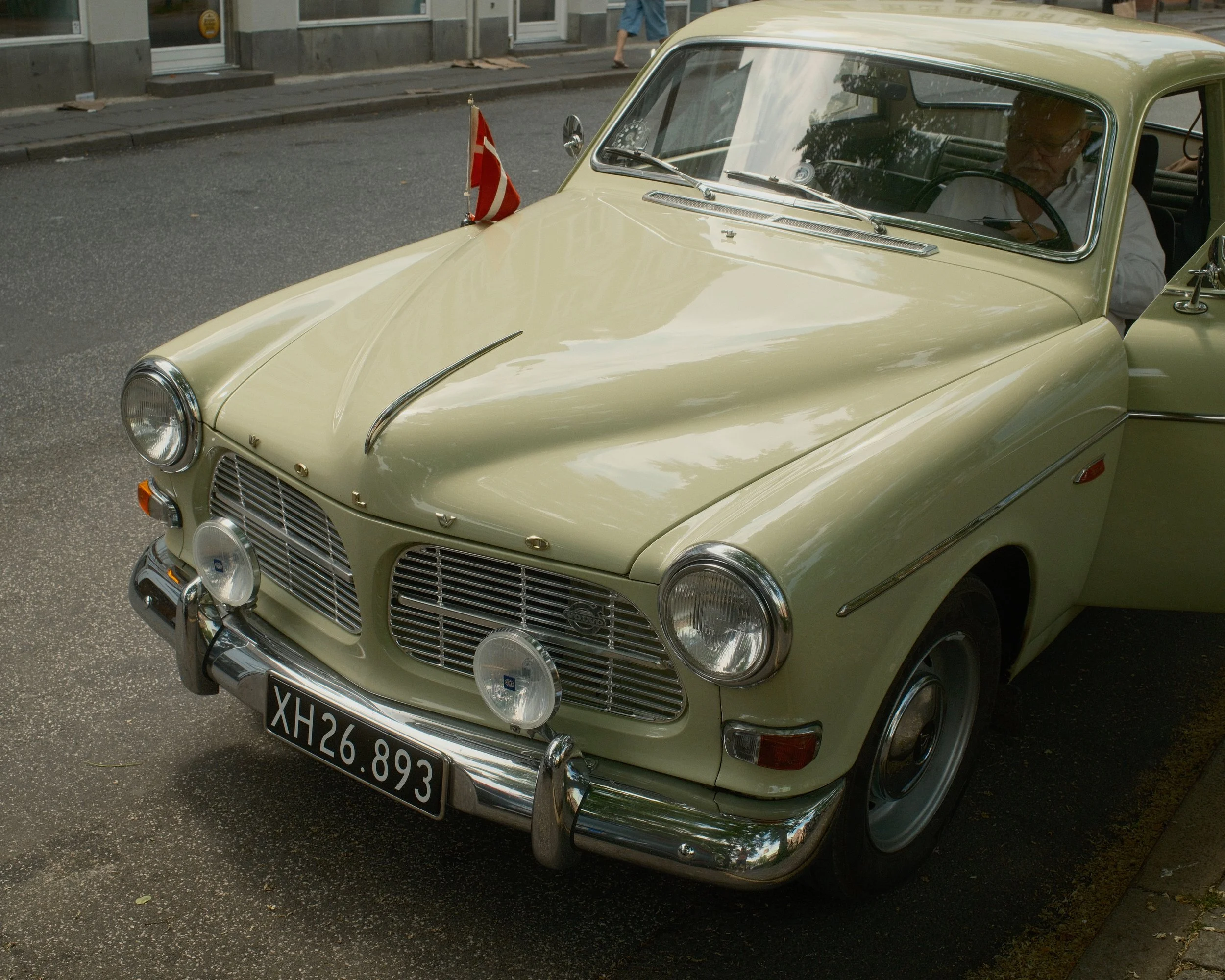
Aarhus C, Denmark: NS – Céladon, in front of this Volvo Amazon and its Danish flag.
What this practice actually requires, once named, remains to be seen.
The megapixel count, as I've already written elsewhere on this blog, matters little in my practice. What matters is what the recipe accomplishes before the shutter is even released: starting from a technically near-perfect interpretation and desaturating it, softening it, and giving it texture — degrading it, in a sense — so that the image already has a soul by the time it forms. That's the whole principle behind the CW series, and it's the same work I recently redid with NS – Céladon, NS – Bleu de faïence or NS – Persimmon: testing the recipe against my catalog of RAF files, adjusting in X Raw Studio, starting over until the balance holds. That's exactly what the APS-C 40MP sensor in my X100vi, paired with its X-Trans processor, lets me do.
The GFX100S II, with an interchangeable lens, would have brought back the same friction the Freewell converters had already taught me to avoid. The GFX100RF, with its fixed f/4 aperture, would have taken away some of the control over that texture I'm trying to sculpt. Neither one served what I actually do.
And on the strictly technical side, I have nothing to envy in full frame either: Alex Cooke rightly points out that a 40-megapixel Fujifilm X-T5 out-resolves several popular full-frame cameras, in a smaller, cheaper, and lighter package, with a native lens system built specifically for the format. But that, in the end, is only a secondary argument. The real point lies elsewhere.
I close this reflection where it began: in front of a GFX I never bought, with an X100vi that never needed anything more.
It wasn't the sensor my practice was missing. It was a name.
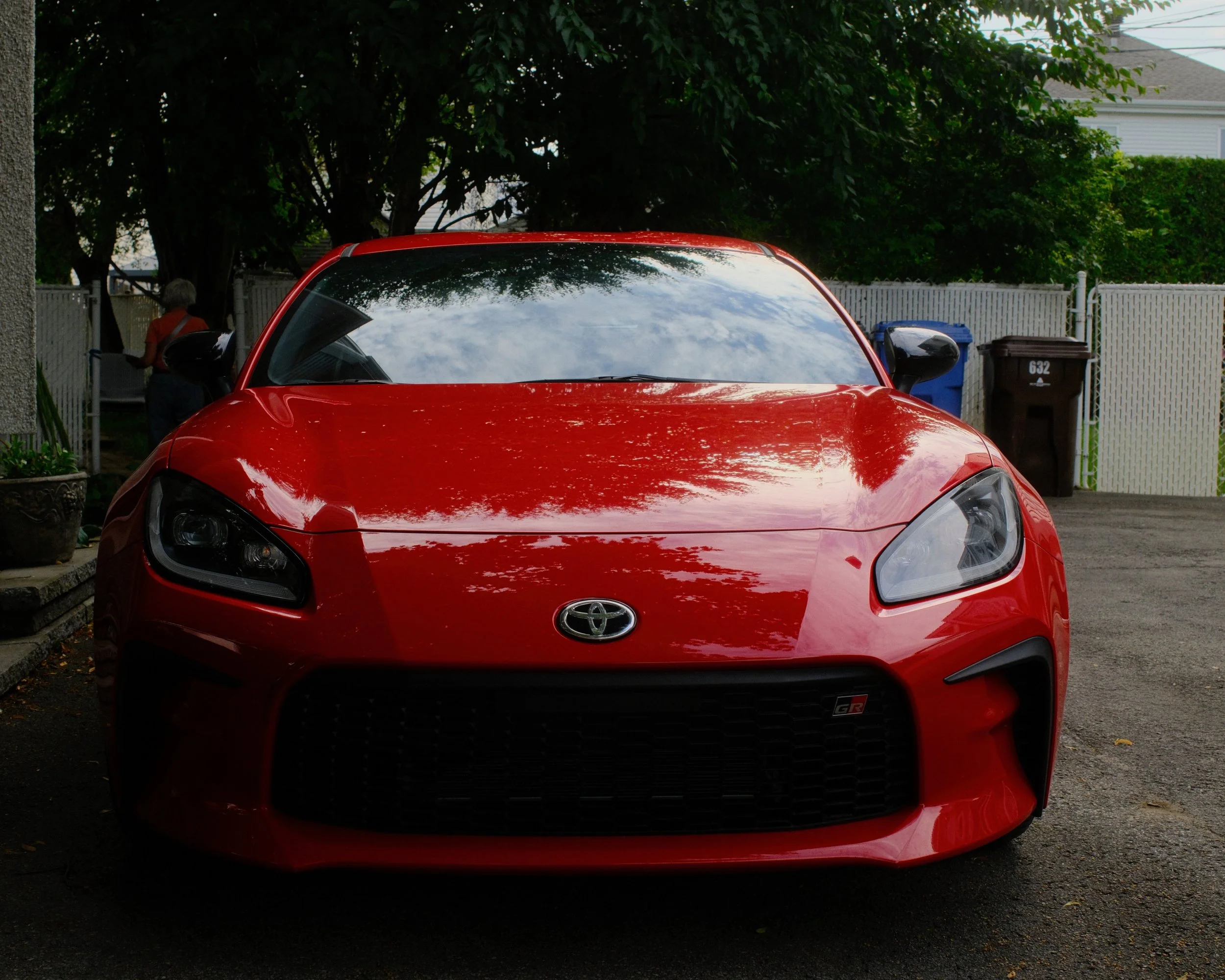
NS – Persimmon, for Jamal's car.
Jamal, Najat's son, tends to his car as if it were the apple of his eye, not to show it off, but because it's already exactly what he needs. I recognize that same disposition in my own relationship with my X100vi.
Slowness, as I've already written, is not a working pace. It is availability itself, toward what one already has, before looking for what one might have.
— Louis-Martin Ouellet
This blog's ten recipes — the seven CW and the three NS — all live in the Recipe Cellar, a space where they simply wait to be discovered.