
A Recipe Should Never Be Used as a Product
Post on the lucelenta.art editorial vision
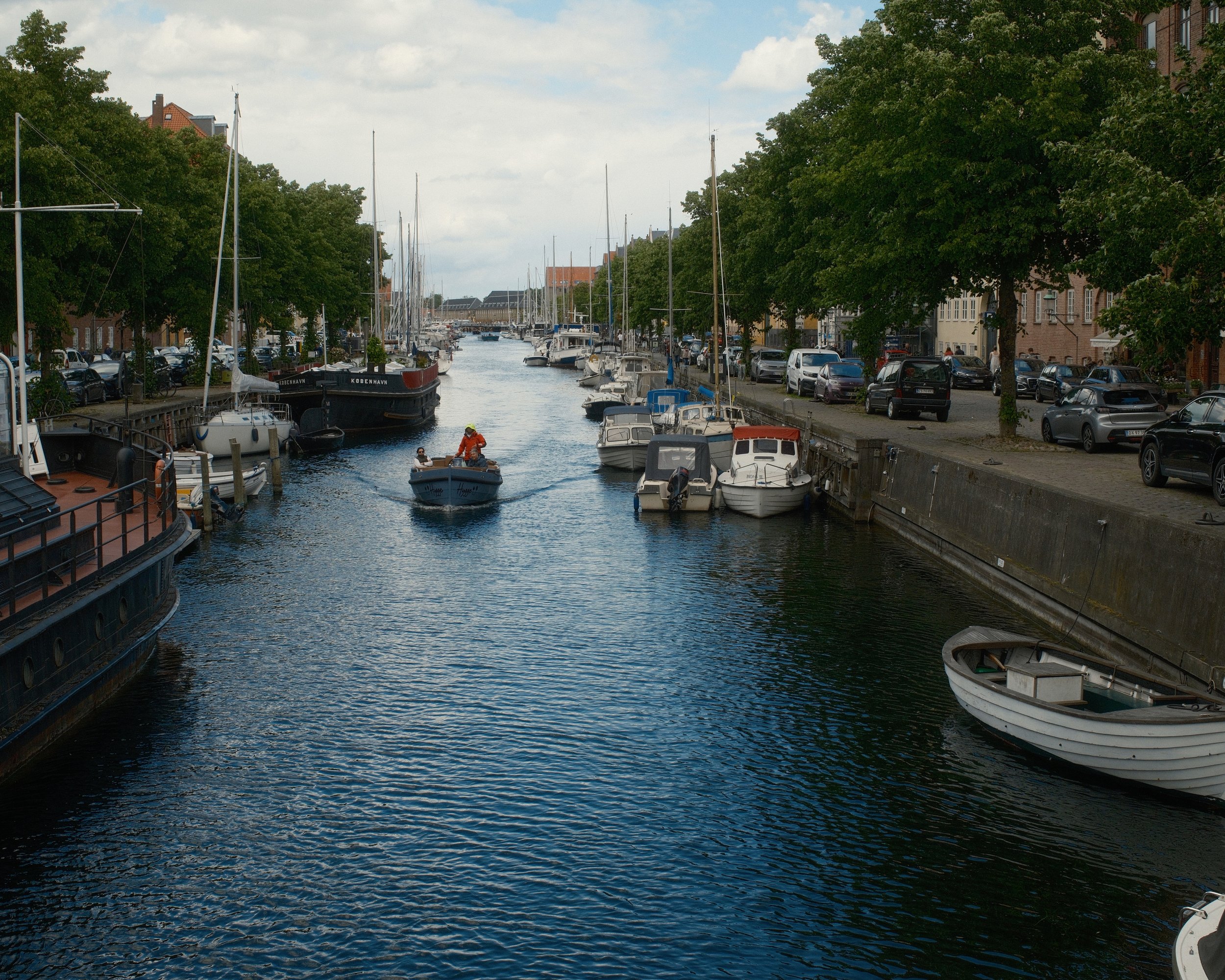
Christianshavn Canal in Copenhagen. (NS - Céladon)
A few months ago, I write to Virginia. We had lost touch over the past few years, but I knew she was an excellent photographer, so I tell her about the launch of my site, hoping for her thoughts. As I remembered it, she was a Canon shooter. What I didn't know is that she now photographs with a Fujifilm X100T. A funny coincidence, she tells me.
In her first comments, she tells me about an upcoming trip to southern Italy, around Naples and Puglia. She had noticed CW – Simple Standard. Her camera couldn't hold every recipe in the series, but it does have the Provia film simulation, and the photos I'd added to illustrate that particular recipe, taken in Positano and Naples, convinced her it would be the right one for her trip.
When she gets back, she shows me a beautiful photo made with my recipe. Then, almost apologetically, she admits she'd changed the white balance: she loved the sharpness of the rendering, but found it too warm for what she was after. She wants to meet in person to explain the change, a little worried, I think, that modifying my recipe might upset me.
It didn't upset me, not at all. Quite the opposite: Virginia had kept only part of my recipe, and made the rest her own. That's exactly what I hope for. Our trips crossed paths: she was coming home just as I was leaving for Denmark and Germany. It wasn't until my own return that she told me the rest of the story: she'd been dreaming of the new X100vi, hard to find, but had managed to reserve one before leaving for Italy, so she'd left with her X100T instead, the dealer having assured her she could pick up the new camera when she got back, which she eventually did. It was in talking with her, about our respective trips, that my thinking about what I wanted to say with this blog took shape.
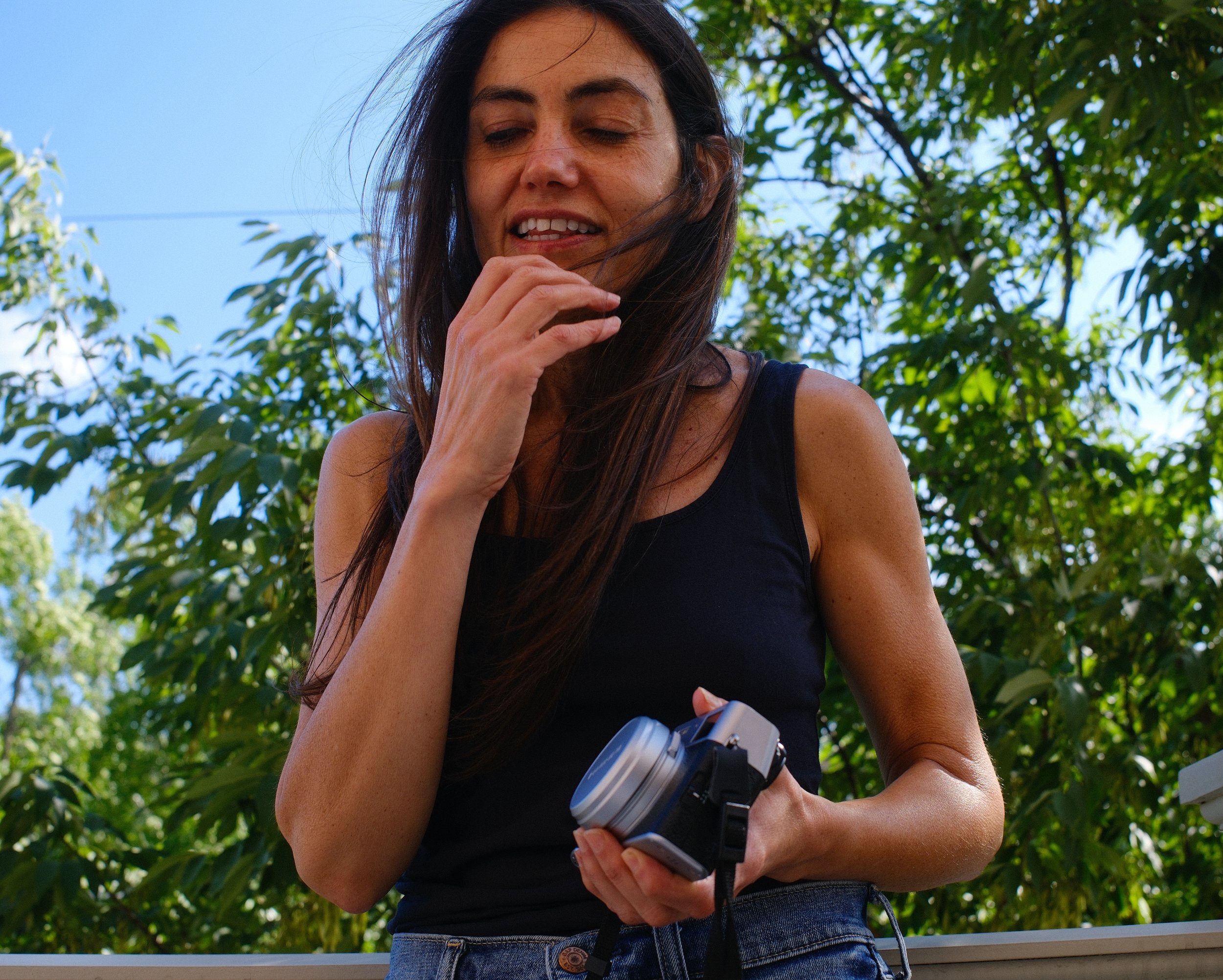
Virginia and her X100vi in hand. (CW - Q3 Analog)
That's what this blog is really trying to do, at bottom: help Fujifilm camera owners, whether or not they have the time or patience to learn everything on their own, by giving them, progressively, tools and guidance to develop their own film recipes, in keeping with their own style.
And yet, I end up naming something I'd sensed for a long time without ever putting it into words: recipe-focused sites often present recipes as a product. A list to browse, a catalogue to scroll through, most of the time without ever explaining what a recipe actually does to light or why it does it. The photographer accumulates, tries, and collects, and risks producing photos that don't necessarily look like them, without a signature of their own.
The film parallel
My film photography practice taught me something else. A film photographer doesn't work with every stock ever made. They'll use a dozen at most, some color and some black and white, choosing among them depending on the light and the day's intention. That limited number isn't a material constraint you put up with, it's a way of working: better to know and work with a few tools than to use too many. "Less is more," as the architect Ludwig Mies van der Rohe used to say.
A limited number of film recipes is the obvious digital counterpart to that limited number of film stocks. It isn't a matter of restricted choice, but a deliberate one: rather than using every recipe that exists, know a few of them intimately enough that they become a natural extension of your vision, the way a film photographer comes to know their favorite stocks better than all the others combined.
Hence the thesis that has run through this blog since its beginning, and that it's time to state directly: a photographer only needs a limited number of film recipes to express their own style. I like to think, in fact, that there are as many styles as there are photographers, which is why it matters for Fujifilm photographers to know how to edit existing recipes or create their own, rather than accumulating other people's.
That conviction doesn't come all at once. Before you can create your own recipes, you need to know your camera by heart: understand what each setting does, on its own and in combination with the others, and observe how each film simulation behaves in its purest form before layering anything on top of it. It's a foundational step, and it takes time. I've written about this elsewhere on the blog: in Nothing Selected, which invites you to observe the simulations with nothing else layered on before building anything on top of them, and in What Film Demands, where the constraints of a camera like the Canon P force a deeper understanding of the relationship between ISO, aperture, and shutter speed, rather than leaving it to automation. My own move into creating recipes came out of that same kind of work, after a trip to southern Italy where too little confidence in my settings cost me hours of correction I would rather have avoided.
What this site has become
Before going any further, it's worth stepping back and looking at what this site has become so far, and how that lines up with what I just said: a recipe should never be used as a product.
To express themselves, a photographer only needs a limited number of film recipes: the ones that let them express themselves as a photographer, matching their signature, or the one they'll eventually develop. That's exactly what this site contains: seven recipes I developed for my own practice, and the look I generally aim for when photographing.
I'm an amateur photographer. My style doesn't need to be so niche that it's identifiable from a single photo. But it shouldn't head off in every direction at once, either. To avoid that, it's essential for me to know what I generally want to produce as photos: my main subjects of interest, the look I usually seek, how I want to frame things, the focal length or lengths I'll use (and why), and the format of my photos. These are things that belong to the photographer, and only the photographer can determine them.
That said, none of this is urgent. You can experiment and build that conviction gradually. It will probably be easier for a photographer who already has experience, who has developed a signature with other systems. It will certainly be harder for someone just starting out in photography, and with Fujifilm on top of that. But for everyone, there will be a learning curve.
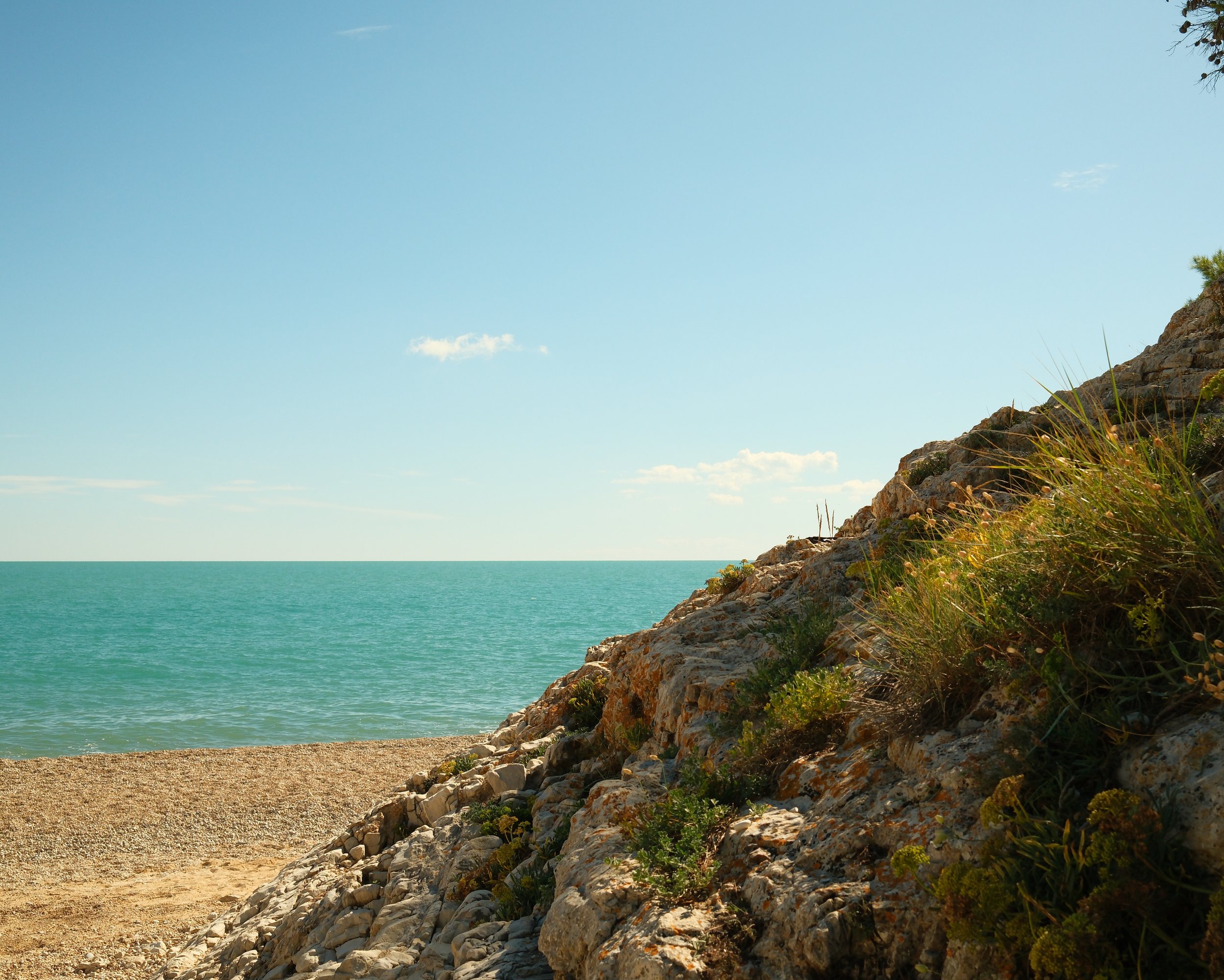
The sea at Mattinata on the Gargano promontory. (CW - Simple Standard)
CW, or the thesis lived out
At some point, I have to admit something simple: the CW series is, in reality, the limited number of recipes I designated for myself, to become the photographer I want to be. That number isn't an accident of however much time I had available: it's a deliberate, closed choice.
The nine articles in the CW series are my own film recipes. I share them because what I want, first and foremost, is to share my process, and to give useful information about why and how I created them. They aren't shared as a product: a fixed recipe, to be used as is, with no setting to be changed. What I wanted to present was a process.
You can take all the distance and all the time you need, if you want to, to retrace my steps and build a proper understanding of the process involved: get familiar with your gear, experiment (to define your style, or to figure out how to reproduce your style with new gear), and work out how the different settings affect one another, how the film simulations behave, and which ones will be useful to you. It's after going through these steps that you'll have the confidence you need to modify recipes made by others, or better still, to develop your own. That's what sets this invitation apart from a catalogue: here, experimentation is a passage, not an end in itself.
NS, or what the foundation doesn't account for
A closed, sufficient foundation can still run into a specific, one-off need it doesn't cover. That's exactly what happened with NS, the series I started after the seven CW recipes.
NS is the space for experimentation: the guarantee that nothing will ever be completely set in stone, without diluting my signature as a photographer. It's the chance to let it evolve gently and coherently, a bit like Leica and Rolex do with their products, reconciling heritage with modernity.
NS – Céladon was born from the color of a coffee cup I noticed at a café in Hamburg, a shade the seven CW recipes weren't rendering the way I saw it. That wasn't a reason to abandon the foundation, or to start accumulating recipes at random again. It was, instead, the moment when knowing my camera and understanding the process of building a recipe became useful, letting me respond to that particular need instead of borrowing the solution from somewhere else.
NS – Bleu de faïence came along after that, with a more deliberate goal from the start: bringing a color from the world of ceramics closer to what a photograph can do with it. The first attempt was too blue, skin tones suffered for it, and the recipe had to be tested against my own catalogue of RAF files, then corrected and tried again with X Raw Studio, until the balance held across several lighting conditions at once. That process, more than the recipe itself, is what I wanted to illustrate here: building a recipe is never an instant gesture, it's a series of corrections measured against what you already know.
NS – Persimmon followed a different logic still: unlike Céladon and Bleu de faïence, both born from a personal encounter, this color already existed in the history of ceramics — at Skarkos, on the Greek island of Ios, then in Japan's Kaki glazes — long before I ever took an interest in it. Built through RGB measurements rather than by eye alone, on photos from a trip already lived, reread afterward with Velvia, it confirms that the NS foundation doesn't need a founding anecdote to stay coherent: sometimes the one-off need comes from the color itself, not from the encounter that reveals it.
So NS isn't just "the series that's still going." It's living proof that a foundational base, however sufficient and closed it may be, doesn't have to account for everything to stay coherent: it just has to know how to respond when a real need comes along.
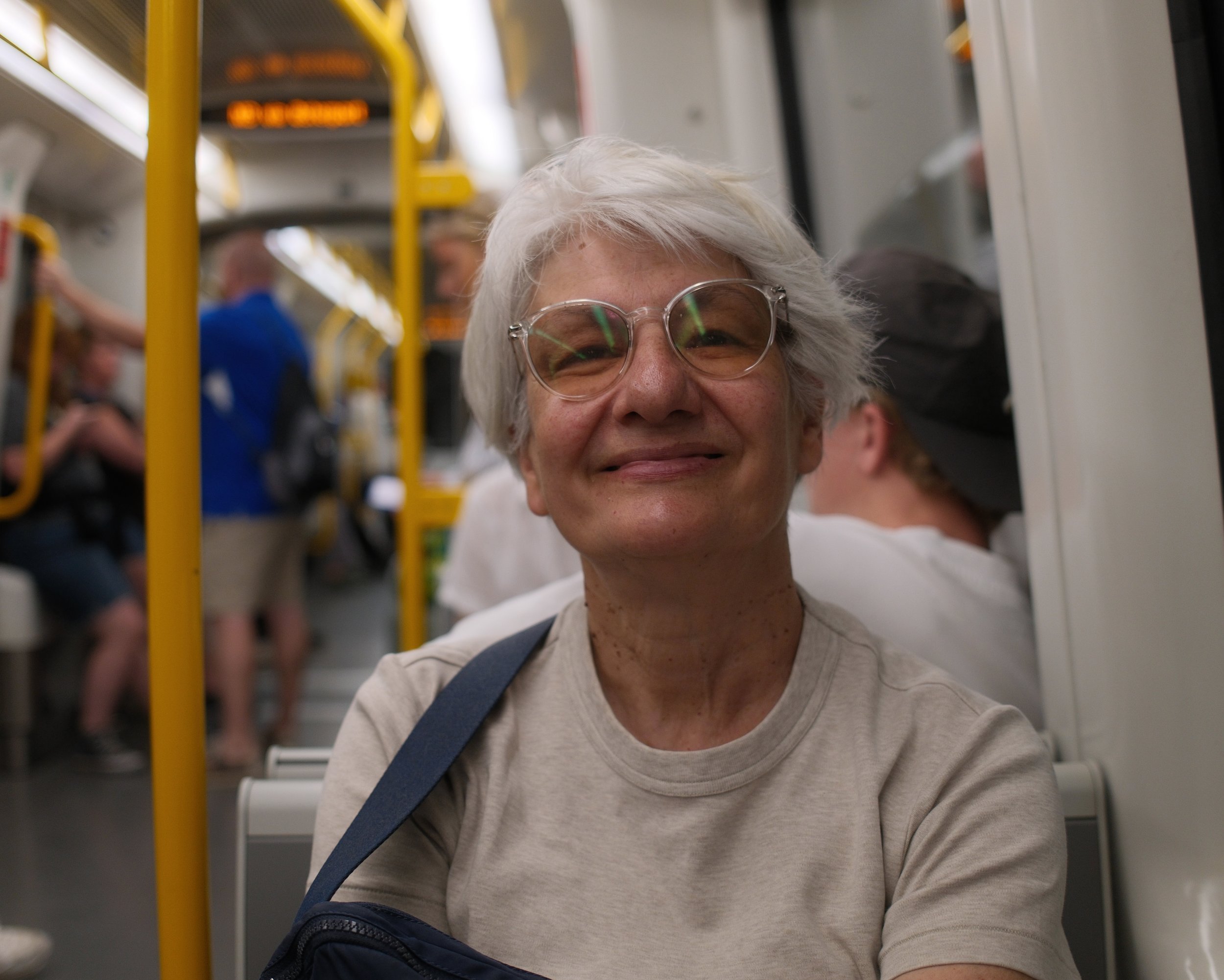
Giuseppina on a Berlin tram. (CW - Typ 113)
It's up to you to choose your foundation
Some of you will want to go further: to understand your camera in depth, all the way to developing your own recipes. Others will prefer to stick with recipes that are already made, mine or someone else's, and that's just as legitimate, as long as they feel like you.
For those of you who want to take that exploration further, four technical posts will follow this one, one each week: each devoted to a coherent slice of the X-Trans V processor's settings, the common core shared by the whole generation of cameras that includes my X100vi. The first profiles the twenty film simulations. The second covers Color Chrome Effect, Color Chrome FX Blue and Grain Effect. The third covers white balance, highlights and shadows, and dynamic range. The fourth and last addresses color, sharpness, clarity and noise reduction. A series meant to be read one setting at a time, in keeping with this blog's spirit: understand before you build.
It's to make that exploration easier that I'm launching, alongside this post, The Recipe Cellar: a page that brings together my ten recipes — seven CW and three NS — each with its reference photo and a link to the post explaining why it exists. At first glance, that could look like exactly what I've just criticized: a list to browse, a catalogue to scroll through. But it's not a catalogue to follow to the letter: it's the trace of a process, seven completed recipes for the CW series, one recipe at a time for the ongoing NS series, whenever a need arises. If you explore them, do it to understand how your own camera responds to light, not to adopt someone else's look.
But if there's only one thing you take away from this blog, let it be this: you don't need any more recipes than a film photographer needs film stocks loaded before heading out. You need to know your own.
- Louis-Martin Ouellet